
Morning on the Spianada starts slowly. Cafés open under the arcades of the Liston, the bell tower of Saint Spyridon rises over the rooftops, and between the Old and the New Fortress the town fills the gap with narrow lanes, tall façades and washing strung across the alleys. Corfu Town looks more Italian than most of Greece, and it has good reason to: four centuries of Venetian rule, followed by the French and the British, each left something you can still walk past, sit in or eat.
Beyond the town the island is long, green and varied. The north-east coast looks across to Albania, with pebbled bays and harbour villages. The west catches the sunset over long sandy beaches and the coves of Paleokastritsa. In between are olive groves, hill villages and a walking trail that runs from one end of the island to the other. Few islands give you a real town and this much coast in one trip.
The Areas
Corfu is big enough that where you stay shapes your days. A good plan is to split a week between the town and one stretch of coast.
- Corfu Town — the Old Town, a UNESCO World Heritage Site since 2007, held between its two fortresses. Best for first-timers, food lovers and anyone without a car: the ferries, the airport and the island's buses all start here.
- Kommeno — a peninsula of cypress and olive gardens just north of town, a short drive from the Old Town, with resort hotels on the water. Good if you want a beach base without losing the town.
- The north-east coast: Kalami and Kassiopi — Kalami, about 28 km from town, is a horseshoe bay below the villages of Gimari and Vlachatika, with views across to the Albanian coast and the house where Lawrence Durrell lived in the 1930s. Further up, Kassiopi is a fishing village with a harbour and a Byzantine fortress. Suits couples and families who like calm water and a taverna close to the sea.
- Paleokastritsa — 23 km west of town: six coves and beaches below green cliffs, with a monastery on the headland and boat trips along the coast. A good base for the north-west.
- The west coast: Pelekas, Glyfada and Agios Gordios — long sandy beaches facing the sunset. Glyfada, about 15 km from town, is lively and well equipped; Agios Gordios, 20 km out, is long and sandy; both are on the green bus routes.
- The north-west: Agios Georgios Pagon — a 2 km sandy beach about 35 km from town, quiet, with family hotels and the double beach of Porto Timoni a short boat ride away. For those who want space.
- The south-east: Benitses and Agios Ioannis Peristeron — coastal villages south of town, less than half an hour from the Old Town and the airport, with family resorts and fish tavernas. Benitses is also an overnight stop on the Corfu Trail.

What to See and Do
Give the Old Town at least a full day. Start on the Spianada, which the Greek National Tourism Organisation calls the largest square in the Balkans and where the town's philharmonic bands play, then cross the bridge into the Old Fortress. It stands on a rocky peninsula about 600 m long, with Venetian bastions, a clock tower and a lighthouse on the Land Tower; on its southern side, the Church of Saint George, built in 1849 for the British garrison, looks like a Doric temple. Back in town, walk through Campiello, the oldest quarter, and visit the Church of Saint Spyridon, whose relic has been the symbol of the town since the 15th century.
The Palace of Saint Michael and Saint George, at the end of the Liston, was the largest and most important building of the period of the United States of the Ionian Islands, and today houses the Museum of Asian Art. South of the centre, Mon Repos is a park next to the remains of ancient Corfu, including the Kardaki temple, the best-preserved ancient Greek building on the island; the villa there was a residence of the Greek royal family, and Prince Philip, the late Duke of Edinburgh, was born in it. At Kanoni, the 17th-century Monastery of Vlacherna sits on an islet about 300 m offshore, and boats run from there to Pontikonisi, Mouse Island.
Outside town, the Achilleion stands above the village of Gastouri, about 10 km south-west of the centre. It was the palace of Empress Elisabeth of Austria, later owned by Kaiser Wilhelm II. The palace interior has been closed for restoration since 2021, but the gardens are open, with their statues from Greek myth, among them the restored Dying Achilles. On the west coast, the Monastery of the Virgin at Paleokastritsa, founded in the early 13th century, sits on the headland above the bay and keeps a small museum of Byzantine and post-Byzantine icons; from the village of Lakones above, the views at sunset are famous, and near Krini the ruins of Angelokastro, a Byzantine castle, stand on a crag.

Venice, Britain and the Coastline
Corfu's character comes from its rulers. Venice held the island from 1386 to 1797 and shaped its fortifications, and Corfu was the only Ionian island the Ottomans never took. The French followed, twice, and built the Liston with its arcades; then came the British protectorate of 1815–1864, which modernised the defences and left a palace and a church in the form of a Doric temple. The oldest surviving building in town, at 18 Filellinon Street, dates to around 1497.
The coast is just as varied. On the west, Glyfada has fine sand that turns the water blue-green, with sunbeds, showers and water sports; Chalikounas is the largest sandy beach on the island. Paleokastritsa is a string of coves: Agios Spyridon has a protected sandy beach, Alypa a small harbour where caiques leave for the sea caves, and Chomi a white pebbled cove reached only by boat. In the north-west, Agios Georgios Pagon is long and rarely crowded, and from there a boat takes you to Porto Timoni. On the north-east coast, Kalami has a pebbled, Blue Flag beach with paddleboards, canoes and boats for hire.
For walkers, the Corfu Trail runs about 180 km from south to north, from Kavos to Agios Spyridon, through Benitses, Pelekas, Liapades, Old Perithia and other villages. It avoids steep, tiring stretches. April to June is the best walking season.

What to Eat and Drink
Corfiot cooking is Greek with a Venetian accent, and the names give it away. Pastitsada is rooster or beef in a deeply spiced red sauce, served over thick spaghetti. Sofrito is thin slices of veal cooked in a white garlic sauce. Bourdeto is scorpionfish or tope in a spicy red sauce, finished with lemon, and savoro is fried fish marinated with rosemary, garlic and vinegar. Look also for nona's pastitsio, pasta wrapped in filo, and for noubulo, a smoked cured pork loin.
The island has some 4.5 million olive trees, and you will find their oil on every table, along with olive-wood bowls and boards in the shops. Kumquat is Corfu's signature fruit, with protected geographical indication status: try it as a bittersweet liqueur, candied or as marmalade. Tsitsibira, ginger beer flavoured with lemon and fermented in the bottle, is the island's own soft drink. Sweets include mandolato, a honey and almond nougat, and fogatsa, a Venetian-style sweet bread. Local wines are made from varieties such as kakotrygis and moschato.
For fish, Klimataria in Benitses is a good place to start: a small seafood taverna that serves the catch of the day, braised octopus and its own bourdeto, open from February to November in the evenings.
Getting There and Around
Corfu International Airport, Ioannis Kapodistrias, is about 3 km from Corfu Town. Flights from Athens take around an hour, and there are many international flights in summer. Bus 15 links the airport with the town roughly every 30 minutes, and there is a taxi rank opposite Terminal A; in high season it is worth booking a transfer in advance.
By sea, the only ferry route from the Greek mainland is from Igoumenitsa, about 1 hour 20 minutes on conventional car ferries run by Kerkyra Lines and Kerkyra Seaways, with many sailings a day. In summer there are also ferries from Italy: Brindisi (about 6–7 hours, late June to mid-September), Bari (8–9 hours), Ancona (about 20 hours) and Venice. Timetables are usually announced in March.
On the island, the green KTEL buses leave from their terminal in town for Paleokastritsa, Glyfada, Agios Gordios and other villages, and city buses serve the nearer suburbs, such as line 7 to Kontokali. A hire car makes the north and west much easier to explore.
When to Go
June to August is the sunniest, driest time, with the sea at 22–26°C. The shoulder seasons are the island at its most pleasant. May is warm and green, with an average of about 19°C, few rainy days and a sea still cool at around 18°C; April to June is ideal for walking. September keeps the summer sea, around 24°C, without the crowds of August, and October is mild, with the water still about 22°C, though rain becomes more frequent. Most of Corfu's roughly 1,000 mm of rain a year falls in autumn and winter.
Easter is Corfu's great festival. On Holy Saturday morning the procession of the Epitaphios leaves the Church of Saint Spyridon together with the saint's relics, with the town's three philharmonic bands each playing a different funeral march, from Faccio's Amleto to the march of Beethoven's Eroica. The procession dates to the mid-16th century and remembers how the saint saved the town from famine. Then at 11:00 comes the First Resurrection, when people throw botides, large clay pots, from their balconies onto the streets below. Times change slightly from year to year, so check the programme before you travel, and book well ahead.
Good to Know
July and August are busy, especially in the Old Town and at Paleokastritsa; arrive early at the popular coves, or take a caique to the ones you cannot drive to. The interior of the Achilleion is still closed for restoration, so expect only the gardens. At the monastery in Paleokastritsa, cover your shoulders and legs; skirts and shawls are provided at the entrance. And on Holy Saturday, if you are watching the botides in the Old Town, stand back from the balconies.
Our Picks
- To seeOld Fortress
Venetian bastions, a lighthouse and a Doric-style British church on a rocky peninsula, with views over the town and the sea.
- To seeMuseum of Asian Art
The grandest building of the Ionian State, at the end of the Liston, holding a collection you would not expect on a Greek island.
- To seeAchilleion gardens
Empress Elisabeth's terraced gardens and the restored Dying Achilles; the palace interior is closed for restoration.
- To seeMonastery of the Virgin
An early 13th-century foundation on the headland, with a small icon museum and views over the coves; dress modestly.
- To walkCorfu Trail
About 180 km in daily sections through olive groves and hill villages; pick one stretch for a day.
- To swimGlyfada
Fine sand, blue-green water and sunsets, 15 km from town by green bus.
- To swimKalami
A pebbled Blue Flag bay facing Albania, with the Durrells' White House at one end.
- To swimPorto Timoni
A double beach on a narrow neck of land in the north-west.
- To eatKlimataria
A small fish taverna with bourdeto and the day's catch, open February to November in the evenings; book ahead.
Where to Stay
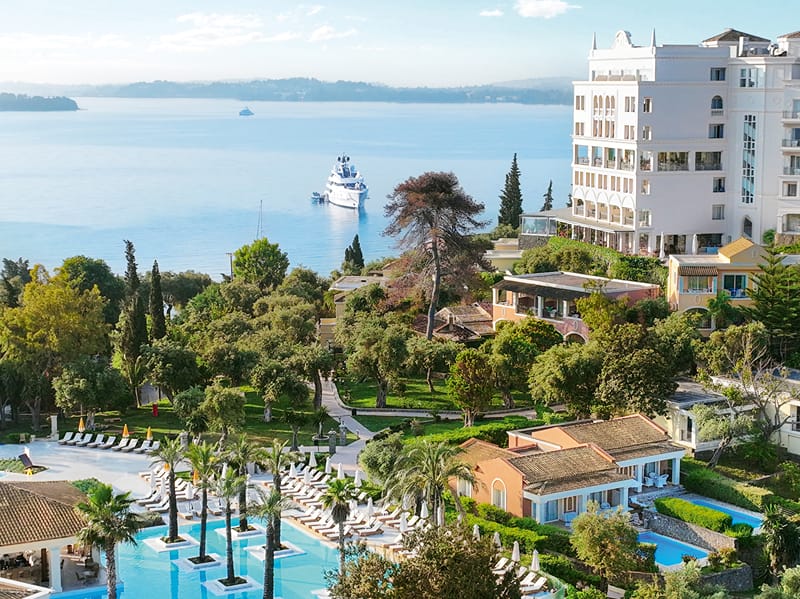
Grecotel Eva Palace
A beach resort where cypress gardens and olive groves meet two seas, with a belle époque beach and a giant pool jardin, just moments away from Corfu Town.
Read article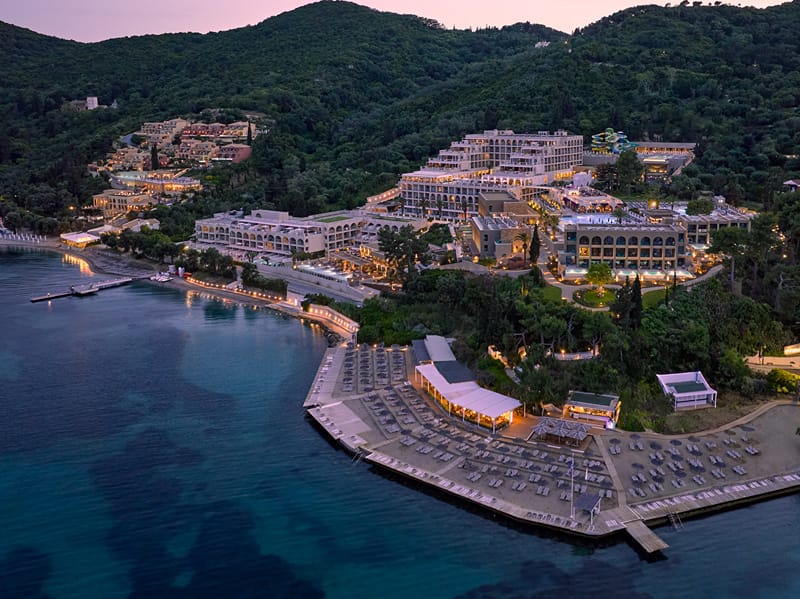
MarBella
A five-star family hotel of the Mar-Bella Collection on the south-east coast, in landscaped gardens over the Ionian, less than 30 minutes from the Old Town and the airport.
Read article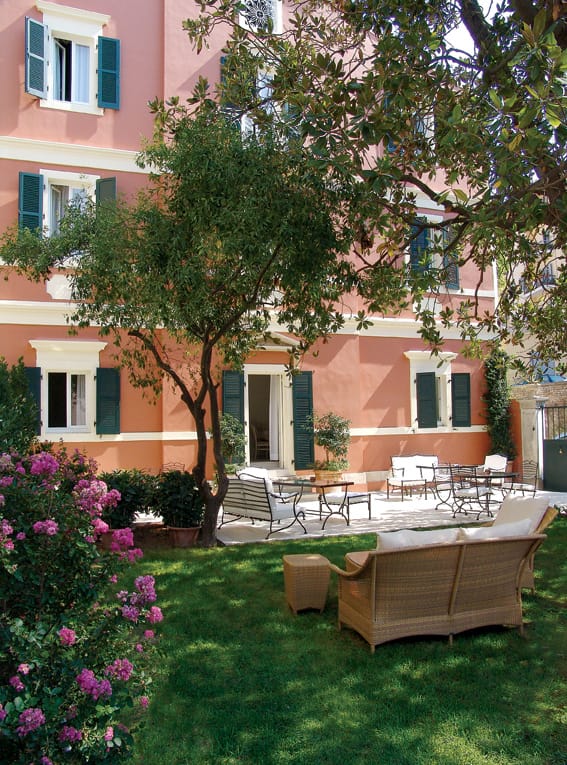
Siora Vittoria Boutique
Nine rooms in a historic residence, each named after an ancestor of the Metaxas family, with oak floors and walls finished in stucco veneziano.
View on TRVL ↗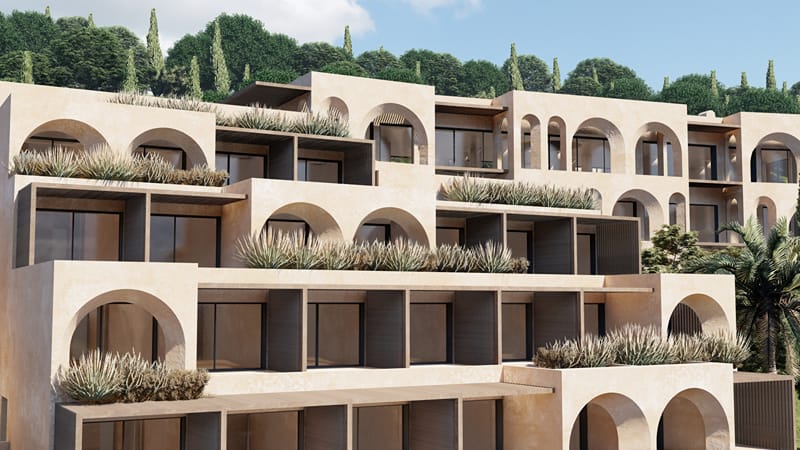
Ella Elyra
A resort on Kontogialos Beach facing west, with sunset views from nearly every corner of its grounds and a focus on couples.
View on TRVL ↗The Essence
Corfu rewards the traveller who uses both halves of it. Spend your mornings in the town, between a Venetian fortress and a coffee under the Liston's arcades, and your afternoons on the coast, in a cove at Paleokastritsa or a pebbled bay looking at Albania. Eat sofrito and bourdeto, finish with a kumquat liqueur, and if you can, come back at Easter, when the bands play and the pots fly. Few islands carry so much of Europe so lightly.