
In winter the road out of Kalavryta climbs about 14 km through fir forest to the slopes of Mount Helmos, the closest ski centre to Athens. Down in the town, at around 750 metres, stone houses, small squares, cafés and tavernas gather under plane trees, and the place is at its liveliest once the snow arrives.
What turns a ski weekend into a proper trip is everything within a short drive: a monastery built into a cliff face, a cave where lakes step down through the rock on three levels, a forest of old plane trees around the springs of the Aroanios with trout on the table beside them, and the Vouraikos gorge, where a narrow-gauge rack railway has climbed from the Corinthian Gulf since 1896. The mountain sets the rhythm here, and the valleys fill the rest of the day.
The Areas
Most visitors stay in the town itself and drive out to the slopes, monasteries and villages. A few quieter bases sit in the valleys around it.
- Kalavryta town — the base for almost everything, with the shops, tavernas, the Holocaust museum and the railway terminus; the ski centre is about 14 km away. Suits first-timers and anyone travelling without a car.
- The ski centre road — just outside town on the way up to Helmos, with chalets and guesthouses a couple of kilometres from the centre. Suits skiers who want to be on the road early.
- Kato Zachlorou — a village deep in the Vouraikos gorge, a stop on the rack railway and half an hour on foot below Mega Spilaio. Suits walkers and anyone after quiet.
- Planitero — about 25 km from Kalavryta on the road to Kleitoria, at 697 metres above the plane forest of the Aroanios springs. Suits a long lunch and an easy walk among the trees.
- Kastria and Lousoi — to the south, the Cave of the Lakes at Kastria lies about 17 km from Kalavryta and 9 km from Kleitoria, and the ancient site of Lousoi sits near Loussiko. Best as a day out rather than a base.

What to See and Do
Start with Mega Spilaio, the Great Cave monastery, at the 10th kilometre of the road from Kalavryta towards Diakopto. Its church is carved into a large cave at the foot of a sheer rock face of Helmos, at about 940 metres. Tradition dates its founding to 362. The monastery keeps an icon of the Virgin, the Spileotissa, made of wax and mastic on wood and traditionally attributed to the Evangelist Luke, along with manuscripts, vestments and frescoes dated to 1653. It opens daily from 08:00 until sunset.
Agia Lavra, 5 km southwest of town, is the monastery tied to the start of the Greek War of Independence. Its most prized possession is the banner of 1821, known as the Banner of the Oath of the Fighters. Visiting hours are short: 10:00 to 13:00, then an hour in the afternoon, from 15:00 in winter and from 16:00 in summer.
In Kalavryta itself, the clock of the central church stands at 2:34. It marks the moment on 13 December 1943 when German occupying forces executed the men of the town on the Kappi ridge just outside it. The former primary school, opened in 1906 with funds from Andreas Syngros, is now the Municipal Museum of the Kalavryta Holocaust, which tells the story of that day and of the women who buried their dead by hand in the frozen ground. Give it an unhurried hour; it opens Tuesday to Sunday, 09:00 to 16:00, and entry is free on 12 and 13 December.
For much older history, the site of ancient Lousoi near Loussiko holds a Doric temple of Artemis Hemera, built in the early 3rd century BC, with the remains of the city market and houses around it. The Austrian Archaeological Institute has been excavating here since 1981, and the site is open to the public.

Winter on Helmos
The Kalavryta Ski Centre opened in 1988 on the northwest side of Helmos. Its slopes run from Xerokambos at 1,700 metres to Neraidorachi at 2,340 metres. Visit Greece lists 12 pistes and about 20 km of skiing served by seven lifts; the local tourism portal counts 14 slopes, 25 km and eight lifts. Either way there is ground for every level: Leto at Xerokambos for beginners, blue runs such as Phaedra, and the black Ino, also called Styga 1, one of the most demanding runs in the country. Nefeli and Achilleas together make a descent of about 3.2 km, one of the longest in Greece. There are ski and snowboard schools, equipment rental, a snowboard park and a chalet at Vathia Lakka, at 1,850 metres.
At the top of Neraidorachi stands Aristarchos, the National Observatory of Athens telescope, described by the local tourism portal as the largest in the Balkans.
Winter is also the best season for the Cave of the Lakes at Kastria. The visit follows a 500-metre route over small bridges through a cave explored to 1,980 metres, where 13 basins hold water all year on three levels. When the snow melts, the cave becomes an underground river with natural waterfalls; in summer parts of it dry out, leaving stone basins and dams up to four metres high.
The third winter classic is the Odontotos, the rack railway: 22 km of 75-centimetre narrow gauge from Diakopto on the Corinthian Gulf up to Kalavryta, built under the government of Charilaos Trikoupis and opened in 1896. It follows the Vouraikos gorge past cliffs and waterfalls and switches to a toothed rack where gradients pass 10 percent. Services have been suspended since March 2026, so read the note under Getting There before you plan around it. In the meantime, an old footpath of about 1.75 km links Mega Spilaio with Kato Zachlorou, about half an hour on foot, with the monastery above you and the sound of the Vouraikos below.

What to Eat and Drink
Kalavryta is cheese country. The local dairy cooperative and creameries make PDO barrel feta, myzithra, gruyere and formaela, along with milk and yoghurt, and some let visitors watch production and taste. Pasta is a local craft too: hylopites, also called toutoumakia, trahanas and other handmade shapes, sold in town alongside honey and herbs. The honey comes in many varieties, fir, chestnut, thyme and heather among them, and the traditional spoon sweet is rose sugar, made from local petals.
The cooking is mountain food. Small goat comes in white sauces, with oil and lemon, oil and oregano or egg and lemon; sausages are smoked or fresh; wild boar and rooster with pasta turn up on taverna menus. Trout is raised at Planitero, at the springs of the Aroanios. Mountain tea grows in two local varieties, from Helmos and from Erymanthos. Chestnuts ripen from September to November, and the village of Kertezi, known for its beans, holds an annual Bean Festival.
Wine has deep roots here: the monasteries of Mega Spilaio and Agia Lavra were important to local winemaking. The red to look for is Mavro Kalavrytino, a rare native grape; Tetramythos in Ano Diakopto makes the only single-variety wine from it, from organic vineyards between 600 and 1,050 metres. Roditis is the local white, and the regional tourism portal suggests it with feta and with goat in white sauce.
Getting There and Around
Kalavryta is around 190 km from Athens by road, roughly two and a half hours: follow the national road towards Patras and turn off at the Diakopto junction before Aigio, then follow the signs. From Patras it is about 77 km. KTEL buses reach the town from Athens in about three to three and a half hours and from Patras in about one and a half to two.
The classic arrival is by rack railway from Diakopto, but regular services were suspended on 12 March 2026 after large rocks fell onto the track from the slopes of Helmos. In early October 2026 a hoped-for restart on 16 October was ruled out while a new safety study goes back through approval, and no new date has been confirmed. Check Hellenic Train before you count on the train. A car is the easiest way to reach the ski centre, about 20 minutes from town, as well as the monasteries, the cave and the villages.
When to Go
Kalavryta has two good seasons. From mid-December to mid-April the ski centre runs daily and the town is at its busiest; this is also when the Cave of the Lakes holds the most water. Autumn is the other: Planitero's village guide singles it out for the plane forest, chestnuts ripen between September and November, and wild mushrooms appear in spring and autumn. Outside the ski season the high ground around the ski centre is open for hiking, mountain biking and mountaineering, without organised activities.
Good to Know
A few places close on fixed days: the Holocaust museum on Mondays, the Cave of the Lakes on Tuesdays and on Easter Sunday. Agia Lavra keeps short hours with a midday break, so plan it for the morning. The rack railway was not running at the time of writing, so check before building a day around it. Ski passes vary by season; Visit Greece lists adult day passes at €22 in low season and €32 in high, with cheaper half-day passes from 13:00, and lift status is posted daily. The ski centre draws more than 150,000 visitors a winter, so book rooms early for weekends and holidays.
Our Picks
- To skiKalavryta Ski Centre
Slopes from 1,700 to 2,340 metres, open daily from December to April.
- To seeMega Spilaio Monastery
A church carved into a cave beneath a sheer rock face; open daily from 08:00 until sunset.
- To seeCave of the Lakes
Lakes on three levels along a 500-metre route of small bridges; closed on Tuesdays.
- To seeAgia Lavra Monastery
Home of the banner of 1821; go in the morning, between 10:00 and 13:00.
- To seeMunicipal Museum of the Kalavryta Holocaust
The town's story told in its former school; Tuesday to Sunday, 09:00 to 16:00.
- To walkMega Spilaio to Kato Zachlorou
An old footpath of about 1.75 km, half an hour down to the village by the river.
- To eatVarvitsiotis
A family taverna since 1973, for grilled meat, handmade pies and Kalavryta formaela.
- To eatPiges
Trout from the Rigogiannis family farm, served among the plane and walnut trees at the Aroanios springs.
- To drinkTetramythos
An organic winery on the slopes of Helmos and the only single-variety Mavro Kalavrytino; call ahead.
Where to Stay
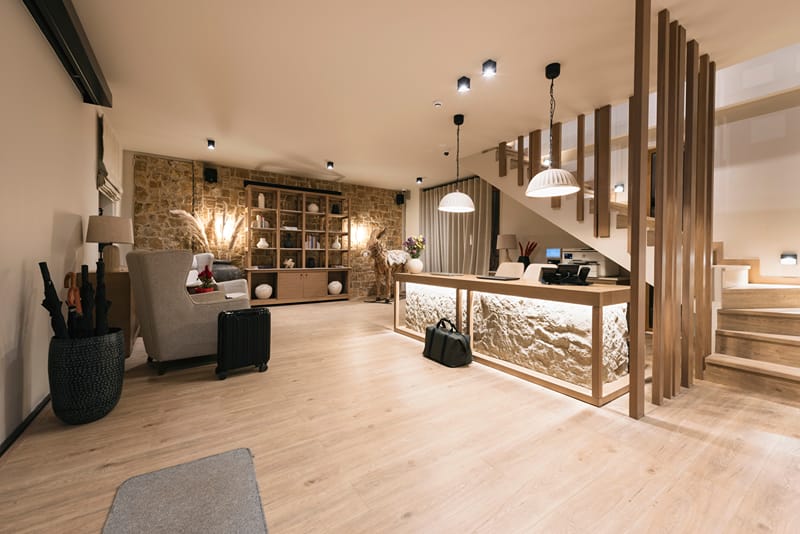
Revi Mountain Resort
A boutique hotel in the heart of Kalavryta where minimalist design meets high-end technology, conceived as a quiet mountain retreat.
View on TRVL ↗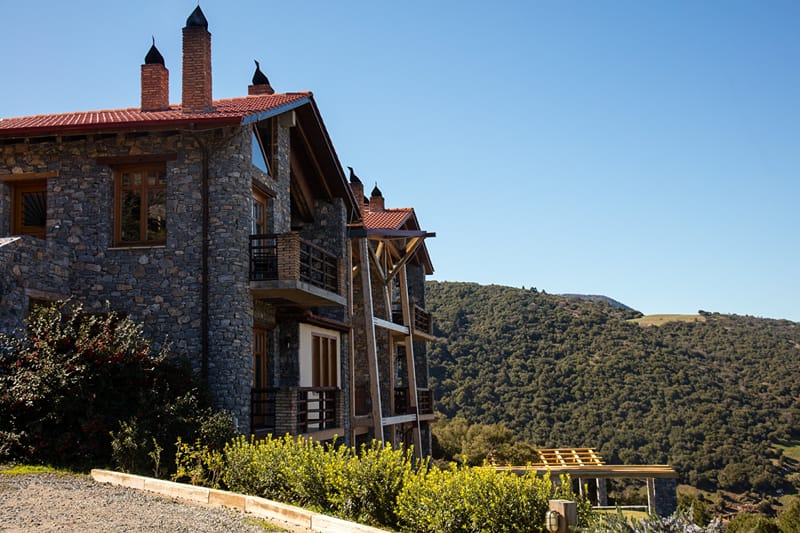
Azanias Chalet Kalavrita
Built of stone and wood in 2003, with seven two-level apartments, each with a fireplace, a fully equipped kitchen and views of the town.
View on TRVL ↗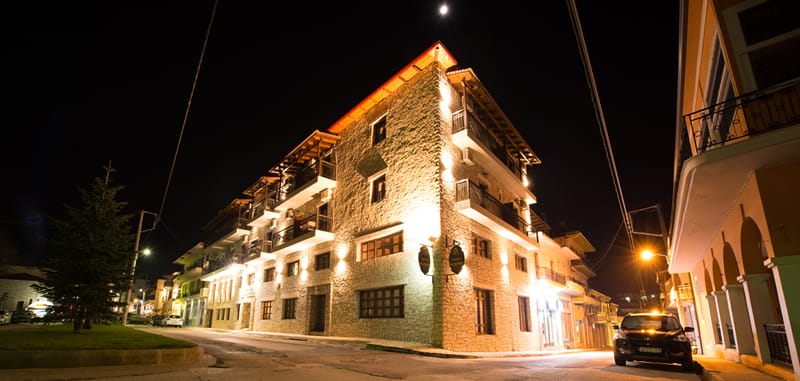
Filoxenia Hotel & Spa
A fully renovated hotel of stone and wood at 756 metres in the foothills of Helmos, looking out over the mountain and the town.
View on TRVL ↗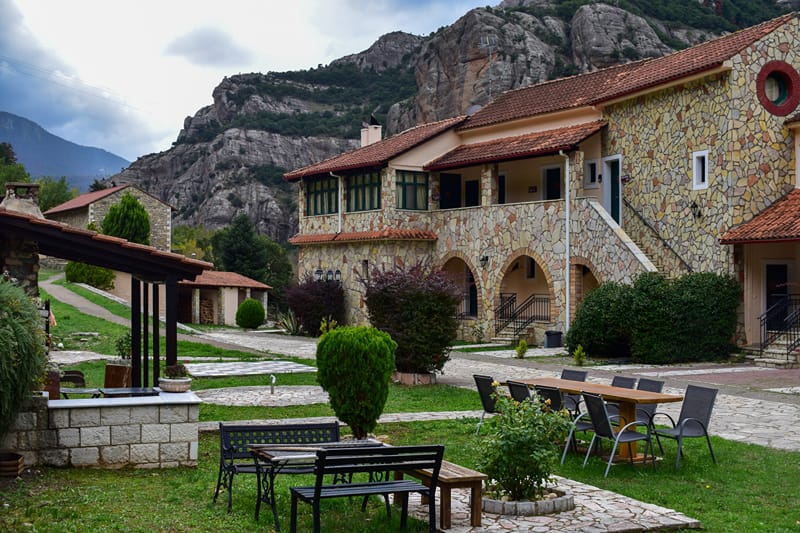
Muntenia Inn Apartments
Studios, apartments and suites on a 20-acre plot bordered by the Vouraikos river, most with fireplaces, facing rocks and fir, plane, chestnut and walnut trees.
View on TRVL ↗The Essence
Kalavryta is best treated as a winter base with room to wander. Ski the morning on Helmos, then come down for goat and hylopites, a glass of Mavro Kalavrytino and an afternoon at a monastery set into a cliff or among the lakes of Kastria, swollen with snowmelt. The town is small, the mountain is close, and every road out of it leads somewhere worth the drive. Come for the snow, and give the valleys a day of their own.