
Stand anywhere on the western rim of Santorini and the island explains itself. The villages sit along the edge of a flooded caldera, the cliffs fall away in bands of red, black and pale ash, and the islets of Nea and Palea Kameni lie in the middle of the bay like the volcano's own signature. It is one of the few places where the view from your breakfast table is also a lesson in geology.
The pleasure of a trip here is that the drama is only half the story. Behind the rim lies a quieter island of hill villages, low basket-trained vines and dry-farmed tomatoes and fava, with wineries in old cellars and a coastline of dark volcanic sand on the eastern side. Spend a few days moving between the two and Santorini feels less like a postcard and more like a place that makes things.
The Areas
Most first-time visitors choose between the caldera villages, for the views, and the inland and beach villages, for space, value and a slower pace. The island is small enough that you can base yourself in one and reach the others easily.
- Fira — the capital and the island's transport hub: almost every bus route starts or ends here. Good for first-timers without a car, and home to the Museum of Prehistoric Thera.
- Imerovigli and Firostefani — on the caldera rim north of Fira, quieter than either Fira or Oia, with the walk out to Skaros Rock on the doorstep. Suits couples who want the view without the bustle.
- Oia — at the northern tip, the village most people picture when they think of Santorini, famous for its sunsets. Below it, Ammoudi Bay has fish tavernas and deep water for swimming off the rocks.
- Pyrgos — an inland hill village with a Venetian castle quarter, Kasteli, at its top and a view across the whole island. The road and footpath to Profitis Ilias, the island's highest point, begin here.
- Megalochori and Emporio — villages of the southern wine country, with stone lanes and old cellars; Emporio has its own fortified castle quarter. Good for a calmer stay with character.
- Kamari, Perissa and Perivolos — the black-sand beach resorts of the east and south coast. Practical for families and anyone who wants to swim every day.

What to See and Do
Start with Akrotiri, on the southwestern coast: a Bronze Age town buried by a volcanic eruption, probably at the end of the 17th century BC, and preserved beneath the ash. Systematic excavation began in 1967 under Spyridon Marinatos and continues today. Under a modern bioclimatic shelter you follow paved streets past a drainage system, open squares and more than 30 multi-storey buildings. It ranks among the most important prehistoric sites in the Aegean.
Then see what was found inside. The Museum of Prehistoric Thera in Fira holds wall paintings and objects from Akrotiri; going after the site, rather than before, makes the rooms come alive. Across the island, Ancient Thera crowns the ridge of Mesa Vouno between Kamari and Perissa: a city founded in the 8th century BC, with an agora, a theatre, sanctuaries and inscriptions cut into the bare rock. Allow about an hour and a half.
For something less obvious, the Tomato Industrial Museum in Vlychada occupies the Nomikos family's tomato-paste factory, built in 1945 and closed after its last season in 1981. Since 2014 it has been a museum and part of the Santorini Arts Factory, a cultural venue for exhibitions, concerts and workshops. It tells the story of the island's tomato, from field to tin.
Finally, get out on the water. Boat trips from Fira's old port and from Athinios cross the caldera to Nea Kameni, where a guided walk leads to the crater, and stop off Palea Kameni for a swim in the warm springs. Bring shoes you can walk in and clothes you do not mind staining.

Walks, Beaches and the Caldera
The single best way to understand the island is on foot. The path along the caldera from Fira to Oia runs about 10 km and takes most walkers three to five hours, mixing village lanes and open dirt trail; going in that direction is mostly downhill. There is little shade, so start early in summer, and take the bus back.
Shorter but just as rewarding: from Imerovigli a signposted path crosses a narrow neck of land to Skaros Rock, where a Venetian fortress stood from the early 13th century. Steps lead down to the small chapel of Theoskepasti on its side. The steps are steep, and the Ministry of Culture forbids going beyond a marked point, so respect the signs. Inland, a trail of about 2.5 km climbs from the main square of Pyrgos to the monastery of Profitis Ilias, founded in 1711 on the island's highest point, around 567 metres.
Santorini's beaches are volcanic, and the sand is dark. Kamari, Perissa and Perivolos on the east and south coast are long and well organised, with sunbeds, tavernas and beach bars; the rock of Mesa Vouno rises between Kamari and Perissa. On the caldera side, Ammoudi Bay has no beach at all: you swim straight off the rocks into deep water, with water shoes a good idea.

What to Eat and Drink
Santorini's soil is poor in water and rich in minerals, and its produce shows it. Fava Santorinis, a protected product made from the legume Lathyrus clymenum, is cooked into a smooth, earthy purée that appears on almost every menu. The small, thick-skinned cherry tomato, tomataki Santorinis, is dry-farmed and has protected designation of origin status; look for it fresh, sun-dried or as paste. Local capers, whose leaves and flowers also go into the cooking, and the sweet white aubergine complete the island's larder.
The vineyard is among the oldest in Europe, and its volcanic soils protected the vines from phylloxera. Growers still train them into low baskets, the kouloura, to shelter the grapes from the wind. The great grape is Assyrtiko: dry PDO Santorini wines are made mostly from it, sometimes with Athiri and Aidani. Look also for Nykteri, an oak-aged style, and Vinsanto, the island's naturally sweet amber wine made from sun-dried grapes. Wineries cluster around Megalochori, Pyrgos, Exo Gonia and the plain of Oia, and many offer tastings by booking.
For a meal that brings it all together, the inland villages are a good bet. Metaxi Mas in Exo Gonia cooks Cretan and Santorinian dishes, from fava and baked white aubergine to fillet in Vinsanto sauce, with produce from a local vegetable garden.
Getting There and Around
Santorini's airport sits on the east coast near Monolithos, about 6 km from Fira. There are daily flights from Athens all year, and seasonal international flights, mostly from May to October, from more than 20 European cities. Ferries from Piraeus run all year, more often in summer, taking roughly five hours on the fast boats and longer on conventional ships; operators include Blue Star Ferries, Seajets and Fast Ferries. They dock at Athinios, the island's ferry port, around 20 minutes from Fira by bus.
The KTEL bus network radiates from Fira: Oia, Kamari, Perissa, Akrotiri and the airport are all reached from there, so a trip between two other villages usually means changing in Fira. Fares are a few euros. A hire car makes the inland villages and wineries easier to reach, and there are rental desks at the airport. Taxis wait at arrivals, but booking a transfer ahead is wiser in summer.
When to Go
June and September are the sweet spots: long sunny days, a sea warm enough to swim (around 22°C in June and higher by late summer) and fewer people than at the peak. May is greener, cheaper and quieter, though the water is still cool. July and August are the hottest and busiest months, cooled by the northerly meltemi wind. October is calm and golden, with a handful of rainy days; from November many hotels and restaurants close, and January is very quiet, which suits walkers and museum-goers more than swimmers.
Good to Know
Santorini is popular, and the caldera villages fill up in summer, especially Oia around sunset and Fira when the cruise ships are in. Greece now charges cruise passengers a fee in peak season, and the island has reinstated a daily cap on cruise arrivals, but the easy fix is timing: walk the caldera villages in the early morning, head inland or to the beach at midday, and watch the sunset from Imerovigli, Pyrgos or a winery terrace rather than Oia's castle. Book popular restaurants and winery tastings ahead in summer. The famous Red Beach near Akrotiri has been closed to visitors because of rockfall; enjoy it from the viewpoint above. Prices on the caldera rim are high; the inland villages and beach resorts are noticeably kinder to the budget.
Our Picks
- To seeAkrotiri
A Bronze Age town under a modern shelter; go in the morning, and on Mondays and Thursdays note the shorter 08:30–15:30 hours.
- To seeMuseum of Prehistoric Thera
The wall paintings and objects from Akrotiri, best seen after the site itself; closed on Tuesdays.
- To seeTomato Industrial Museum
The island's tomato story told in the old Nomikos factory, open April to November, Tuesday to Sunday.
- To walkThe caldera path
About 10 km along the rim, mostly downhill in this direction; start early.
- To walkSkaros Rock
A short, steep path to the site of a Venetian fortress and the chapel of Theoskepasti.
- To swimAmmoudi Bay
Deep water straight off the rocks, with fish tavernas at the waterline.
- To drinkSanto Wines
The winery of the island's cooperative, with tastings, local olive oils and terraces over the caldera.
- To drinkDomaine Sigalas
Tastings and food-and-wine pairings among the vines, by advance booking.
- To eatMetaxi Mas
Cretan and Santorinian cooking in a village courtyard; reserve by phone.
Where to Stay
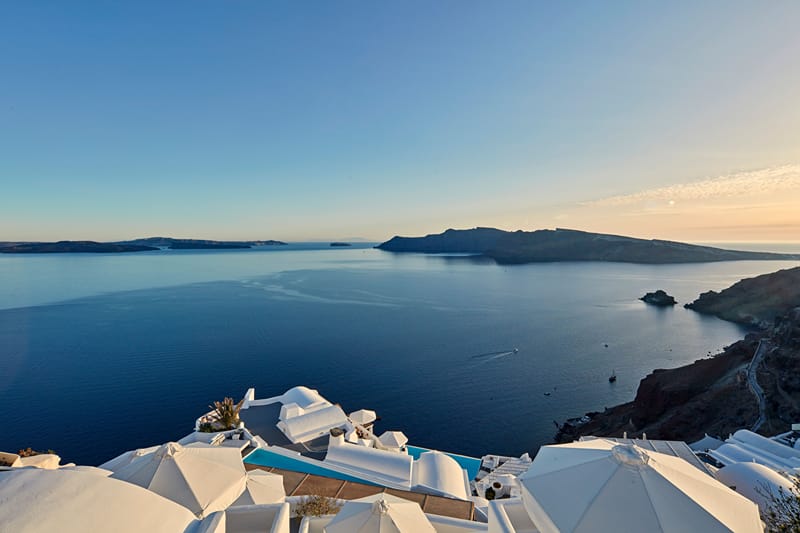
Katikies Santorini
The first Santorini luxury hotel to intertwine boutique comforts with the island's monumental natural setting, with infinity pools above the caldera.
Read article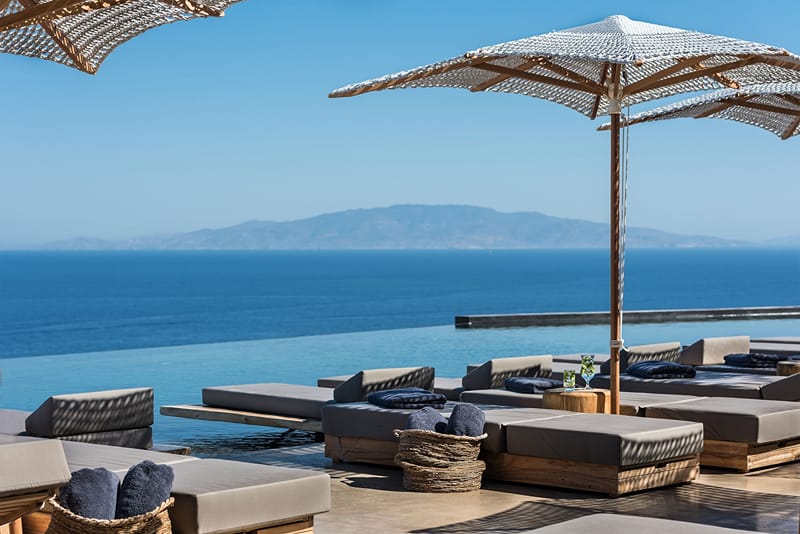
Andronis Arcadia
114 suites and villas with private pools, the Evexia Spa and an ideal starting point to explore the village on foot.
Read article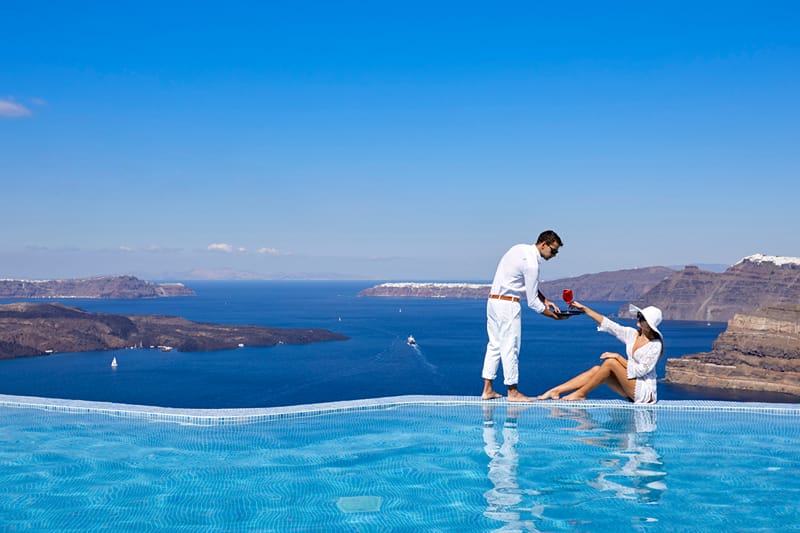
Suites of the Gods
A five-star hotel in Aegean Cycladic style, 350 metres above Athinios port, overlooking the caldera, the volcano and the sunset.
View on TRVL ↗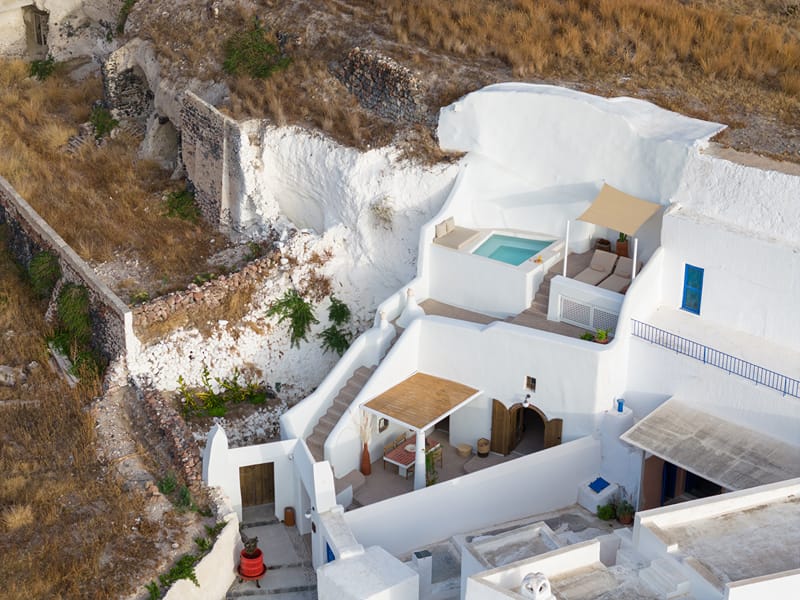
Kanava Cave Winery
A cave winery more than 200 years old, remodelled into an apartment with modern comforts on the edge of the traditional village of Mesaria.
View on TRVL ↗The Essence
Santorini rewards the visitor who looks past the rim. Watch the light change over the caldera, by all means, but then follow the island inland: to a glass of Assyrtiko poured from vines that have grown in ash for centuries, a plate of fava in a village courtyard, a swim off dark rocks, an evening walk to a castle on a hilltop. The island grew out of its volcano, and everything good about it still tastes of that.