
Look up from the harbour in Nafplio and you see the whole town at once: a small fortress sitting on its own islet in the bay, the old walls of Akronafplia on the rock behind the rooftops, and the Venetian bastions of Palamidi high on the hill above. Below them lie stone-paved lanes, bougainvillea, neoclassical mansions and Ottoman fountains, packed into an old town you can cross on foot in a quarter of an hour.
This was the first capital of the modern Greek state, until the court moved to Athens in 1834, and it still carries itself like one. It is also a town that works in every season. The climate is mild, the sea stays warm well into autumn, and in winter, when the beach crowds have gone, a weekend of castle walks, museums, long lunches and a day among the vines of Nemea is about as good as a short break in Greece gets.
The Areas
Nafplio is compact, and most visitors stay in or very close to the old town.
- The Old Town — the historic centre at the foot of Akronafplia and Palamidi, with Syntagma Square, the museums and the main street the locals still call Megalos Dromos, the Great Road. Best for a first visit and for anyone without a car.
- Psaromachalas — a small, quiet corner of the old town tucked under the walls of Akronafplia. Suits couples who want to be central but away from the busier streets.
- Pronia — the neighbourhood east of the old town along 25 Martiou Street, at the back of Palamidi. More residential, with neighbourhood tavernas and the paths up through the pine woods to the castle.
- The New Town — the modern streets beyond the town park, where the bus station and the everyday shops are. Practical rather than pretty.
- The hillside towards Karathona — the green slopes south of Palamidi, on the road to Karathona beach. Good with a car, for families, and for a winter stay with more space and a fireplace.

What to See and Do
Start with Palamidi. The Venetians built it between 1711 and 1714 on a hill 216 metres above the town, with eight bastions linked by walls; Greek fighters took it in November 1822, and the bastions now carry the names of ancient heroes. Tradition says there are 999 steps up from the town, but a count gives about 857. Climb in the morning, when the stairway is in shade, or drive round to the back gate via 25 Martiou Street. Inside, look for the cell where Theodoros Kolokotronis, the hero of the War of Independence, was held, the church of Agios Andreas, and the great water cisterns. The views over the Argolic Gulf improve with every bastion, and the southern end is the quietest.
Akronafplia, the rock above the old town, is the oldest part of Nafplio, with stretches of Bronze Age wall in its western part and later work by Franks, Venetians and Ottomans. Entry is free. Wander off the road between the walls for views north over the town and south to Arvanitia; at the western tip, past the Five Brothers bastion with its five old cannon, a slope of prickly pear flowers yellow in summer and fruits in autumn and winter.
Out in the harbour, the Bourtzi has guarded the entrance to the port since the Venetians built it in the 1470s, when a chain could be stretched from it to block enemy ships. It was thoroughly renovated in 2023. Small boats cross from the quay near Filellinon Square in a couple of minutes, depending on the season; the town looks its best from the islet just before sunset.
Syntagma Square is the town's living room, where Nafpliots take their morning coffee and children play in the evening. On it, the Archaeological Museum fills two floors of a Venetian building of 1713, with finds from the Palaeolithic to the Roman period; its star is the Dendra panoply, a near-complete suit of Mycenaean bronze armour from the late 15th century BC. Just off the square stands the grey stone Vouleftiko, built in 1730. A few minutes away, the Ethnological Museum of the Basil Papantoniou Foundation, founded in 1974 and European Museum of the Year in 1981, holds costume and collections of popular and modern Greek culture; its Museum of Childhood occupies the old railway station in the park. History is close at hand here: Ioannis Kapodistrias, the first governor of Greece, was assassinated on the steps of the church of Agios Spyridon in 1831.
Finally, walk. A waterfront walkway loops around the foot of Akronafplia to Arvanitia, the town beach of fine gravel between the two castles. From the car park there, a path continues about 2.5 km along the coast to the long sandy beach of Karathona, roughly 45 minutes on foot, with small chapels scattered around the bay.

Day Trips: Mycenae, Epidaurus and Nemea
Nafplio sits in the middle of one of the richest corners of ancient Greece, and three day trips are within easy reach. Mycenae is about 20 km north, roughly half an hour by car. You enter the Bronze Age citadel through the Lion Gate, built around 1250 BC, its two carved lionesses the largest surviving sculpture of the Bronze Age Aegean. About 100 metres from the main site, the Treasury of Atreus is a beehive tomb more than 13 metres high whose dome was, for around a thousand years, the tallest and widest in the world; many visitors miss it. Wear good shoes, as the stones are slippery. On the way, Tiryns, a few kilometres outside Nafplio, has walls still standing up to 7 metres high, and shares its UNESCO listing with Mycenae since 1999.
Epidaurus, about an hour by bus to the east, was the most celebrated healing sanctuary of the ancient world, dedicated to Asklepios. Its theatre, designed by Polykleitos the Younger in the 4th century BC, seats up to 14,000 and is famous for its acoustics; the sanctuary and theatre have been a UNESCO World Heritage Site since 1988. See the small museum first, with its ancient surgical instruments, then the site. In summer the theatre still stages ancient drama as part of the Athens Epidaurus Festival, as it has every year since the 1950s; KTEL usually runs a bus from Nafplio on performance evenings.
Nemea, about 35 km north, combines wine and archaeology. At Ancient Nemea, columns of the Temple of Zeus, built around 330 BC, have been raised again, and at the stadium nearby athletes entered through a vaulted tunnel about 36 metres long, the earliest known Greek vault. The Nemean Games were held here from 573 BC, and the victors were crowned with wild celery. All around lies the largest continuous vineyard in Greece, spread across the town and 17 villages, given over to the red Agiorgitiko grape. Dozens of wineries open their doors for tours and tastings; book ahead, especially at weekends.

What to Eat and Drink
The plain of Argolis around Nafplio is orange and olive country; these are the region's main crops, and you will taste both on every table. In town, Staikopoulou is the restaurant street, lined with tables, but some of the best meals are in the smaller tavernas of the back lanes and of Pronia. On Syntagma Square, the cafés serve pikilia, a plate of small bites to go with an ouzo or a coffee, and along the promenade of Akti Miaouli people gather to watch the sun go down behind the Bourtzi.
The wine to order is Agiorgitiko from Nemea. It is the only grape allowed in the Nemea appellation, which makes red wine alone: deep in colour, fruity and spicy, with notes of plum. Some of the most serious come from the higher slopes, such as the hills of around 500 to 600 metres near Koutsi. At GAIA's winery there, the Village Flavors experience pairs the wines with a two-hour lunch of rustic Peloponnesian dishes.
Getting There and Around
Nafplio is about 147 km from Athens. By car, take the motorway from Athens airport towards Elefsina and Corinth, then follow the signs for Nafplio; allow about two hours, and take care on the narrower, winding stretch after Corinth. KTEL Argolida buses leave from the Kifissos bus station in Athens, generally every hour, and take two to two and a quarter hours via Corinth and Argos; from the airport, the X93 bus runs to Kifissos. The train line to Nafplio is suspended.
Once you arrive, leave the car. The old town is walkable end to end in under 15 minutes, and there is a large car park at the harbour, 10 to 15 minutes' walk from most old-town lodgings. The bus station and the main taxi rank are on Syngrou Street, at the edge of the old town. KTEL Argolida runs buses to Mycenae and Epidaurus, but a hire car, available in town, makes the day trips and the wineries far easier.
When to Go
Nafplio is a town for all seasons, and its mild climate brings visitors year-round. Autumn and winter weekends may be the best of all: the sea stays warm well into autumn, the hard climbs are kinder in the cool, the prickly pears ripen on Akronafplia, and the museums and lanes are quieter. Winter days are short, so make an early start. September brings the grape harvest to Nemea, when the Great Days of Nemea open the wineries to visitors. Spring is good for walking the hills and coast around town. Summer is beach and festival season: Arvanitia and Karathona are fully set up, and the Epidaurus theatre stages its performances, with the 2026 festival running from late May into August.
Good to Know
Climb Palamidi early and bring water; the steps number more than 850, whatever the legend says. Opening hours change with the season, so check them for the castles and sites before you set out. Bourtzi boats run according to the season, so ask at the quay. Book winery visits in Nemea ahead; GAIA in Koutsi opens Wednesday to Sunday. At Mycenae, wear proper shoes and allow more time than you think.
Our Picks
- To seePalamidi
A Venetian fortress of eight bastions with the whole Argolic Gulf below; climb the steps in the morning shade.
- To seeArchaeological Museum
The Dendra panoply, a Mycenaean suit of bronze armour, in a Venetian building of 1713.
- To seeEthnological Museum, Basil Papantoniou Foundation
Costume and popular culture of modern Greece, open daily 09:00–15:00.
- To seeBourtzi
The 15th-century sea fortress, renovated in 2023, a short boat ride from the quay; go just before sunset.
- To walkAkronafplia
Free to wander, with Bronze Age walls, the Five Brothers bastion and views both ways.
- To walkArvanitia to Karathona
About 2.5 km of coastal path from the town beach to a long sandy bay, roughly 45 minutes.
- To seeMycenae
The Lion Gate and the Treasury of Atreus; do not skip the tomb, 100 metres from the main site.
- To seeAncient Theatre of Epidaurus
The 4th-century BC theatre of the Asklepios sanctuary; see the museum first.
- To seeAncient Nemea
The Temple of Zeus and a stadium entered through a 36-metre vaulted tunnel.
- To drinkGAIA Wines
Agiorgitiko from vineyards at 550 metres, with vineyard walks and tastings Wednesday to Sunday; book ahead.
Where to Stay
Amfitriti Palazzo Design
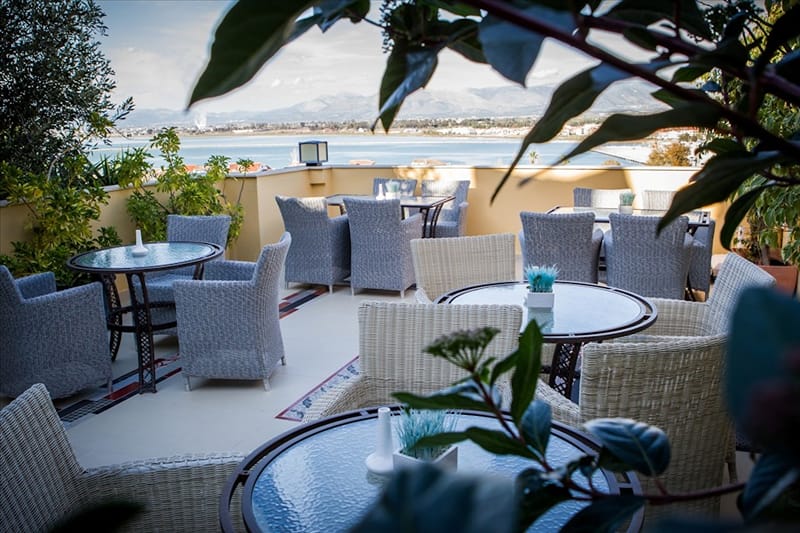
A small luxury hotel in the heart of the old town, with seven rooms each different in style and a view over the old town and the castles.
View on TRVL ↗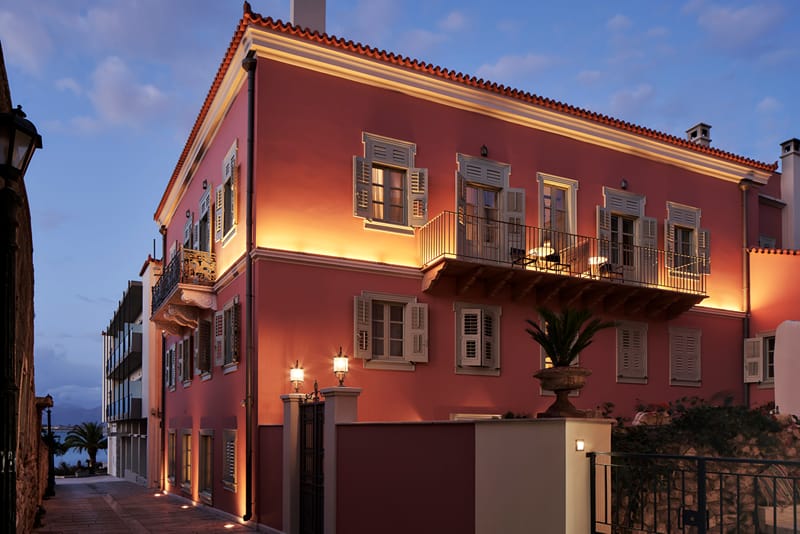
Ippoliti Luxury Hotel
An authentic 19th-century neoclassical mansion, renovated to combine the tradition of Nafplio with modern amenities, its rooms in a light neoclassical style with Tuscan furniture.
View on TRVL ↗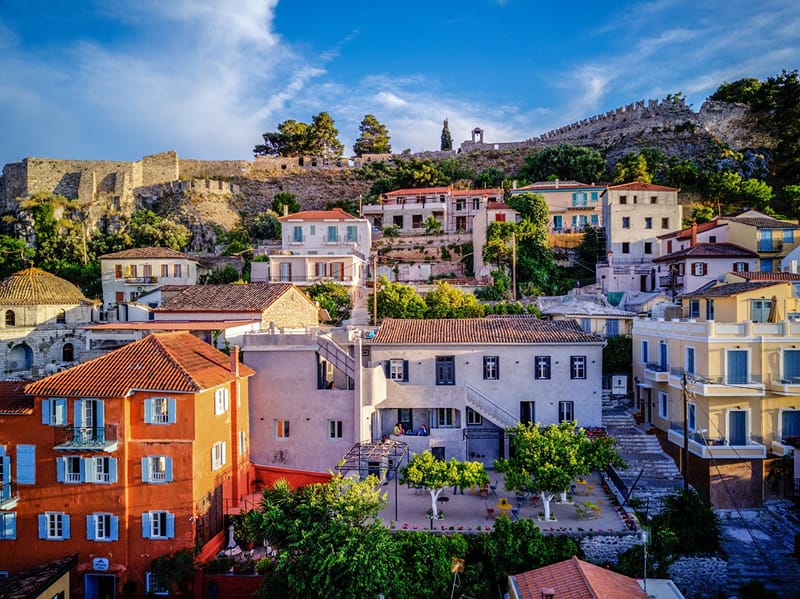
Aethra Boutique Rooms
A traditional 19th-century building with a large yard full of orange and lemon trees and a view of Nafplio.
View on TRVL ↗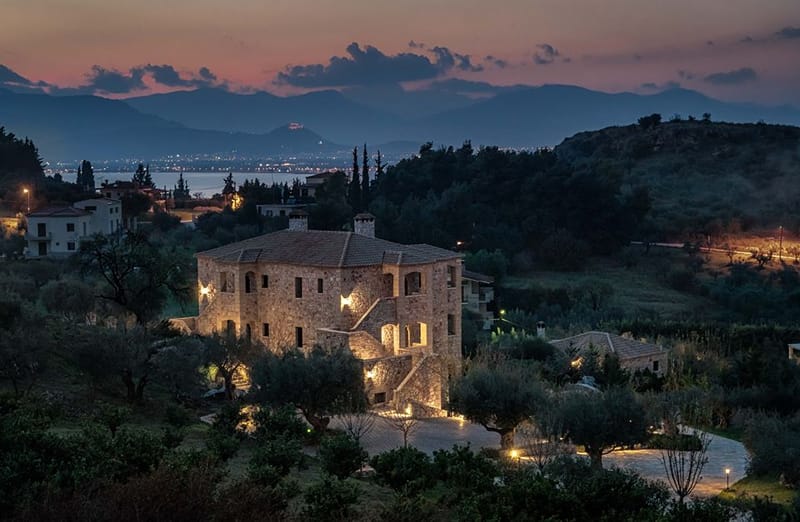
Klymeni Traditional Homes
Stone-built apartments with a fireplace in the living room, set in 30,000 square metres of gardens with olive trees, 1 km from Palamidi and with a view of the Argolic Gulf.
View on TRVL ↗The Essence
Nafplio is a small town with a long reach. In two days you can climb a Venetian fortress before breakfast, cross to a castle in the bay, walk the shore to a sandy cove, stand in the Lion Gate at Mycenae and finish with a glass of Agiorgitiko among the vines of Nemea. Then you come back to the lanes, the square and the harbour lights, and it feels exactly the right size. Come in winter, and you may have the best of it to yourself.