
Kalamata sits at the head of the Messinian Gulf with Mount Taygetos rising straight behind it, and it is one of the easiest places in Greece to begin a summer. A long town beach runs beside the seafront avenue, an old town of churches and cafés gathers under a 13th-century castle, and the airport is a few minutes from the centre. The city grew wealthy after independence on olive oil, raisins and figs, and the olive that carries its name is still the first thing most people know about it.
From here the coast opens in two directions. South-east, the road climbs into the Messinian Mani, to the stone towers of Kardamyli and the beaches of Stoupa. West, an hour away, lie Pylos and the great bay of Navarino, the omega-shaped sands of Voidokilia and the resorts of Costa Navarino. Inland, Ancient Messene is one of the most complete classical cities in Greece. Come for the sea in summer, or in autumn, when the water is still warm and the olive harvest is getting ready.
The Areas
Most visitors split their stay between the city and one stretch of coast. Each base gives the trip a different rhythm.
- Kalamata — the capital of Messinia and the second-largest city in the Peloponnese. Stay on Navarinou, the seafront avenue, if you want the beach outside the door, or near the old town for the evenings. It suits travellers without a car, and anyone who likes a real working city around them.
- Kardamyli — about 36 km south-east of Kalamata, at the foot of Taygetos on the Messinian Gulf, and a long-time favourite of walkers and writers. Stone tower houses, a small harbour and a string of pebble beaches; best for couples and hikers.
- Stoupa — a little further south, in the Outer Mani, built around a sandy bay, with Kalogria beach just outside the village. Both beaches are fed by underground freshwater springs. Easy-going and good for families.
- Pylos and Navarino — the harbour town on the Bay of Navarino, less than an hour west of Kalamata. A base for Voidokilia, the Gialova lagoon, Methoni and the Costa Navarino resorts.

What to See and Do
In Kalamata, begin at the castle, built in 1208 by the Frankish Villehardouins on a pine-covered hill above the city; Visit Greece calls the Castle of Isabeau the city’s reference point. Around it spreads the old town, the main place to meet and go out at night. At its heart is the Church of the Holy Apostles, a Byzantine church where Petrobey Mavromichalis declared the revolt against Ottoman rule in 1821. Beside the castle, the 18th-century nunnery of Saints Constantine and Helen still weaves silk on looms in the Byzantine tradition, and the Archaeological Museum of Messenia, on Papazoglou Street, shows finds from across the region, including a mosaic from Koroni.
Then walk down to the sea. The Railway Park at the end of Aristomenous Street keeps old steam engines out in the open, with a café in the old station building. From the port and marina, the town beach runs about 2.5 km east along Navarinou Avenue, organised and calm, with room for walking, cycling and swimming all the way.
Inland, about 40 minutes by car, Ancient Messene was founded in 369 BC by the Theban general Epaminondas. The archaeological park covers around a third of the original city, and excavations since 1987 have brought back most of the public buildings that the traveller Pausanias described: a well-preserved Odeon, the Asklepieion, the theatre, the Fountain of Arsinoe and a stadium with its heroon intact. It is open every day from April to October (08:00–20:00 in high summer, closing earlier as the days shorten) and 08:30–15:30 from November to March, closed Tuesdays; a full ticket is €15.
In the Mani, Old Kardamyli, just above the village, holds the fortified complex of the Mourtzinos–Troupakis clan with its 18th-century church of Agios Spyridon; part of it has been restored and turned into a museum. Behind the village the Viros Gorge runs about 20 km into the mountains, dry in summer, and in Homer’s Iliad Kardamyli is one of the seven cities Agamemnon offers Achilles. On the cliff above Kalogria beach at Stoupa stands a bust of Nikos Kazantzakis.

Pylos, Navarino and Voidokilia
Pylos is a town of arcades and plane trees around the Square of the Three Admirals, laid out by French troops in 1829. Its obelisk honours Codrington, de Rigny and van Heiden, the commanders of the British, French and Russian fleets that won the Battle of Navarino in the bay on 20 October 1827. The town still marks the date every year with the Navarinia, which makes October a good time to visit. Above the harbour, the Ottoman fortress of Niokastro, built in the 1570s, is one of the best-preserved castles in Greece, and its old French barracks now house the Archaeological Museum of Pylos.
About 8 km north of Pylos, near the village of Gialova, the Gialova lagoon (also called Divari) is a stopover for birds migrating between Africa and Northern Europe, and home to the rare African chameleon. On its seaward side lies Voidokilia, a crescent of sand and dunes shaped like the Greek letter omega, thought to be the ‘sandy Pylos’ where King Nestor welcomed Telemachus in the Odyssey. Above it are the ruins of a 13th-century Frankish castle and Nestor’s Cave, where, the myth says, Hermes hid stolen cattle. The lagoon, the bay and the island of Sfaktiria are protected under Natura 2000. The Palace of Nestor itself stands about 17 km north of Pylos.
Next to all this, Costa Navarino has four five-star resorts, The Romanos, The Westin, W Costa Navarino and the Mandarin Oriental, plus four 18-hole golf courses including the Dunes Course and the Bay Course, designed by Robert Trent Jones Jr.
What to Eat and Drink
The olive comes first. Kalamata olives are almond-shaped, plump and dark purple, picked by hand and cured in brine and wine vinegar under a layer of olive oil. In the EU the name is protected: only olives and olive oil from the region around Kalamata may carry it, and the same variety grown elsewhere is sold as Kalamon. Figs and raisins built the city’s fortune alongside the oil, and all three end up together in the Messinian salad, with orange, olives and local oil.
Look out for siglino, pork salted, smoked over sage and preserved in olive oil, often served with fried eggs and potatoes; for smoked pork sausages with orange; and for lalangia, spirals of dough fried in olive oil and eaten with a sharp cheese and honey. Pasteli, the sesame bar, is the local sweet.
On Wednesday and Saturday mornings, producers from across Messinia fill the market at Kalamata’s New Municipal Market with greens, fruit, honey and mountain herbs from Taygetos. In the historic centre, Thiasos, a café-ouzeri on Ypapantis Street in a building that was a café in 1914, serves meze from Messinian produce under two old plane trees, often to a soundtrack of rebetika.
Getting There and Around
Kalamata International Airport is about 8 km, or ten minutes by car, from the centre, with a bus stop right outside. In summer it has seasonal flights from across Europe, from airlines such as Ryanair, easyJet and Jet2; schedules change each season, so check before you plan.
By road, Visit Greece puts Athens airport about 230 km away. The drive is motorway almost all the way: from the Corinth Isthmus the A7 Moreas Motorway runs via Tripoli to Kalamata, 147 km, fully open since 2016. KTEL Messinias runs buses from Athens, with a stop in Tripoli on regular services and faster express runs; check current times with KTEL before you go.
A car is the practical choice for the rest. Pylos is less than an hour from Kalamata, Ancient Messene about 40 minutes, and the Mani road south to Kardamyli and Stoupa follows the coast along the foot of Taygetos.
When to Go
Summer is the season this coast is built for. Days are hot and dry, with average highs around 31°C in July and August, the sea is at its warmest and everything is open. Each summer the castle comes alive with the Kalamata International Dance Festival, which reached its 32nd edition in 2026. Go to the beaches early or late, and keep the middle of the day for a long lunch in the shade.
Autumn is mild. October still averages highs of about 24°C, the sea holds its warmth, the crowds leave the beaches, and Pylos celebrates the Navarinia around 20 October. Ancient Messene keeps its long daylight hours until the end of October. By November, highs fall to around 20°C and winters are mild and wet.
Good to Know
Ancient Messene closes on Tuesdays from November to March and on a few holidays, including 1 January, 25 March, 1 May, Easter Sunday and 25–26 December; entry is free on the first and third Sunday of each month in winter and on the last weekend of September. Kalamata’s market runs on Wednesday and Saturday mornings, so plan one of them into your stay. The Mani roads are narrow and winding; allow extra time and drive in daylight. At Voidokilia, the castle ruins above the beach are signposted as closed, so enjoy them from the path. And in summer, bring water and a hat for Messene: there is little shade among the ruins.
Our Picks
- To seeAncient Messene
A classical city founded in 369 BC, with a stadium, theatre and Odeon in a green valley; open daily in summer.
- To walkKalamata Castle and old town
The 1208 castle above the city, the Holy Apostles church and the silk-weaving nunnery next door.
- To swimKalamata town beach
Around 2.5 km of organised beach right in the city, calm water for an early swim.
- To eatKalamata market
Producers from all over Messinia on Wednesday and Saturday mornings; buy olives, honey and Taygetos herbs.
- To drinkThiasos
Ouzo and Messinian meze under plane trees, in a café building from 1914.
- To seeOld Kardamyli
The Mourtzinos–Troupakis tower complex and the church of Agios Spyridon above the village.
- To swimKalogria
A sandy bay just outside Stoupa, fed by freshwater springs, with Kazantzakis watching from the cliff.
- To swimVoidokilia
The omega-shaped bay of the Odyssey, with the Gialova lagoon behind the dunes.
- To seeNiokastro
An Ottoman fortress from the 1570s above Navarino Bay, with the Archaeological Museum of Pylos inside.
Where to Stay
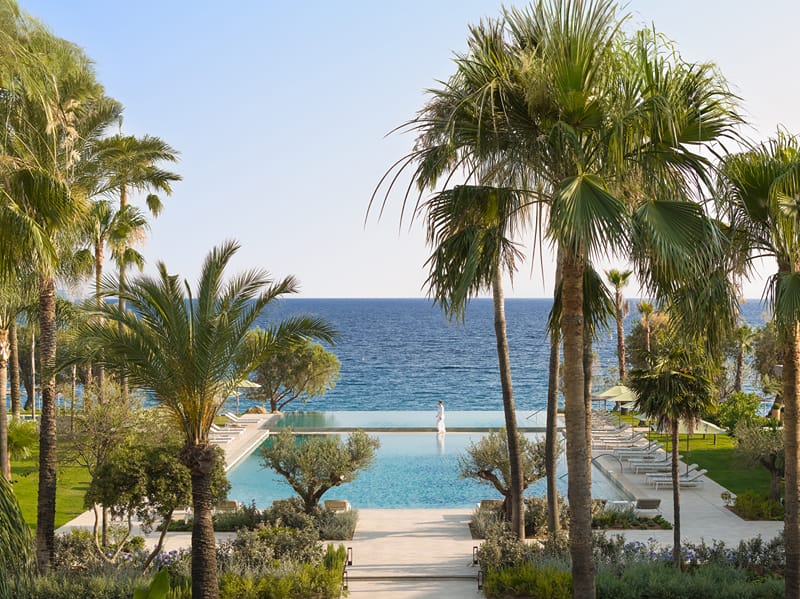
Grecotel Filoxenia Kalamata
A 162-room beachfront hotel reimagined as a Mediterranean retreat, with olive and palm gardens flowing into the sea, infinity pools and the Olive Spa.
View on TRVL ↗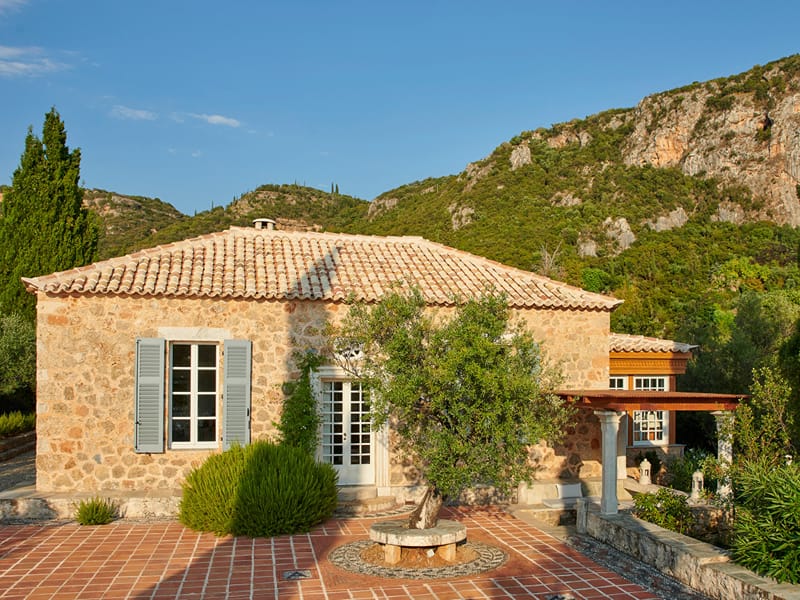
Patrick Leigh Fermor
The home Patrick and Joan Leigh Fermor bequeathed to the Benaki Museum, three stone buildings in a Mediterranean garden of cypress and olive trees rolling down to the sea, open to guests for part of the year.
View on TRVL ↗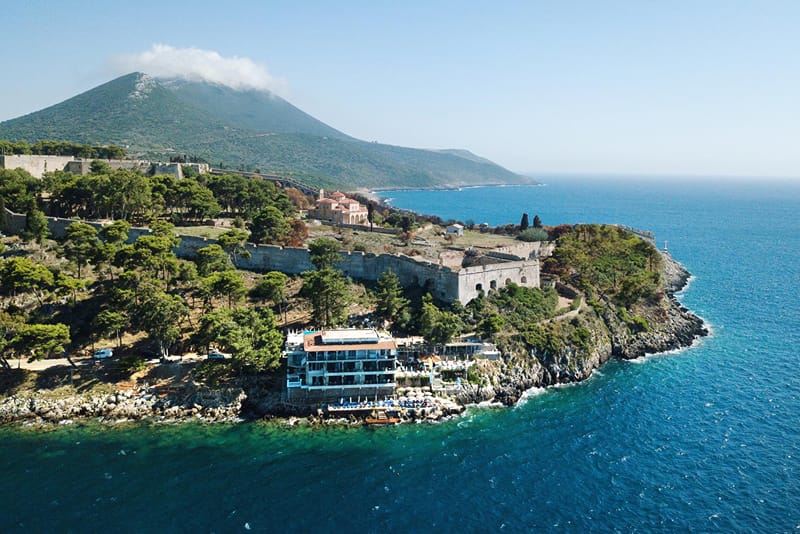
Karalis Beach Hotel
Seventeen renovated rooms built literally by the sea below the castle, with balconies looking over the bay of Navarino and a roof café-restaurant.
View on TRVL ↗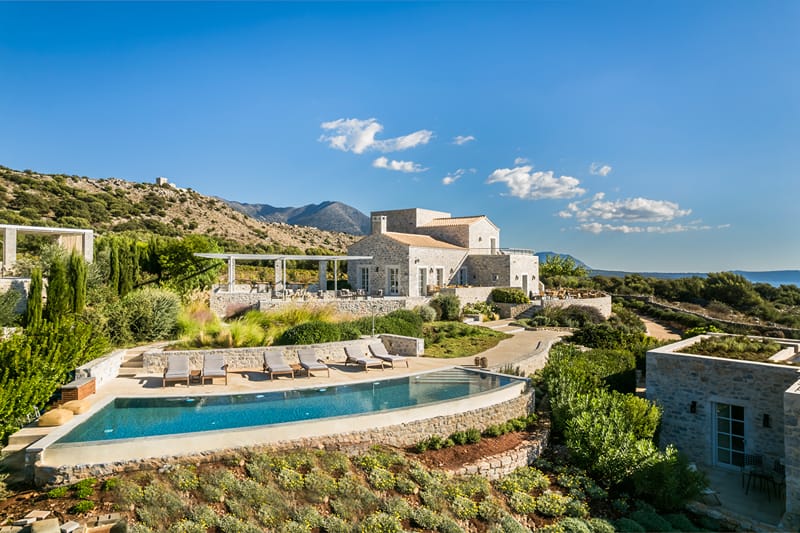
Aria Estate Suites
Sixteen apartment-style suites built in 2018 with local materials and building techniques, with complete privacy and views of the Messinian Bay.
Read articleThe Essence
Messinia gives you the whole southern Peloponnese in one place. A city morning at the market and a swim off Navarinou, an afternoon among the columns of Messene, a drive down the Mani coast to Kardamyli’s towers, a sunset over the omega of Voidokilia. In between, a plate of olives, siglino and lalangia, and a glass of ouzo under the plane trees. Come in summer for the dance festival and the warm sea, or in October, when the beaches empty, the light softens and Pylos remembers Navarino.