
Morning in Naoussa starts at the old harbour, where the fishing boats tie up beside the half-sunken walls of a Venetian fort and the former fishermen's warehouses have become tavernas. Naoussa claims the largest fishing fleet in the Cyclades, and you taste it at lunch. An hour later you can be in Lefkes, high in the middle of the island, setting off on foot down a marble-paved path that has linked two villages for more than a thousand years.
Paros is the island of Parian marble, the fine, almost translucent stone of the Venus de Milo and of Praxiteles' Hermes, and it still turns up everywhere: in churches, old paths and the walls of the castle in Parikia. This guide is for planning a trip that uses all of it: the capital and its great Byzantine church, the fishing port, the mountain villages, the beaches sorted by the summer wind, and the short crossing to Antiparos.
The Areas
Parikia is the capital, the main port and the centre of everything practical. The ferries, the bus station, the Archaeological Museum and the church of Panagia Ekatontapyliani are all within a few minutes of the quay, and the old town climbs behind them to Kastro hill. It suits travellers who come by boat, want to island-hop, or prefer to have restaurants and buses on the doorstep. Beaches such as Livadia, Krios and Parasporos are close by.
Naoussa, on the north coast, is the second town and the one most people fall for: a fishing port with Venetian architecture, a busy harbour front and a long evening. It is the base for the beaches of Naoussa bay, Kolymbithres among them, and for the best of the island's eating. Ampelas, a small fishing village a few kilometres to the east, is the quieter alternative.
Lefkes is the highest of the large inland villages, built like an amphitheatre beneath a pine-covered hill, with many lanes closed to cars. It suits walkers and anyone who wants cooler evenings and a slower pace. Below it on the east side, Marpissa is a large village convenient for the east-coast beaches, and Piso Livadi, its small harbour, has rooms, tavernas, a bit of nightlife and boats to nearby islands. Logaras beach is next door. Further south, Drios and Golden Beach are the windsurfing coast, and Aliki, a fishing village turned resort, is sheltered from the wind and well suited to families.
Antiparos, less than 2 km across the strait from Pounta, has its own small town and a population of about 1,265. It is a day trip for most visitors and a base in its own right for those who want a smaller island next to a bigger one.

What to See and Do
Start with Panagia Ekatontapyliani in Parikia, one of the most important early Christian monuments in Greece. Legend says Saint Helen, mother of Constantine the Great, was caught in a storm off Paros on her way to the Holy Land and vowed to build a church here; her son took up the task. The church was renovated in the 6th century, when the dome was added, and ancient marble was reused over the centuries. Do not miss the 4th-century baptistery with its cruciform font, one of the best preserved in the Orthodox east. The name means the church of a hundred doors: 99 are visible, the story goes, and the hundredth is hidden. The Byzantine Museum of Paros, with its icons, is inside the complex.
A short walk away, the Archaeological Museum holds Archaic and Classical sculpture and finds from the Neolithic to the Roman period, including the 'Fat Lady' from Saliagos, dated to about 5000 BC, and a fragment of the Parian Chronicle. Above the seafront, the walls of the Venetian castle were built almost entirely from the marble of an ancient temple, column drums and all.
In Naoussa, walk out to the little fort at the harbour mouth and visit the Folklore Museum near the main square, which shows the collection of Dr Othon Kaparis. In Lefkes, the church of Agia Triada, built of Parian marble in 1835, has two bell towers and views over the east coast. Marpissa has a folklore museum founded by the village women's association and the Nikos Perantinos Sculpture Museum, and the monastery of Agios Antonios sits on top of Kefalos hill above it.
On Antiparos, the Cave of Antiparos has been used as a shelter since the Neolithic; the church of Agios Ioannis Spiliotis stands at its entrance, and around 340 steps lead down into the chamber. In the town, a wall survives of the castle built in 1440 by Giovanni Loredan. Off the southwest coast, the islet of Despotiko holds the remains of a Doric temple of around 500 BC, under excavation since 1997.

Beaches and the Wind
From about mid-May to mid-September, the meltemi blows from the north across the central Aegean, at its strongest in the afternoon and often easing at night. On Paros it decides the beach day. On a windy day, head for a sheltered bay; on a still one, the open north and east coasts are at their best.
The great sheltered swim is Kolymbithres, on Naoussa bay, where granite rocks worn by salt, water and air break the shore into a string of sandy coves. The water is calm, warm and very shallow, so it is ideal for small children, and you can reach it by boat from Naoussa or by road. Agia Irini, about 4 km south of Parikia, is a closed bay with fine golden sand, tall pines and a small taverna. Aliki, on the southwest coast, is sheltered too.
Close to Parikia, Livadia is a long organised beach just north of the old port, and Krios and Marcello, across the bay, can be reached by boat from Parikia; Krios has shade under big pines. Parasporos, 2.5 km south of town, is long and sandy, and lively with waves when the north wind blows. Near Naoussa, Piperi is a family beach within walking distance of the port.
On the east coast, Golden Beach (Chryssi Akti) is the island's largest beach, a Blue Flag beach with surf clubs, and New Golden Beach (Tserdakia) next door has hosted world windsurfing championships; both have instructors for beginners. Pounta, on the east coast, is the island's young, sporty beach, where winds converge. Tsoukalia and Glyfades face the summer wind and often have waves, which is why windsurfers like them. Logaras, beside Piso Livadi, is a large sandy beach with turquoise water and pine shade, good for families; Molos is vast and open, and Lolantonis, reached by a path down from a hilltop taverna, is one of the most unspoiled.

What to Eat and Drink
Parian cooking is built on the sea and the land, cooked in olive oil and served with local wine. The dish to look for is gouna, mackerel salted and dried in the sun. Revithada, chickpeas baked slowly in a clay pot, is another island classic, and kakavia is the fish soup. Order octopus marinated in vinegar at an ouzeri in Naoussa, and ask about the local cheeses: soft, creamy xinomyzithra and salted toumoumi. Wild greens gathered from the hills turn up on the table too.
Paros makes white wine from the Monemvasia grape, produced by the Moraitis and Asteras wineries. The Moraitis winery in Naoussa was started in 1910 by Manolis Moraitis, and visits can be arranged by email.
For a feast, follow the calendar: the Wine and Fish Festival in Naoussa is held on the first Sunday of July, Pirate Night (Koursariki Nychta) on 23 August brings a staged raid, fireworks and a seafood feast to the harbour, Parikia celebrates 15 August with music and dance after the procession at Ekatontapyliani, and Lefkes holds the Karavolas feast, with snails, wine and dancing until dawn, in late August.
Getting There and Around
Paros Airport (PAS) is about 9 km southwest of Parikia, at Voutakos Agkairias. Flights from Athens take about 45 minutes, and from Thessaloniki about 1 hour 15 minutes.
Parikia is the main port, served all year from Piraeus and Rafina. From Piraeus there are up to six crossings a day with Blue Star Ferries and Seajets, taking between about 2 hours 40 minutes and 5 hours depending on the boat. Rafina is the closer port if you land at Athens airport. Paros is also a hub for onward boats to Naxos, Santorini and the other Cyclades. In summer, boats leave Naoussa for day trips to Mykonos, Tinos, Delos and Naxos.
For Antiparos, the car ferry from Pounta, south of Parikia, runs all year about every 30 minutes and takes about 10 minutes; in summer the last boat back to Pounta leaves Antiparos at 2 am. In summer a passenger boat also runs from Parikia.
KTEL Paros buses leave from the station next to the port in Parikia, with main routes to Naoussa and Aliki and onward stops in the villages. In summer the Naoussa route runs into the early hours. A hire car or scooter makes the beaches and inland villages much easier; book automatics ahead.
When to Go
June and September are the sweet spots: the sea averages about 22°C in June and 24°C in September, the island is fully open, and there is room on the beaches. July and August are hotter and busier, with the strongest meltemi, the festivals and the island at full volume; around 15 August, Parikia is especially full.
The shoulder seasons suit Paros well because the ferries run all year. In May the sea is still cool, at about 19°C, but the hills are green and good for walking; in October it is still around 21°C. The island's 35 km network of walking trails, the Byzantine path among them, is at its most pleasant outside the heat of high summer.
Good to Know
- Check the wind forecast in the morning and choose your beach by it: sheltered bays when the meltemi blows, the open coasts when it drops.
- Book your first night ahead, especially if you arrive late or in strong wind; the port can be hectic.
- Inspect rental scooters, quads and cars before signing, and ask exactly what the insurance covers.
- Walk the Byzantine path downhill, from Lefkes to Prodromos, and arrange a bus or taxi back up.
- Bring water and good shoes for the Antiparos cave: what you walk down, you climb back up.
- Book dinner in Naoussa in July and August; the popular tables fill early.
Our Picks
- To seePanagia Ekatontapyliani
The church of a hundred doors, with a 4th-century baptistery and the Byzantine Museum inside the complex.
- To seeArchaeological Museum of Paros
Parian marble sculpture and the Neolithic 'Fat Lady' of Saliagos, a few minutes from the port.
- To walkThe Byzantine path
3.5 km of marble paving, about 45 minutes and almost all downhill, past olive groves, windmills, fountains and bridges.
- To swimKolymbithres
Sandy coves between sculpted granite rocks, with calm, shallow water when the wind is up elsewhere.
- To seeCave of Antiparos
A deep cave entered beside the church of Agios Ioannis Spiliotis; go early in the day.
- To eatOuzeri Halaris
Octopus, seafood pasta and meze, with fish from the restaurant's own boats.
- To eatSweet Smelling Kitchen
Homemade pies and slow-cooked meats on a terrace, in the village since 1995.
- To eatTsachpinis
A traditional taverna with hand-made pies and oven-roasted lamb on Sundays.
- To drinkKallitexniko Kafeneio
Homemade meze and local wine at the bottom of the Byzantine path, with rebetiko on Sundays.
- To drinkMoraitis Winery
A family winery since 1910 and the place to taste Parian Monemvasia; arrange your visit by email.
Where to Stay
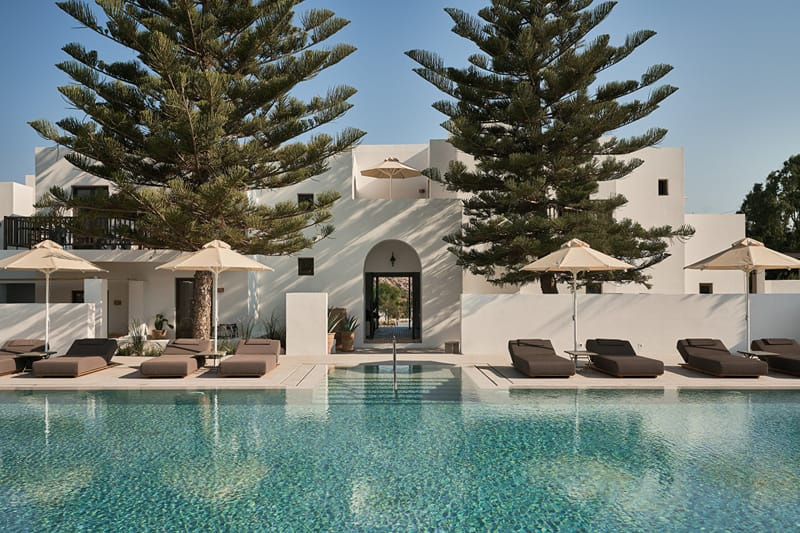
Parilio Hotel Paros
46 suites and villas designed by Interior Design Laboratorium and informed in their entirety by this north-western corner of the island, its landscape, history and mythology.
Read article
Andronis Minois Paros
44 renovated suites, an ESPA spa and a sea-view restaurant, a member of Small Luxury Hotels of the World, about 10 minutes from the airport.
View on TRVL ↗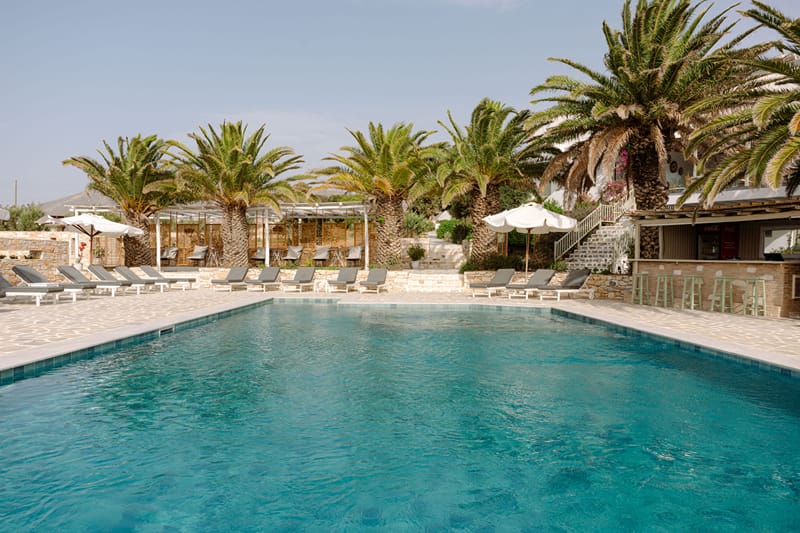
Pnoi Hotel Paros
A small, private hotel with rooms that combine traditional architecture with modern touches, overlooking the Blue Flag beach of Logaras.
View on TRVL ↗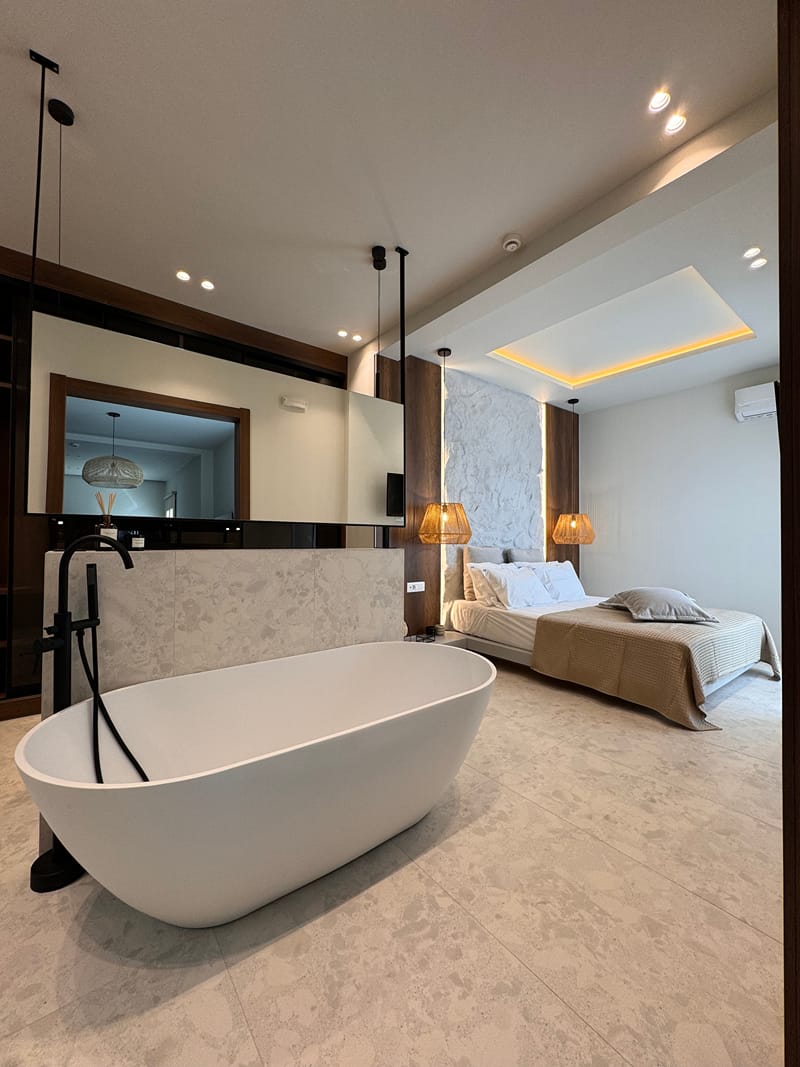
Poema Antiparos
Eight independent residences of wood and stone a few minutes from Antiparos village, some with small private pools on the balconies.
View on TRVL ↗The Essence
Paros rewards the traveller who moves around it. Spend a morning in the cool of Ekatontapyliani, walk down the marble path from Lefkes to a coffee in Prodromos, swim wherever the wind allows, and end the day at the harbour in Naoussa with gouna and a glass of island Monemvasia. Take the ten-minute boat to Antiparos once, at least. Few islands give you this much variety within an hour's drive, and the marble under your feet is the thread that ties it all together.