
Morning at Meteora starts with the rocks. Grey sandstone pillars stand straight up from the edge of the Thessalian plain, the light moves down their faces, and on the summits sit monasteries that seem to have grown out of the stone. Six of them are still home to monks and nuns, and they are open to visitors on a weekly rhythm of their own.
The pleasure of a trip here is how close it all is. You can sleep at the foot of the rocks in Kalambaka or Kastraki, walk up old monastic paths in the morning, climb a few hundred steps to a frescoed church, and be back in a village taverna by lunch. Come in autumn or winter and the crowds thin, the mist settles between the pillars and the place feels closer to what the monks came for.
The Areas
Almost everyone stays in one of two places, and they sit side by side at the foot of the rocks. The choice comes down to whether you want a small town with services or a village with the rocks over your roof.
- Kalambaka — the town at the foot of the rocks, on the bank of the Pinios river and the gateway to Meteora. It has the bus station, most of the shops and restaurants, the Byzantine Church of the Dormition and the Natural History Museum. Good for travellers without a car and anyone who wants choice in the evening.
- Kastraki — the neighbouring village on the western approach, right below the pillars. Quieter, with the Doupiani chapel, the Holy Spirit rock and the start of the old paths up to the monasteries on its doorstep. It suits walkers, climbers and couples, but note that it is very quiet in the off-season and many businesses close for winter.

What to See and Do
The monasteries come first. Monastic life here took shape in the 14th century, when the monk Athanasius the Meteorite arrived from Mount Athos and founded a community on the broadest rock; at its height Meteora had 24 monasteries. Six remain active today, together forming the second-largest monastic community in Greece after Mount Athos. Meteora was inscribed as a UNESCO World Heritage Site in 1988, for both its culture and its nature.
Great Meteoron, Athanasius' foundation, is the largest, on the tallest rock, with a long winemaking tradition and a vineyard revived since 2013. Varlaam, named after the ascetic Varlaam, has the church of All Saints and is reached by 195 steps. Holy Trinity, with roots in the mid-14th century, is the most secluded: 149 steps lead up to it, and a chapel of St John the Baptist is carved into the rock. Roussanou, on a cliff about 60 metres high, and St Stephen's are both communities of nuns; St Stephen's, reached by a stone bridge from the road, is the easiest to visit. St Nicholas Anapafsas, the first you meet coming up from Kastraki, has wall paintings by the painter Theophanis Strelitzas Bathas.
Each monastery closes on its own day, and the timetable changes with the season. In the summer timetable (1 April to 31 October), Great Meteoron opens 09:30–15:00 and closes on Tuesdays; Varlaam 09:00–16:00, closed Fridays; Roussanou 09:00–16:30, closed Wednesdays; Holy Trinity 10:00–16:00, closed Thursdays; St Stephen's 09:00–13:30 and 15:30–17:30, closed Mondays; St Nicholas Anapafsas 09:00–17:00, closed Fridays. From 1 November to 31 March, Great Meteoron closes Tuesday to Thursday, Varlaam closes Thursdays and Fridays, Roussanou shortens to 09:00–14:00 and St Nicholas to 09:00–16:00. The monasteries set their own hours and can change them without notice, especially around religious holidays, so check before you go. Entry is €5 per person at each monastery, in cash; children up to 12 enter free.
Down in Kalambaka, the Byzantine Church of the Dormition stands at the foot of the Agia cliff, built in the 10th or 11th century over an early Christian basilica, with a marble pulpit and wall paintings whose oldest layer dates to the late 11th or early 12th century. The Natural History Museum of Meteora shows more than 350 species of mammals and birds in dioramas, plus around 250 species of mushroom, and runs truffle hunting. A few kilometres outside town, Theopetra Cave, with traces of human presence going back about 130,000 years and rare Middle Palaeolithic footprints, has reopened to visitors along with its museum.

Paths Between the Rocks
Before the roads, the monks walked, and their paths are still there. The classic climb starts in Kastraki's central square, passes below the rock church of Agios Georgios, crosses the road and follows an old stone-paved path up past the Drakospilia to a fork: one branch to Great Meteoron, the other to Varlaam. It is about 2.2 km with 250 metres of ascent, roughly an hour and ten minutes.
For a longer day, a 13.8 km route starts at the Holy Trinity car park and follows stone paths down to Kalambaka and its Church of the Dormition, then on to Kastraki, with more descent than climb. A 4 km path from the Doupiani rock passes Kreni Petra, with its old hermitages, and the Ypapanti monastery on its way up to Great Meteoron. Shortest of all, the marked trail from Kastraki to the Holy Spirit rock takes about 20 minutes, with a ruined chapel in a cave at the top and views over the village, the plain and the Pindos mountains; it is steep and exposed near the end and needs a good level of fitness.
The rocks are also one of Greece's best-known climbing areas. Doupiani is the most famous spot, used for abseiling with 20-metre ropes, and climbers usually start from Kastraki. Beginners should go with an experienced local guide and rented equipment. Each year on St George's feast, climbers hang coloured scarves on the chapel of Agios Georgios Mandilas, high on its rock above Kastraki.

What to Eat and Drink
The cooking here belongs to the mountains as much as the plain. The Vlach communities of the Pindos left a cuisine of wild herbs, mushrooms, river trout and lamb, and in Kalambaka Valia Calda builds its menu on it: walnut balls, lamb with traditional pasta, black pig with mountain mushrooms, and giant beans with leeks from a Meteora monastic recipe, alongside local wines and a smoked, unfiltered microbrew.
Mushrooms and truffles are a local subject in their own right: the Natural History Museum's mushroom section is the first of its kind in Greece, the town holds an annual Mushroom Festival, and the museum sells its own mushroom pasta, soups and truffle pastes. For something sweet, Rombos Patisserie in Kalambaka has been making halva since 1924. And look for wine from the monasteries' own tradition: the Great Meteoron vineyard dates back to the 14th century, and its old cellar still holds wooden barrels.
Getting There and Around
Kalambaka is in central mainland Greece. KTEL intercity buses connect it with Athens in about 4.5 to 5 hours, with Thessaloniki in about 3 to 3.5 hours, and with Trikala, from where a local bus runs roughly hourly and takes about 45 minutes; some Athens services need a change in Trikala. The rail branch from Palaiofarsalos to Kalambaka has been out of service since storm damage in 2023, with a reopening expected; check Hellenic Train's timetable before planning around it.
A local bus leaves Kalambaka bus station a few times a day for Kastraki and the six monasteries, about €2 a ride or €5.50 for a day ticket. The timetable is not published online, so ask at the station. The monastery loop by road is about 25 km and takes under an hour of driving without stops; a car gives you the most freedom, and in high season it pays to arrive before 9am, since 10am to 2pm is the busiest time for parking.
When to Go
Spring and autumn are the best seasons for walking; summer is hot by midday, and winter trails can be slippery. October brings crisp mornings and golden afternoons, and after the national holiday on 28 October the crowds drop sharply. From then until mid-December is one of the calmest periods of the year, and March, May and late October to November are the best months for hiking.
Winter is quiet, moody and sometimes snowy, with mist hugging the rocks; on a few days a year snow covers the cliffs and the monasteries. It is a beautiful time for the views and for the monasteries themselves, which stay open on the winter timetable, but fog can hide the pillars for hours, and some outdoor activities are cancelled when the weather turns. Easter week and September to late October are the busiest times; if you come then, the trails are emptiest between 6:30 and 8:30 in the morning, and day-trippers thin out after 3:30 in the afternoon.
Good to Know
Dress for the monasteries: men need long trousers, women skirts below the knee and covered shoulders, and sleeveless tops are not allowed for anyone. Wrap-around skirts are available at the entrances, but there is nothing for men, so carry long trousers in your bag. Bring cash for the entrance fees. Speak softly inside, follow the signs on photography, which some monasteries restrict, and stay out of spaces marked private. Plan your days around the closing days; in winter, Great Meteoron is open only from Friday to Monday. Wear proper shoes, as every monastery except St Stephen's involves steps or uphill walking.
Our Picks
- To seeGreat Meteoron
The oldest and biggest of the monasteries, founded by Athanasius the Meteorite; in winter go Friday to Monday.
- To seeSt Stephen's Monastery
A community of nuns with an iconostasis dated 1814, and the easiest monastery to visit; closed on Mondays.
- To seeHoly Trinity Monastery
The most secluded of the six, 149 steps up, with a chapel carved into the rock; closed on Thursdays.
- To seeChurch of the Dormition
A Byzantine church at the foot of the Agia cliff, with a marble pulpit and frescoes from the late 11th or early 12th century.
- To seeTheopetra Cave
Traces of human life going back some 130,000 years, newly reopened with its museum; closed on Tuesdays.
- To walkKastraki to Great Meteoron
The old stone path of the monks, about 2.2 km and an hour and ten minutes uphill.
- To walkHoly Spirit rock
A steep 20-minute climb to a cave chapel with views over the village, the plain and the Pindos.
- To eatValia Calda
Vlach mountain cooking with monastic recipes, mountain mushrooms and local wines; open daily.
- To seeNatural History Museum of Meteora
Hundreds of species of animals and mushrooms, and truffle hunting to book.
Where to Stay
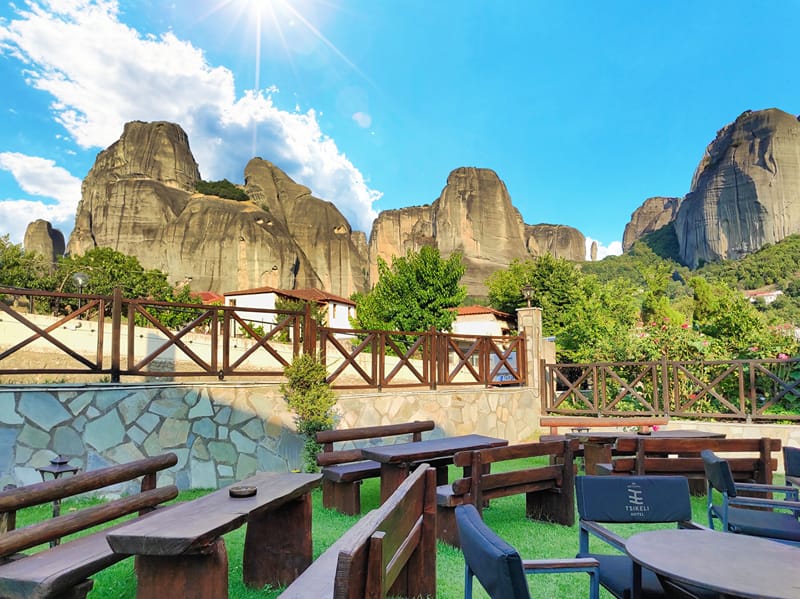
Tsikeli Boutique Hotel
An adults-friendly, eco-friendly hotel at the foothills of the Meteora rocks, blending traditional architecture with modern aesthetics in earthy tones, stone walls and woodwork.
View on TRVL ↗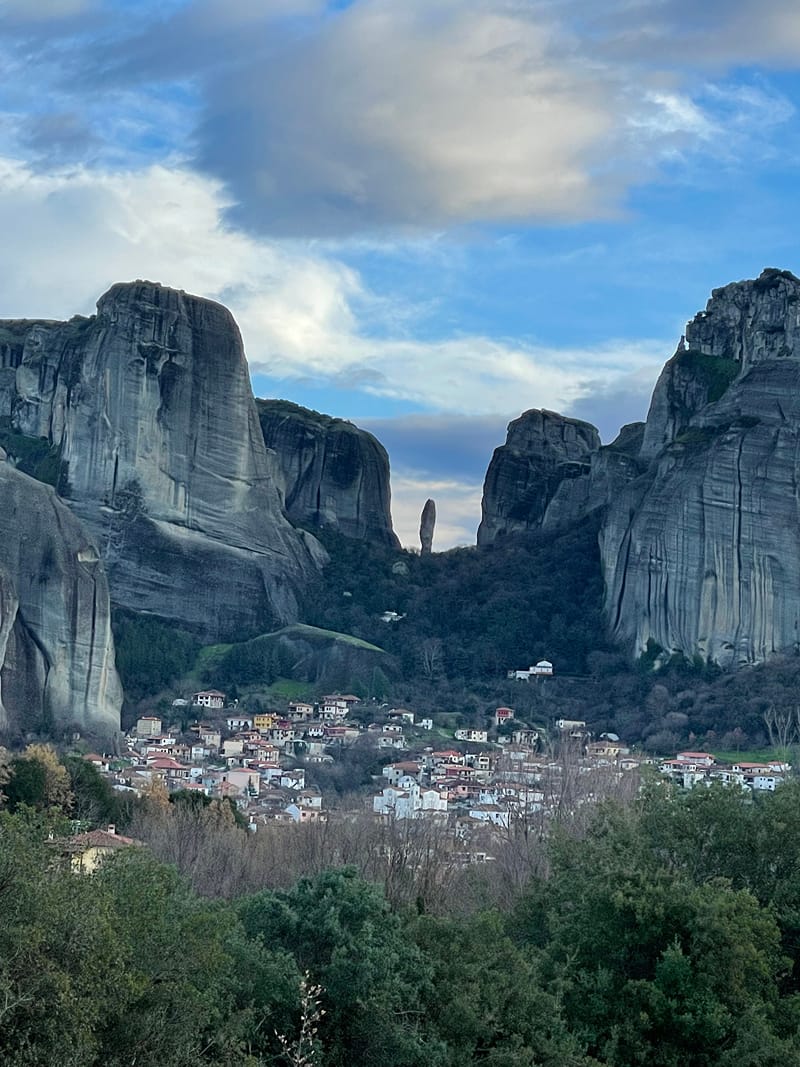
Archontiko Mesohori
A 19th-century mansion on the old square of Kastraki, renovated in 2006, with six two-room apartments and a green garden with views.
View on TRVL ↗
Theatro Hotel Odysseon
A fully renovated four-star boutique hotel just beneath the imposing rocks, with a view of Meteora and easy access to the sights.
View on TRVL ↗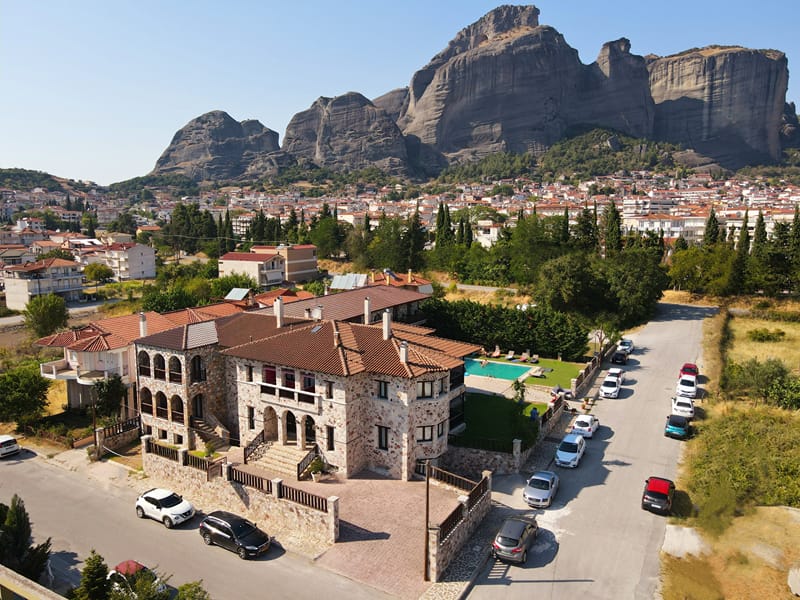
Monastiri Guesthouse
A stone-built guesthouse a short walk from the town centre, with rooms in modern or traditional style, some with rare monastery furniture, and an outdoor pool overlooking the rocks.
View on TRVL ↗The Essence
Meteora rewards the visitor who slows to its pace. Climb to one monastery in the morning and another after lunch, walk the paths the monks used before there were roads, eat mushrooms and mountain lamb in Kalambaka, and watch the evening settle on the pillars from a terrace in Kastraki. Come when the season turns, when the mist lifts off the rocks one by one, and you will see why people chose to live up there in the first place.