
Morning in Thessaloniki starts with a paper bag of bougatsa, still warm, and a sesame koulouri from a street-corner stand. By noon the old market lanes behind Aristotelous Square are loud with fishmongers and spice sellers; by evening the ouzeries of Ladadika have their tables out, and the long seafront fills with people walking nowhere in particular. It is a city that eats well, often and late, and makes no fuss about it.
Under all that appetite lie two thousand years of building. A Roman emperor's palace quarter, fifteen early Christian and Byzantine monuments on the UNESCO list, Ottoman walls climbing to a hilltop old town: they are not fenced off from daily life but woven into it, between bakeries and bus stops. And because Thessaloniki is a working city rather than a seasonal resort, it stays open and lively all year, with a new metro that makes it easier to get around than ever.
The Areas
The centre is compact and walkable, and most visitors stay between the seafront and Egnatia Street. The hill above it and the seaside suburbs to the southeast offer a different pace.
- Aristotelous Square and the centre — the grand square running up from the sea to Egnatia Street, laid out to a plan by the French architect Ernest Hébrard after the Great Fire of 1917. The old markets, the main shopping streets and the waterfront are all on the doorstep. The natural choice for a first visit.
- Ladadika — the old oil-market district near the port, one of the areas that survived the 1917 fire. Its wholesale shops were turned into tavernas and bars from the 1990s, and its pedestrian lanes are now the city's busiest place for an evening of ouzo and small plates. Lively and central; expect noise late at night.
- Ano Poli — the Upper Town, inside the walls on the hill: cobbled lanes, small houses and mansions in the Macedonian style, Byzantine churches, the Vlatadon Monastery and views over the whole gulf. Suits walkers and anyone who wants quiet evenings, with a downhill walk to the centre.
- The Rotunda and the Arch — the streets around Galerius' Roman monuments, inside the centre. Good for anyone who wants to step out of the door and into the city's history.
- Kalamaria — the seaside district to the southeast, with the marina at Aretsou and fish tavernas along the shore at Nea Krini. Since the metro extension opened in August 2026 it is a short ride from the centre, which makes it a calmer base for families and repeat visitors.

What to See and Do
Start with the Romans. Around AD 299 the emperor Galerius made Thessaloniki his seat and built a palace quarter covering more than 150,000 square metres. Its pieces are still scattered across the centre: the triumphal Arch of Galerius, known to everyone simply as the Kamara; the Rotunda, a massive round building of the early 4th century that was later converted into a church; and the remains of the palace itself. A few streets west, the Roman Forum was built in two phases in the 2nd and 3rd centuries AD. You can walk its square, see the small odeon that still hosts events, and go underground into the vaulted cryptoporticus, where a museum displays finds from the site.
The Byzantine city is everywhere. In 1988 UNESCO listed fifteen of its early Christian and Byzantine monuments. Hagios Demetrios stands over the ruins of a Roman bath, where the saint was martyred in 303. Hagia Sophia dates from the late 7th century and was modelled on its namesake in Constantinople. Look also for the Acheiropoietos basilica, the red-brick Panagia Chalkeon, built in 1028, and Hosios David in Ano Poli, a late 5th-century church famous for its mosaic of Christ.
Two museums bring it all together. The Archaeological Museum, on Manoli Andronikou Street, covers Macedonia from prehistory to late antiquity and includes a permanent exhibition on the gold of the Macedonians. The Museum of Byzantine Culture presents the Byzantine world across eleven permanent halls, from daily life and worship to art and trade, with exhibits mostly from Thessaloniki and Macedonia.
Then head for the water. The White Tower, built in the late 15th century on the site of an older Byzantine tower, now holds a six-floor exhibition on the city's history since its founding in 316/315 BC, and its rooftop looks over the Thermaic Gulf. From the Tower the seafront promenade runs for about five kilometres between the port and the Concert Hall, lined on the inland side by thirteen themed gardens.

Ano Poli and the Walls
The best afternoon in Thessaloniki is a slow climb. Start near Agios Dimitriou Street and walk uphill: the apartment blocks give way to narrow cobbled streets, flower-filled gardens, small houses and mansions in the Macedonian style. On the way you pass Saint Catherine's Church, the Church of Saint David and Agios Nikolaos Orfanos, all part of the UNESCO listing, as well as the Alatza Imaret, an Ottoman building, and the Vlatadon Monastery, founded in the 14th century and the only Byzantine monastery in the city still in use.
At the top are the walls. Building began in the late 4th century, on top of earlier Hellenistic and Roman fortifications, and the circuit once ran for about eight kilometres. The fortress of Eptapyrgio, or Yedi Kule, stands at the northeastern corner of the acropolis; nearby, the Trigonion Tower is the classic place to watch the sun go down over the city and the sea. Small squares with traditional cafés and tavernas wait for you on the way back down.

What to Eat and Drink
In 2021 Thessaloniki became the first Greek city to join UNESCO's Creative Cities Network as a City of Gastronomy, and the title fits. Its cooking carries the traces of everyone who has lived here, from Sephardic Jews and Armenian traders to refugees from Asia Minor and newcomers from the Balkans and the Black Sea.
The day begins with bougatsa, the city's signature: layers of crisp filo filled with cheese, with sweet cream dusted with sugar and cinnamon, or with minced meat, sold in bougatsa shops that keep long hours. Koulouri, the sesame bread ring, is sold on street corners all year. For something sweet, trigona Panoramatos are filo cones soaked in syrup and filled with cream, named after the hillside suburb of Panorama.
At lunch and dinner the city eats in company. Ouzeries and tavernas line the pedestrian streets and arcades of Ladadika and the market quarter, each with its own specialities: charcoal-grilled sardines, stuffed squid, meatballs, salads with sesame and pomegranate. Mussels are a local passion, served in a spicy sauce or cooked into a pilaf. For the market itself, Kapani, also called Vlali, is the oldest open market in the city, with produce, spices, olives, fish, meat and old coffee shops, many run by the same families for two or three generations. Next to it, Athonos Square has spice and food shops and restaurants used by locals and students alike.
Winter has its own menu. Patsas, tripe soup, is served in dedicated restaurants, especially late at night and in the cold months, and salepi, a hot drink made from orchid flour, is the city's answer to a chilly morning.
Getting There and Around
Thessaloniki's airport, Makedonia, lies about 15 km southeast of the centre. Airport bus 01X runs to the centre roughly every half hour, and its night version, 01N, keeps the link going around the clock; the ticket for the airport lines costs €2.00. A taxi takes around 20 minutes to the centre and costs roughly €15–20 by day, with a surcharge at night.
The metro is the city's newest pleasure. Line 1 opened on 30 November 2024 between the New Railway Station and Nea Elvetia, and on 27 August 2026 a branch with five new stations, Nomarchia, Kalamaria, Aretsou, Nea Krini and Mikra, opened towards the southeast, bringing the network to eighteen stations. For visitors it links the railway station, the centre and the seaside district of Kalamaria. Trains run from 05:15 to 00:30, and until 02:00 on Fridays and Saturdays. A single ride costs €0.60 and a 24-hour ticket €2.50, bought from machines in the stations. The metro does not run to the airport.
City buses cover everything else, with an urban ticket at €0.60 valid for 70 minutes. In the centre, though, the best way to get around is on foot.
When to Go
Thessaloniki works in every season. May and late September are warm without being heavy, with average highs of around 25–27°C and a sea already over 18°C in May. July is hot, with average highs above 30°C, and August is busy, so book ahead. October is mild, with highs around 22°C, and is one of the best months for festivals; the Thessaloniki International Film Festival follows in November, running from 5 to 15 November in 2026.
Winter is the city's best-kept argument. December and January are cold and damp, with highs around 10–11°C and the occasional cold northerly wind, the Vardaris, blowing down from the Balkans. But this is when Thessaloniki feels most itself: museums are quiet, the Roman sites are open on shorter winter hours, the markets and bougatsa shops run as usual, and evenings are made for patsas, salepi and long dinners in Ladadika. Pack a warm coat and you will have the city largely to yourself.
Good to Know
The Roman Forum and the Galerian Complex with the Rotunda close on Tuesdays, and from November to March they open 08:30–15:30; entry is free on the first and third Sunday of each month in that period. Metro tickets are sold only from the machines in the stations. The airport buses use their own ticket, separate from the ordinary city fare. The centre is flat by the sea and steep in Ano Poli: comfortable shoes help, and taking the bus or a taxi up and walking down is the easy way round.
Our Picks
- To seeThe Rotunda and the Arch of Galerius
The heart of a Roman emperor's palace quarter; closed on Tuesdays.
- To seeRoman Forum
A Roman square with its odeon and an underground museum in the old cryptoporticus, eight minutes on foot from Aristotelous.
- To seeMuseum of Byzantine Culture
Eleven halls that make sense of the churches you will see around the city.
- To seeWhite Tower
The city's story on six floors, ending on a rooftop over the Thermaic Gulf.
- To walkAno Poli to the Trigonion Tower
Cobbled lanes, Byzantine churches and the walls, timed to arrive at sunset.
- To walkThe seafront promenade
About five kilometres of sea and themed gardens, best in the evening.
- To eatKapani market
The city's oldest market for olives, spices and a quick meze in the lanes; go in the morning.
- To eatOlympos Naoussa
A historic waterfront restaurant, reopened after three decades, with modern Greek cooking under chef Dimitris Tasioulas; book online.
- To eatTrigona Elenidis
The syrup-soaked cream-filled filo cones of Panorama, made to the family recipe since 1960.
Where to Stay
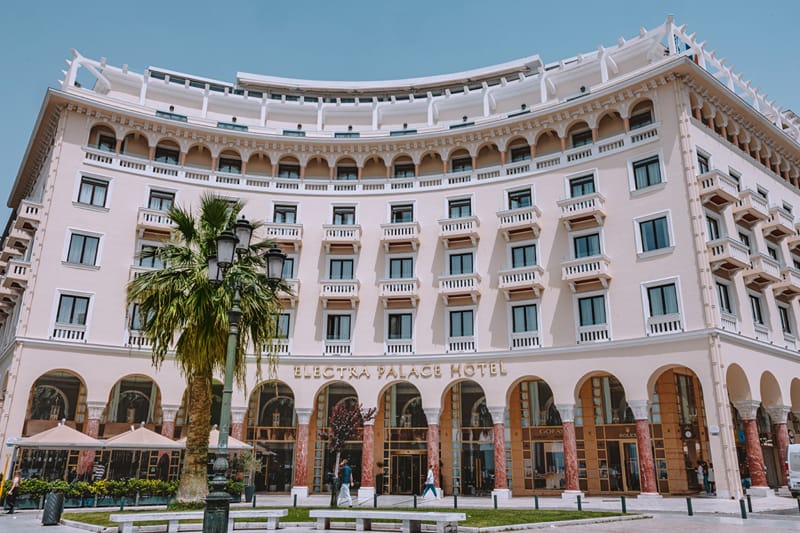
Electra Palace Thessaloniki
A hotel as legendary as its location on Aristotelous Square overlooking the sea, with works by leading Greek artists and a private collection of Russian art shown in collaboration with MOMus.
View on TRVL ↗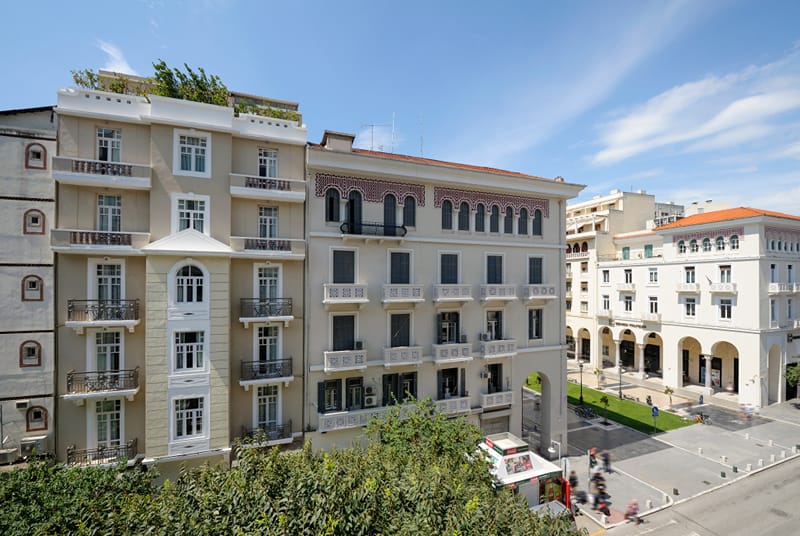
The Modernist Thessaloniki
A strikingly restored 1920s building a few strides from Aristotelous Square, with 41 rooms designed in a minimalist yet sensual style.
View on TRVL ↗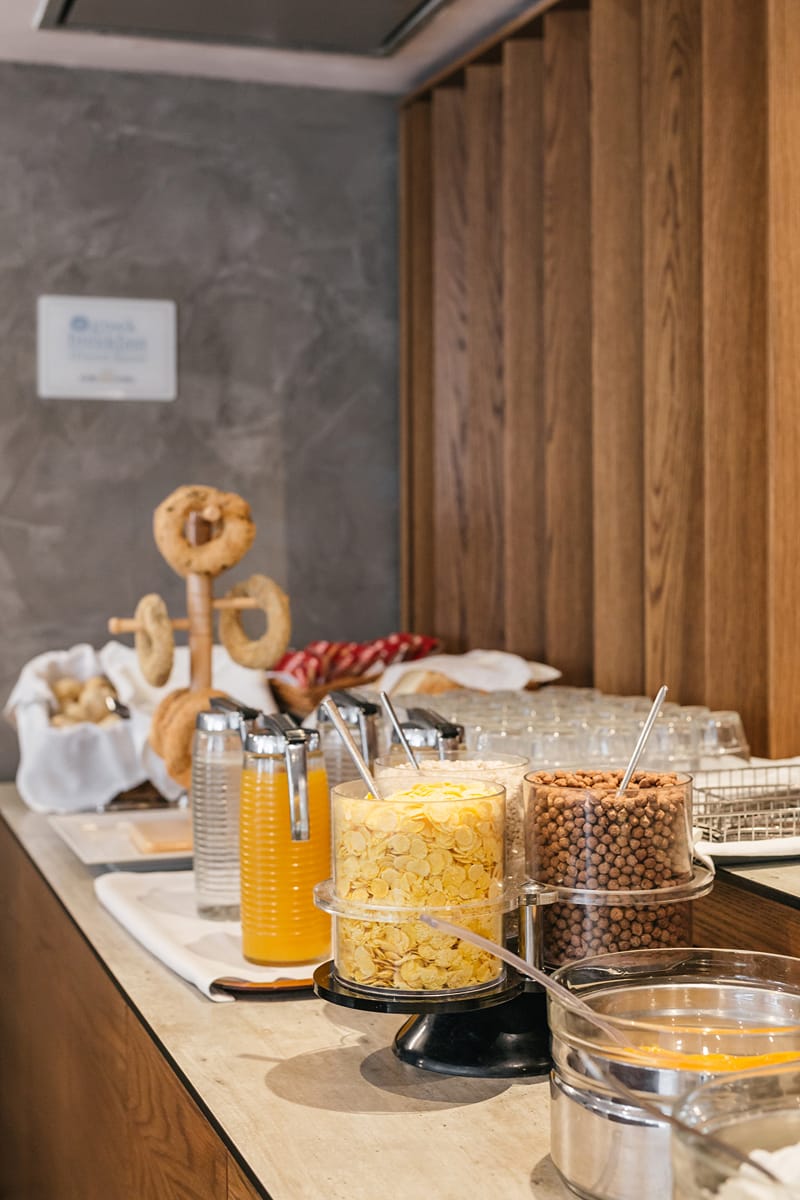
Ladadika Design Thessaloniki
Suites and double rooms with a distinctive design in the Ladadika quarter, a two-minute walk from Aristotelous Square.
View on TRVL ↗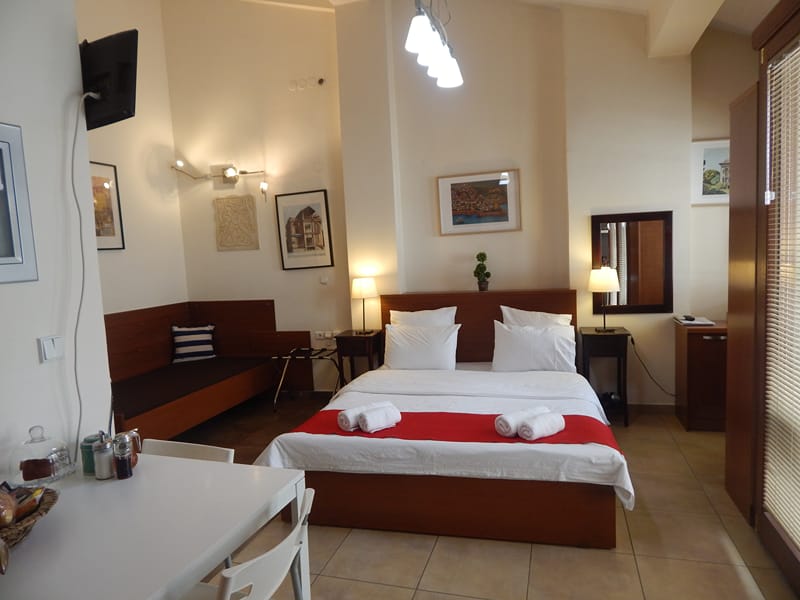
Kripis Studios Thessaloniki
Self-catering studios with balconies in the old part of the city, five minutes on foot from Byzantine churches and museums, with walks along the walls close by.
View on TRVL ↗The Essence
Thessaloniki is a city you taste before you understand it. A slice of bougatsa at the counter, a plate of mussels in a Ladadika arcade, a cone of trigona on the way up the hill: between them sit an emperor's arch, a church built over a Roman bath and walls that still frame the sunset. Come in summer for the sea and the long evenings, or in winter for the quiet museums and the warm soup, and you will find the same thing either way, a city that has been feeding its visitors for two thousand years and still enjoys it.