
Rhodes gives you two islands in one trip. In the north sits a walled town that the Knights of St John built over two centuries, still lived in, with its palace, its hospital turned museum and a maze of lanes inside four kilometres of walls. Beyond it runs a long island of sandy coves, mountain villages, vineyards on the slopes of Attavyros and, near the south, the white village of Lindos under its acropolis.
The weather is generous too. Rhodes counts some 300 sunny days a year, and the sea keeps its summer warmth well into autumn, so October here can still mean long swims and dinners outdoors. Base yourself in the Old Town for history and evenings, on the east coast for beaches, and keep a day free for the boat to Symi.
The Areas
Rhodes is a big island, and where you sleep shapes the trip. The north has the town and the airport; the east coast has the calm, sandy bays; the west is greener, windier and quieter.
- Old Town — the Medieval Town inside the walls, a UNESCO World Heritage Site. Small hotels in restored knights' houses, the museums on your doorstep, and lanes that are at their best early in the morning and after dark. Best for first visits and anyone without a car.
- Ixia and Ialyssos — the resort strip on the northwest coast, between town and airport. Good hotels and long beaches, but this is the windier, stonier side of the island, which suits windsurfers better than swimmers who want flat water.
- Faliraki and Kallithea — on the east coast just south of town. Faliraki is the lively one, with a long beach and a busy night scene; Kallithea, about 9 km from town, is calmer, with coves and watersports.
- Lindos — the village under the acropolis, about 40 km south of town, closed to cars, with a sandy main beach and St Paul's Bay below. Beautiful and busy by day; it suits couples who want to wake up there and see it before the coaches arrive.
- Lardos, Pefkos and Vlicha — the coast around Lindos, with beach resorts and villas. Good for a quieter beach holiday within reach of Lindos.
- Archangelos and the inland villages — Archangelos is the island's second-largest town; villages such as Asklipio, Theologos and Siana show the rural island of orange groves, vines and springs.

What to See and Do
Start inside the walls. The Medieval City was built roughly between 1309 and 1523, when the Knights Hospitaller held the island until Suleiman the Magnificent took it, and it was inscribed by UNESCO in 1988. Walk the full circuit of lanes rather than ticking off sights: past the Clock Tower, through La Juderia, the old Jewish quarter with the Kahal Shalom Synagogue, and up the stone Street of the Knights.
At the top of that street stands the Palace of the Grand Master. The Knights converted a Byzantine citadel into the palace in the 14th century; in 1856 a lightning strike set off a gunpowder store nearby and the explosion brought most of the upper floors down. What you see now was rebuilt under Italian rule between 1937 and 1940, designed by the architect Vittorio Mesturino. Inside are halls paved with mosaics brought from Kos, among them a 2nd-century Medusa. Close by, the Hospital of the Knights, begun in 1440, now holds the Archaeological Museum, whose star is the Crouching Aphrodite, a statue of the 1st century BC.
Lindos deserves a full morning. The acropolis rises over the village, with the Doric Temple of Athena Lindia, built around 300 BC on the site of an earlier temple, and the walls of a Knights' castle raised before 1317. At the foot of the steps, look for the relief of a ship's stern carved into the rock around 180 BC. The climb is tiring in the heat and not accessible for those with limited mobility; donkeys wait at the village entrance. Afterwards, wander the lanes looking for the old captains' houses, then go down to swim.
On the east coast between town and Lindos, Kallithea Springs is a restored spa set by a small bay, with gardens and a beach; there is a small entry fee. In the west, the ruins of the castle of Monolithos sit on a rock above the sea, with a small chapel at the top and one of the best views on the island, and the castle of Kritinia watches over the coast further north.

East Coast, West Coast
The simplest rule on Rhodes: the east coast is mostly sand and calm water, and the west is stonier and windier, which makes it the side for windsurfing and kitesurfing. Plan beach days around that, and check the wind before you choose a side.
Heading south from town, Anthony Quinn Bay is a small bay with two separate beaches and good snorkelling; Faliraki has a long sandy beach; Tsambika is one of the island's best-loved beaches; and at Lindos the main beach lies a short walk down from the square, with St Paul's Bay, where the apostle is said to have landed in a storm, on the other side of the rock. Lindos has some of the few truly sandy beaches on the island, so expect company in summer.
At the very south, about 92 km from town and 40 km from Lindos, Prasonisi is a sandy spit that joins a small cape to Rhodes in summer and turns it into an island in winter. One side faces the Aegean with waves for experienced riders; the other faces the Mediterranean with flat water for beginners. Its predictable winds have made it known for windsurfing and kitesurfing.

What to Eat and Drink
Rhodian cooking is generous and home-style. Look for pitaroudia, fritters made from pureed boiled chickpeas, and lakani, meat slow-cooked in tomato sauce in a wood oven, named after the lidded clay pot it is cooked in. For celebrations Rhodians make melekouni, a sweet of roasted sesame and honey.
The island's drink is souma, a grape distillate sometimes called Rhodian raki or tsipouro. Wine comes from the slopes around Embonas, under Mount Attavyros, at 1,216 metres the island's highest point. The white Athiri grape has been grown here since antiquity and is the heart of the PDO Rhodes white. Wikivoyage's verdict on local wine is short: cheap and excellent.
For a beach lunch, To Nisaki has been serving seafood on the beach at Kolymbia since 1954; in Lindos, Mavrikos sits in a neoclassical building on the main square. Tap water on the island is drinkable.
Getting There and Around
Diagoras International Airport is on the west coast just north of the village of Paradeisi, about 14 km southwest of Rhodes town. From April to October flights arrive from all over Europe; in winter, connections are domestic, mainly from Athens and Thessaloniki. The flight from Athens takes about an hour, from Thessaloniki about 1 hour 20 minutes. Ferries also link Rhodes with the other Dodecanese islands and with the Turkish coast.
Two bus companies share the island: RODA runs the northwest coast, including the airport, and KTEL Rhodes runs the east coast, including Lindos. There is no direct bus from the airport to Lindos; you change in Rhodes town, and the whole trip takes about 2 hours 20 minutes, against about 50 minutes by taxi over 51 km. Taxis are dark blue with white roofs; agree an approximate price before you set off.
To see the villages, the west coast castles and Prasonisi, a rental car makes life much easier. Fill the tank before long drives, as petrol stations can be scarce in the countryside. Lindos itself is pedestrian inside the village, so park on the edge and walk in.
A Day on Symi
Symi lies about 24 km north of Rhodes, and its harbour, Gialos, is lined with colourful neoclassical mansions that climb the slopes from the water. Ferries and fast catamarans leave from the main port of Rhodes, near the Old Town, every day in season. The fastest crossing takes about 50 minutes; slower ships take up to an hour and a half.
Take the morning boat, climb the stairs from Gialos to Chorio for the view back over the harbour, swim, and have lunch by the water. The island's famous monastery is at Panormitis in the south, reached by boat, car or a bus that runs about three times a day from the south side of the harbour. Check return times before you settle into a long lunch.
When to Go
The season on Rhodes is long. Averages at the airport give daily highs of about 28 °C in September, 25 °C in October and 21 °C in November, with the sea at around 27 °C, 24 °C and 21 °C respectively, which means swimming well into autumn. The island counts more than 3,000 hours of sunshine a year.
July and August are the hottest and fullest months. September and October are the sweet spot: warm water, softer light, easier walking in Lindos and the Old Town. In winter, flights are domestic only, but the Old Town is still a lived-in town and the island is at its quietest.
Good to Know
Do the Lindos acropolis early, or late in the afternoon, and carry water; in summer the ticket office runs on time slots, so book ahead on the official Ministry of Culture site. Wear sensible shoes for the polished stones of the Old Town. If you rent a moped, wear a helmet and fill up before setting out. Faliraki is lively at night, so families may prefer it by day. And when choosing a beach, think about the wind: the east coast is the calmer side.
Our Picks
- To seePalace of the Grand Master
The Knights' palace, rebuilt by the Italians in 1937–1940, with floors of Roman mosaics from Kos.
- To seeArchaeological Museum of Rhodes
The 15th-century Hospital of the Knights, home of the Crouching Aphrodite.
- To seeAcropolis of Lindos
The Temple of Athena Lindia, a Knights' castle and a ship relief carved around 180 BC.
- To swimSt Paul's Bay
A sheltered bay below the acropolis, good for a swim after the climb.
- To swimAnthony Quinn Bay
Two small beaches with some of the best snorkelling near town.
- To swimPrasonisi
Flat water on one side, waves on the other, and steady wind for kites and sails.
- To seeMonolithos Castle
Ruins and a small chapel on a rock, with one of the best views on the island.
- To eatTo Nisaki
A seafood tavern on the sand, serving since 1954.
- To eatMavrikos
A table in a neoclassical building on the village's main square.
Where to Stay
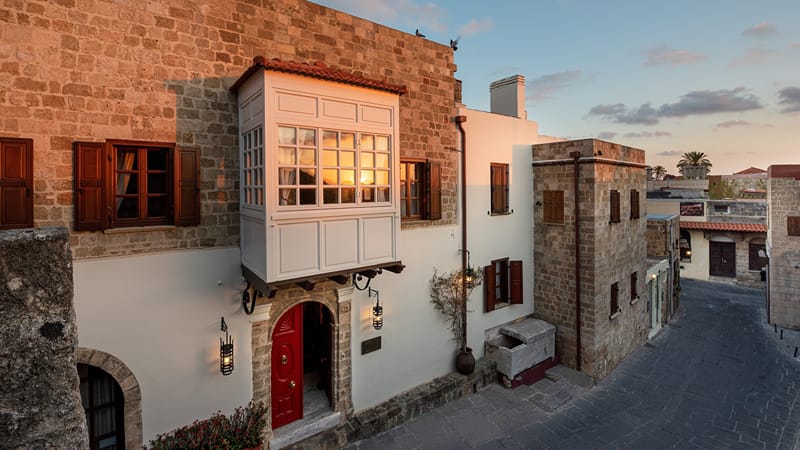
Kokkini Porta Rossa
A restored 14th-century knight's residence within the walls, with six spacious suites, antiques, artifacts and colourful courtyards.
View on TRVL ↗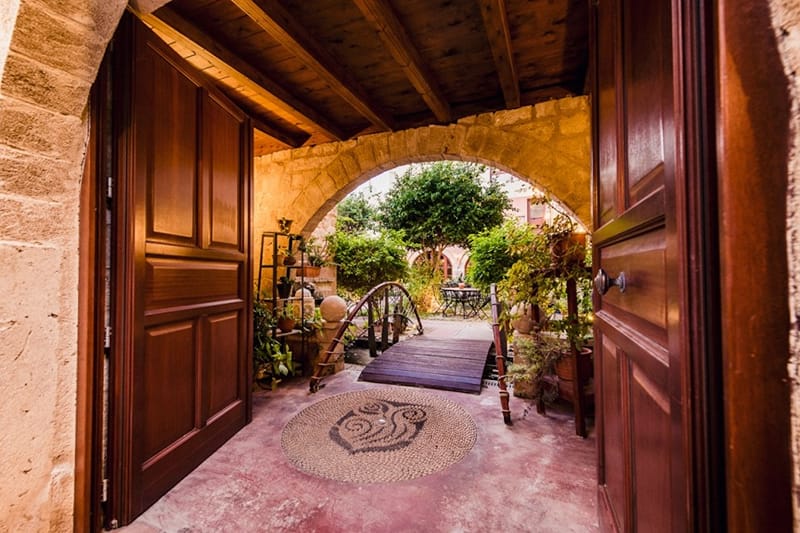
Avalon Boutique Hotel
A historic medieval building a breath away from the Grand Master's Palace and the Street of the Knights, with six suites, a villa and a deluxe room, all with verandas.
View on TRVL ↗
Melenos Lindos Luxury
Designed to look like a village within a village, its architecture combines ancient history with 21st-century comfort, with views of the rocky natural harbour.
View on TRVL ↗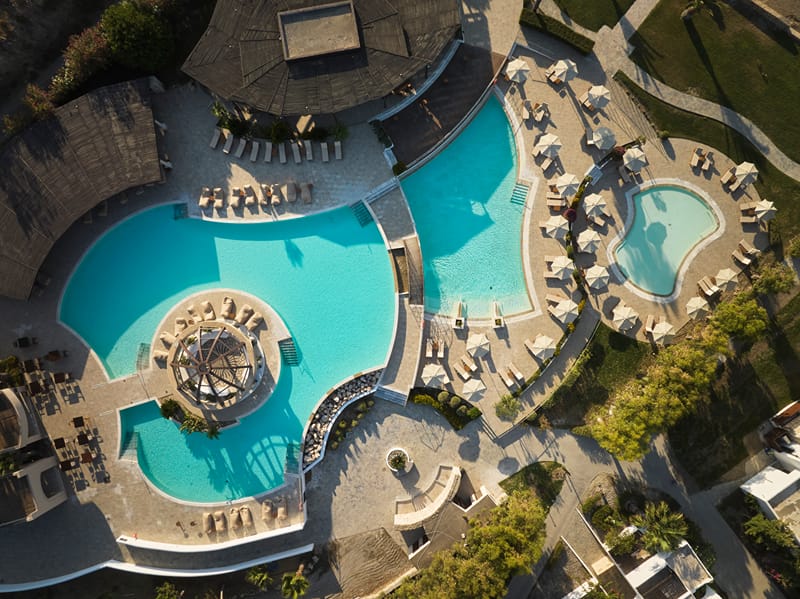
Aulus Lindos Rhodes
A five-star beachfront resort on the southeastern coast with 188 rooms and suites, many with private pools or Jacuzzis, designed for families and couples seeking relaxed island living.
Read articleThe Essence
Rhodes asks for a slow rhythm. Spend your mornings inside the walls before the town fills, swim on the calm east side in the afternoon, drive up to Embonas for a glass of Athiri, and give Lindos the early light it deserves. Take the boat to Symi on a clear day. Come in September or October, when the sea is still warm and the evenings long, and the island shows you why its summers seem never to end.