
Crete is an island you eat your way across. Breakfast can be a barley rusk soaked in olive oil and grated tomato, lunch a plate of snails with rosemary behind a covered market, dinner fish by the sea with a small glass of tsikoudia set down unasked at the end. In between there are Venetian harbours, Minoan palaces older than most of Europe's history books, and mountains high enough to hold snow well into spring.
It is also big enough to feel like a small country. Four regions run from west to east, each with its own towns, wines and coastline, and the south faces a different sea from the north. That is the pleasure of it: you can spend a week here and still be planning the next trip before you leave.
The Areas
Chania, in the west, is the one many visitors fall for first. Its old town grew up largely under Venetian rule and wraps around a harbour with a Venetian-era lighthouse at its mouth; walk ten minutes or so east and the Splantzia quarter is quieter, with tavernas on small squares. Behind the town rise the White Mountains (Lefka Ori), and the region holds the island's most famous beaches, Balos and Elafonisi. It suits walkers, beach people and anyone who likes a town to come home to in the evening.
Rethymno is the smallest of the four regions and the most mountainous. Its old town is compact and easy to love: a Venetian fortress, the Fortezza, above the sea; a 16th-century loggia; and the Rimondi Fountain, whose three lion-head spouts have run since 1626. From here the south coast and Preveli are within reach. Good for couples and for a slower pace.
Heraklion is the capital and the largest region, home to the main airport, Knossos and the archaeological museum that holds the finds from it. The vineyards of Peza and Archanes lie just inland. It suits culture-first travellers and anyone who wants short transfers.
Lasithi, in the east, is calmer and greener. Agios Nikolaos sits around Lake Voulismeni, joined to the sea by a narrow channel; Elounda looks out on the Venetian fortress of Spinalonga; further east, Sitia makes its own protected olive oil. Above it all, the Lasithi Plateau lies at around 900 metres in the Dikti range.
The south coast deserves its own line. Facing the Libyan Sea, it gets more sunny days than the north. Sfakia, with Hora Sfakion and Agia Roumeli, is gorge-and-boat country; further east, Matala sits on the edge of the Messara plain with Phaistos nearby.

What to See and Do
Start with the Minoans. In 2025 UNESCO inscribed six Minoan palatial centres on the World Heritage List: Knossos, Phaistos, Malia, Zakros, Zominthos and Kydonia. Knossos, just outside Heraklion, is the famous one; pair it with the Heraklion Archaeological Museum, where its finds now live, and do both on the same day if you can. Phaistos sits on a hill above the Messara plain, its first palace built around 1900 BC, and makes a good half-day with a swim at Matala afterwards.
In Chania, give the old town an unhurried afternoon: the harbour, the lanes behind it, Splantzia at dusk. In Rethymno, climb to the Fortezza late in the day and finish at the Rimondi Fountain. In the east, take the short boat from Plaka to Spinalonga, where Venice built a fortress in 1579 to guard the Gulf of Elounda; the island later became the setting for Victoria Hislop's novel The Island.
Less obvious, and worth the drive: the Lasithi Plateau, with the remains of the windmills that once pumped water for its fields, and the Dikteon Cave above Psychro, which tradition names as the birthplace of Zeus and where finds show people came for thousands of years. Wine lovers can spend a morning among the vineyards of Peza and Archanes south of Heraklion.

Beaches, Gorges and the Outdoors
Crete has more than 1,000 kilometres of coastline, so the choice is wide. Elafonisi, on the south-western tip 76 kilometres from Chania, is a protected Natura 2000 site with shallow water and patches of pink sand made of crushed shells; the dunes are roped off, and taking sand or shells is forbidden. Balos, on the Gramvousa peninsula in the north-west, is a lagoon reached either by boat from Kissamos or by an unpaved road of around eight kilometres followed by a steep walk down.
On the south coast, Preveli is a river beach: the Kourtaliotis runs through a gorge, widens into a long pool and meets the Libyan Sea beside a grove of Theophrastus palms, the second-largest palm stand on the island after Vai in the east. It is a 15 to 20-minute walk down from the car park, and boats also run from Plakias and Agia Galini.
Then the gorges. Samaria is the classic: 16 kilometres from Xyloskalo, at 1,227 metres, down through the White Mountains to Agia Roumeli, from where you leave by boat to Hora Sfakion or Sougia. Its season normally runs from May to October and it closes in bad weather, so check the official ticket site first. Imbros, nearby, is shorter, roughly eight kilometres from Imbros village down to Komitades, with a narrowest point under two metres wide. If you want height rather than depth, Mount Ida (Psiloritis) tops out at 2,456 metres.

What to Eat and Drink
Begin with dakos: a barley rusk briefly softened in water, topped with grated tomato, crumbled mizithra, olive oil and dried oregano. It is at its best in summer, when tomatoes are ripe. Then try staka, a rich sheep's-milk cream often poured over pilaf or eaten with eggs, and the slow dishes the island does well, such as snails with rosemary, braised goat, or lamb with stamnagathi, a wild green.
The cheese to know is Graviera Kritis, a hard cheese protected as a PDO since 1996, made mainly from sheep's milk with up to 20 per cent goat's milk and ripened for at least three months. It is mild and nutty young, sharper with age. The olive oil is serious too: Sitia, in the far east, has its own PDO extra virgin oil made from Koroneiki olives.
Tsikoudia, which most Cretans call raki, is distilled from what is left after winemaking, and in traditional tavernas it often arrives on the house at the end of the meal. Crete makes about a fifth of Greece's wine, much of it around Peza. Look for the white Vidiano, now the island's star white grape, and the reds Liatiko, Kotsifali and Mandilari; the PDO names on labels include Peza, Archanes, Dafnes and Sitia.
Getting There and Around
Most visitors fly into Nikos Kazantzakis Airport at Heraklion or Daskalogiannis Airport at Chania; there is also a smaller airport at Sitia, and a new airport at Kasteli is planned. By sea, ferries from Piraeus run to Heraklion and to Souda, the port of Chania, with operators including Minoan Lines and ANEK Lines. Heraklion also connects with the Cyclades, Kissamos with the Peloponnese, and Sitia with the Dodecanese.
A car makes the island far easier. The national road along the north coast links the main towns; Chania to Heraklion is about 138 kilometres, roughly two hours. KTEL buses run between the big towns, with hourly departures between Chania and Heraklion taking about two and three-quarter hours. On the south coast, boats connect villages such as Agia Roumeli, Sougia and Hora Sfakion.
When to Go
May and September are the months most often recommended. In May the sea is around 19 to 20°C; by September the water is at its warmest. October is quieter, with the sea still around 22 to 23°C and archaeological sites far less busy.
July and August are hot and full. The meltemi, the northerly summer wind, is strongest then and can make the north coast choppy, so the sheltered south-facing beaches come into their own. Note that Spinalonga closes from November to March and the Samaria Gorge has a summer season only.
Good to Know
Do not try to see everything. Crete covers around 8,400 square kilometres, and two bases, one west and one east, work better than a new hotel every night.
Go early to the big names. In August the car park at Elafonisi can fill by 9am, and Knossos is calmer at opening. Adult entry to Knossos is €20 in 2026; buy at the official hhticket.gr rather than through resellers.
Read the small print on hire cars before driving the dirt road to Balos; many policies do not cover it, and the boat from Kissamos is the easy alternative.
Gorges close in bad weather, and Samaria's dates move with conditions. In mid-October 2026 its official ticket site listed it as closed until further notice, so check before you plan a day around it.
Eat a street or two back from the harbours. In Chania, harbour-front mains run around €15 to €25, while the tavernas behind the market and in Splantzia are often cheaper and more local.
Our Picks
- To eatPeskesi
Old Cretan recipes cooked with produce from the restaurant's own farm, in a restored stone mansion; book ahead.
- To eatDounias
A family taverna where everything is cooked over wood, with vegetables, meat, cheese and wine from the family's own land; call ahead.
- To eatPortes
Slow-cooked Cretan dishes such as snails with rosemary and braised goat with kritharaki.
- To eatThalassino Ageri
A fish taverna serving since 1985, with tables at the water's edge for sunset; closed Mondays.
- To seeHeraklion Archaeological Museum
The finds from Knossos and the other Minoan palaces under one roof; see it on the same day as the site.
- To seeKnossos
The best known of the six Minoan palatial centres on the UNESCO list; arrive at opening.
- To seeSpinalonga
A five-minute boat ride to the Venetian fortress of 1579; open April to October.
- To swimPreveli
A river, a palm grove and the Libyan Sea in one place, at the end of a short walk.
- To walkImbros Gorge
About eight kilometres down to Komitades, shorter and gentler than Samaria, between walls that close to under two metres.
Where to Stay
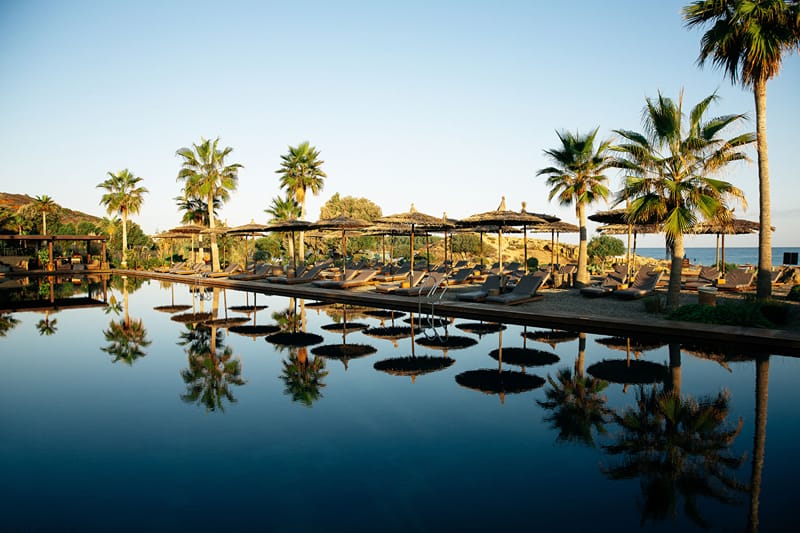
Domes Zeen Chania
Positioned near Chania's city centre, the resort describes itself as an ideal base for exploration.
Read article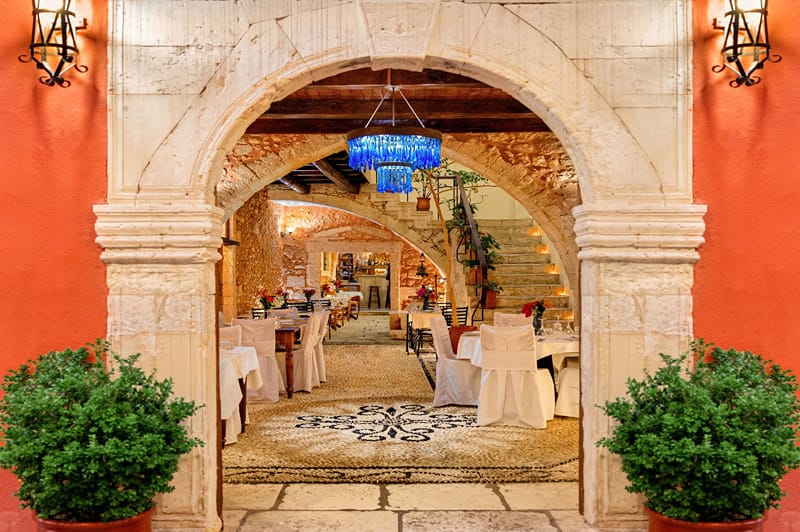
Veneto Rethymno
A Venetian mansion of the 15th century in the Old Town of Rethymno, close to the shopping district, the museums and numerous cafes.
View on TRVL ↗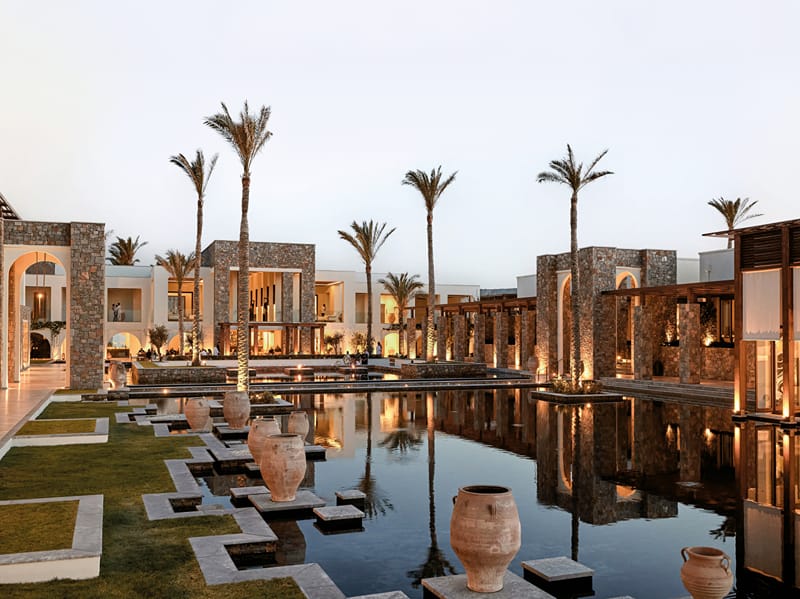
Amirandes
A living tribute to Crete's legendary past that reimagines the island's heritage with echoes of Minoan splendour and Venetian grace.
Read article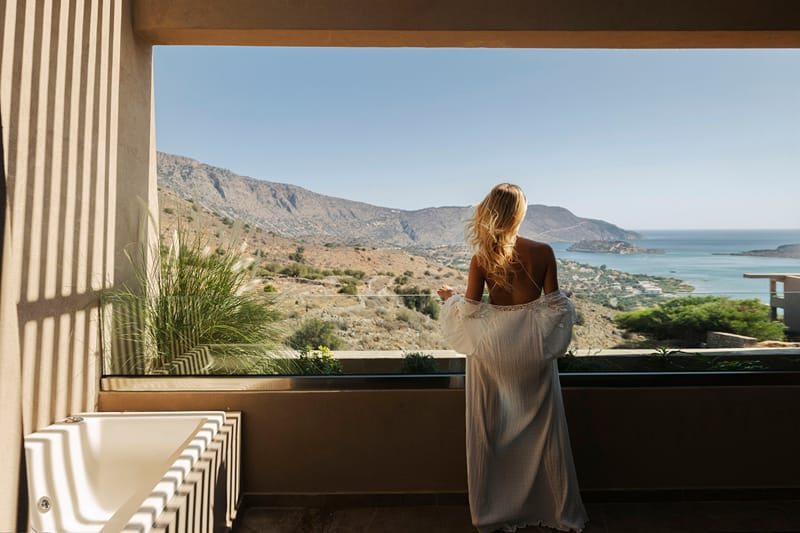
Domes Aulus Elounda
An adults-only hotel that extracts the essentials of premium accommodation and delivers an accessible, casual luxury.
Read articleThe Essence
Crete rewards appetite in every sense. Come hungry for palaces whose first walls rose around 1900 BC, for a gorge that ends at the sea, for graviera and Sitia oil and a carafe of Vidiano, for a harbour at dusk. Then pick two corners of the island, slow down, and leave the rest for next time. There is always a next time with Crete.