
Pelion rises east of Volos as a long, hooked peninsula between the Pagasetic Gulf and the Aegean, its highest summit, Pourianos Stavros, at 1,624 metres. This is the mountain of the centaur Chiron, tutor to Jason, Achilles and Heracles, and it still feels like a place made for long walks and longer meals. Around two dozen villages are scattered across its slopes among plane, chestnut, beech and fir trees, built in stone and slate on terraces, with shaded squares, marble fountains and cobbled lanes that climb from one level to the next.
Most people know Pelion as a summer destination, and the beaches of the east coast are reason enough to come in July. But winter suits the mountain just as well. Fires are lit in the mansions, the small ski centre above Hania opens when the snow arrives, and a plate of spetzofai with a glass of tsipouro makes more sense in January than at any other time. Volos, a short drive below, is the easy gateway.
The Areas
Pelion divides roughly into the villages above Volos on the western slopes, the high pass at Hania, and the greener, wetter villages of the Aegean side. For a winter weekend, most people stay close to Volos; for a longer trip, the east is worth the drive.
- Makrinitsa — around 600 metres up and known as the balcony of Pelion, with a plane-shaded square looking straight down on Volos and its port. Cars stay outside; you park at the edge and walk in. Best for couples and anyone who wants the classic view and a mansion to sleep in.
- Portaria — next door to Makrinitsa at about 600 metres, the village where Pelion tourism began, rich in water, mansions and paths. It has the widest choice of places to eat and stay, and sits roughly midway between Volos and the ski centre. A practical base for first-timers.
- Hania — the high pass at around 1,200 metres, about 2 km from the ski slopes, surrounded by beech forest with views over the Pagasetic Gulf. Suits skiers and anyone who wants proper snow outside the window.
- Milies and Vizitsa — two villages on the western slopes further south, Milies with its library, church and old railway terminus, Vizitsa with its stone mansions. Good for walkers and a slower stay.
- Tsagarada and Zagora — the eastern villages above the Aegean. Tsagarada is spread through a chestnut forest in four settlements around its churches; Zagora, home to around 2,000 people, is the mountain's apple country. Best for a longer trip, and in summer for the beaches below.
- Volos — the port city at the foot of the mountain, with buses up to the villages, tsipouro on the waterfront and ferries to the Sporades. A sensible base if you prefer a city to a village.

What to See and Do
Start in Makrinitsa. The main square, with its tall plane trees, the church of Agios Ioannis Prodromos and a marble fountain from around 1809, is the place to sit with a coffee and look down over Volos and the gulf. Below the square, the Topali mansion, built in 1844 and fortress-like in shape, houses the Museum of Folk Art and History of Pelion, with more than 1,500 objects from everyday life on the mountain. Then simply walk: Makrinitsa's lanes are stone-paved, steep and lined with tall mansions decorated by regional folk artists.
Portaria is a few minutes away. Look for the 19th-century basilica of Agios Nikolaos, with reliefs on its facade, and for the old mansions of the Zoulias and Kantartzis families, a reminder that the village grew rich on silk. The Centaur's Path leaves from here, a walk through green woods marked with red circles painted on the stones, with a fountain, benches and the Spring of Manas nearby.
Further south, Milies is one of the villages of the Greek Enlightenment: its school, founded in 1814 by Anthimos Gazis and Grigorios Konstantas, is now a library. The church of the Taxiarches, renovated in 1741, is known for its frescoes and its acoustics. On the east side, Zagora keeps the old school associated with Rigas Feraios, now a museum, and a Public Historic Library founded in 1762. In Tsagarada, the square of Agia Paraskevi is shaded by a plane tree estimated to be at least 1,000 years old, possibly the oldest in Greece. And in Kissos, the small 17th-century stone church of Agia Marina stands on its plane-shaded square.
Between villages, Pelion is best explored on foot along its kalderimia, the old cobbled mule paths, typically about two metres wide, that once linked the settlements. Several hiking paths start in Milies, and volunteers in south Pelion have been mapping and restoring these routes for walkers. Down in Volos, the house of Giannis Kontos, where the painter Theophilos worked, is now the Theophilos Museum, a good stop on the way back to town.

Winter on the Mountain
Pelion's ski centre, Agriolefkes, sits above Hania, about 27 km from Volos. It was started in 1967 on the initiative of the mountaineering club of Volos, when its first aerial lift began operating, which makes it one of the oldest ski centres in Greece. It is small and friendly rather than grand: the slopes run between about 1,170 and 1,471 metres, there are five lifts, and most of the skiing is intermediate. Four downhill slopes are approved by the International Ski Federation, and a 5 km cross-country track runs through beech, fir and chestnut forest with views of the Aegean.
On the mountain you will find a shelter, a restaurant and refreshment room, ski and snowboard rental, a first-aid post and a ski school that takes children from the age of three. There is parking for more than 800 cars. The season generally runs from late December to mid-March, with the lifts usually open from 09:00 to 16:00, though hours change with weather, weekdays and holidays.
The top of the centre is low by ski standards, and snow can vary from one winter to the next, so check before you plan a trip around the slopes. Not skiing? Winter on Pelion is just as much about walking in the snow-dusted beech woods around Hania, driving from village to village and settling into a mansion with a fireplace.
What to Eat and Drink
Pelion cooking is mountain food with the sea in sight, and it is generous. The dish to order first is spetzofai: spicy country sausage cooked with sweet peppers, onion, garlic and olive oil in a rich tomato sauce, the best-known local dish on the mountain. The villages are also known for their charcuterie, and the tavernas cook pies, slow-cooked meats and the kind of dishes the hotels like to call grandma's recipes.
Fruit is the other local story. Milies takes its name from apple trees, and Zagora's farmers have grown apples through their cooperative since 1916; Zagorin apples have held protected designation of origin status since 1996. Pelion is also known for the firiki apple, plums and greengages, and the chestnut trees that cover so much of the mountain are a reminder of what lands on the table in autumn and winter.
Down in Volos, tsipouro is the drink of the city, a clear spirit served with seafood and small plates of meze. An evening at a tsipouro table by the harbour is a fine way to start or end a trip to the mountain.
Getting There and Around
Volos is the gateway. By car from Athens it is about 360 km on the national road through Lamia and Larisa; from Thessaloniki, take the national road south. KTEL buses run from the Liossion bus station in Athens to Volos, and from Thessaloniki too; allow about 4.5 to 5 hours from Athens and 3 to 3.5 hours from Thessaloniki, depending on connections. From Volos, local KTEL buses serve almost every Pelion village, although services are infrequent. Nea Anchialos airport near Volos operates mainly in summer with charter and low-cost flights, so in winter most visitors fly into Athens or Thessaloniki.
Once here, a car makes all the difference. National roads 34 and 34A lead from Volos into the mountain, Makrinitsa is about 10 km from the city by winding road and the ski centre about 27 km. The roads are narrow, with hairpin bends and blind corners, and fog, heavy rain and the occasional mudslide are part of autumn and winter. Carry snow chains in winter, especially for the crossing at Hania, and leave more time than the map suggests.
When to Go
Pelion is a year-round destination. For snow, come between late December and mid-March, when the ski centre usually operates; weekends and holidays are busiest, so midweek is calmer. Spring is the season for walking, when the paths are green and the water runs. The little Pelion train, the narrow-gauge line between Ano Lechonia and Milies, runs on weekends from spring to autumn, not in winter. Summer belongs to the east coast and its beaches, Mylopotamos, Fakistra, Agios Ioannis and Chorefto among them. Autumn brings the apples and chestnuts, and the first fires of the season.
Good to Know
Mountain weather turns quickly: check the forecast and the ski centre's operation before driving up, and keep chains in the car even on a clear morning. Wear good shoes, because the cobbled lanes of the villages are steep and can be slippery when wet. In Makrinitsa you leave the car at the village car park and walk in. Smaller museums often keep weekend hours, so check ahead. If you plan to stay in a mansion for Christmas, New Year or a winter weekend, book early.
Our Picks
- To skiAgriolefkes Ski Centre
One of Greece's oldest ski centres, with five lifts, mostly intermediate runs and a ski school for children from three.
- To walkAgriolefkes cross-country track
A 5 km trail through beech, fir and chestnut forest with views to the Aegean.
- To seeThe square of Makrinitsa
Plane trees, a marble fountain from around 1809 and the whole of Volos at your feet.
- To seeMuseum of Folk Art and History of Pelion
More than 1,500 objects of mountain life in an 1844 mansion below the square.
- To walkThe Centaur's Path
A wooded trail marked with red circles, close to the Spring of Manas.
- To seeChurch of the Taxiarches
Frescoes and fine acoustics in a church renovated in 1741.
- To seeThe plane tree of Agia Paraskevi
A tree estimated at 1,000 years or more, possibly the oldest in Greece.
- To eatKritsa
A restaurant with a fireplace in a neoclassical building from the 1900s, cooking traditional dishes with local products.
- To eatThe taverna at Hani Zisi
Local specialties cooked daily from local produce, a few minutes from the slopes.
Where to Stay
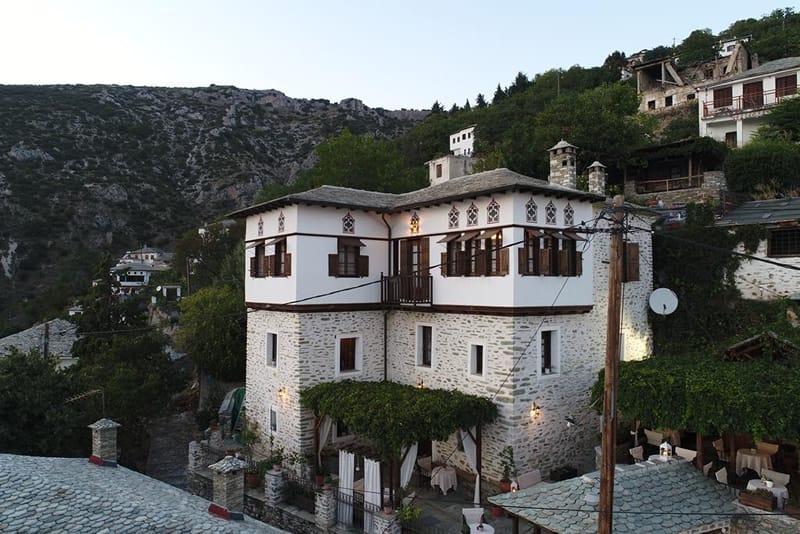
Evilion Traditional Mansion
A sunny 19th-century mansion built in 1856, in the centre of Makrinitsa, with stone walls, wooden ceilings and views over Volos and the Pagasetic Gulf.
View on TRVL ↗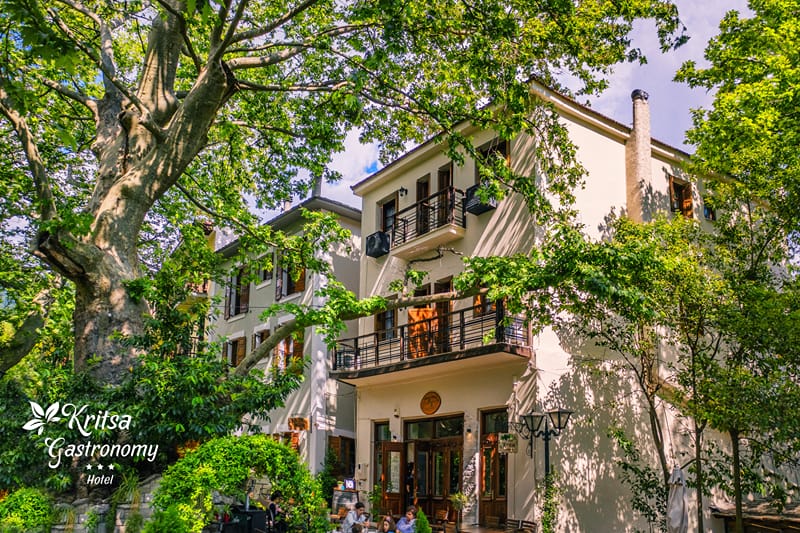
Kritsa Gastronomy Hotel
A cosy hotel and restaurant right on the central square of Portaria, about a 15-minute drive from the Pelion Ski Centre.
View on TRVL ↗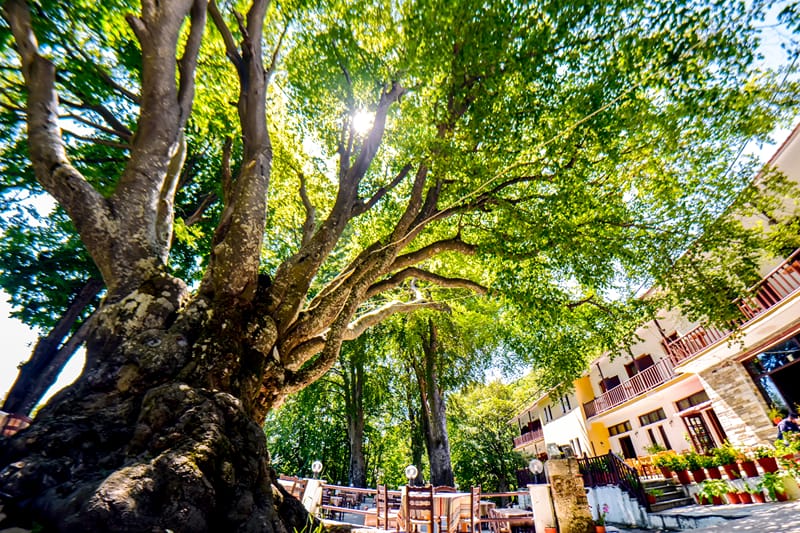
Hani Zisi Hotel
A family-run hotel with roots in 1904, open all year at 1,200 metres, between the beech forest and the view of the Pagasetic Gulf.
View on TRVL ↗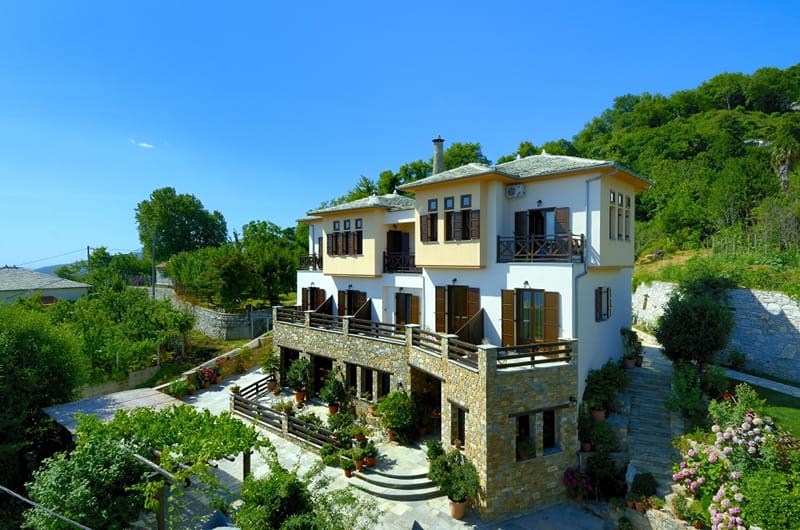
Iris Guesthouse Pelion
A guesthouse in traditional Pelion style a few minutes from the square with its 1,000-year-old plane tree, with select rooms offering fireplaces and views of the Aegean.
View on TRVL ↗The Essence
Pelion in winter is a mountain that takes care of you. Spend a morning on the slopes above Hania, an afternoon walking the stone lanes of Makrinitsa as the lights come on in Volos below, and the evening by a fire with spetzofai and a glass of tsipouro. Come back in summer for the Aegean beaches, and you will find the same villages waiting, simply greener.