
Valencia is a city of easy pleasures. The old town is a few minutes' walk from a park that runs nine kilometres through the city along the former bed of the Turia, and the park leads almost to the sea. Lunch is paella, as it should be in the place that invented it, and the afternoon drink is a cold glass of horchata made from tiger nuts grown in the fields just north of town.
This guide covers the neighbourhoods and who each suits, the Silk Exchange and the Central Market, the City of Arts and Sciences, the beaches and the Albufera lagoon, the Fallas in March, how to get in from the airport by metro, and when the weather is at its kindest.
The Areas
Valencia is flat and easy to cross on foot or by bike, so choose your base for mood: medieval lanes, a creative grid of cafés, or sea air.
- Ciutat Vella — the historic centre, where the city was founded more than 2,000 years ago, with the Cathedral, the Silk Exchange, the Central Market and the Plaza de la Virgen. Suits first-timers who want to walk to the main sights.
- El Carmen — one of the six neighbourhoods of Ciutat Vella, between the two surviving gates of the old wall, the Serranos and Quart towers. Murals cover many walls, Calle de Moret is known as the street of colours, and Plaza del Tossal is the heart of the nightlife. Suits travellers who like street life and late evenings; Plaza del Carmen is the quieter corner.
- Ruzafa — just south of the centre, called the creative heart of the city and nicknamed the Valencian Soho, with its own market, contemporary galleries, brunch cafés and terraces that fill at sunset. Next door is Parque Central, a 10-hectare park beside the North Station opened in 2019. Suits food lovers and anyone who likes an evening drink among locals.
- Cabanyal — the old fishermen's quarter by the sea, known for houses with tiled façades on streets such as Calle de la Reina and Calle del Progreso, modernist fronts and a market of 150 stalls. Suits travellers who want the beach on the doorstep and a neighbourhood with its own character.

What to See and Do
Lonja de la Seda. The Silk Exchange, built between the 15th and 16th centuries and declared a UNESCO World Heritage Site in 1996, is the Gothic masterpiece of the city's merchant age. In the Hall of Columns, eight helical stone columns rise like twisted ropes; here merchants signed contracts and the city kept its municipal bank, the Taula de Canvis. The Consulate pavilion was the seat of the first maritime trade court in Spain, and Pere Compte designed the spiral staircase of the tower. It opens Monday to Saturday from 10:00 to 19:00 and on Sundays and holidays from 10:00 to 14:00. Entry is €2, and free on Sundays and holidays.
Cathedral and Miguelete. The Cathedral mixes Romanesque, Gothic and Baroque, and since the 15th century it has kept in its own chapel the Holy Chalice. General entry is €12 (€6 reduced). From Monday to Friday it opens 10:30 to 18:30, on Saturdays 10:30 to 17:30 and on Sundays and holidays 14:00 to 17:30. The bell tower, the Miguelete, has its own ticket and 207 steps to a 360-degree view. Every Thursday the Water Tribunal meets at the Cathedral's Apostles' Gate.
The Serranos Towers and the Quart Towers are the two gates that survive from the old city wall, and both can be climbed for views over the old town; the Quart Towers, from the 15th century, still show marks from cannonballs fired during the War of Independence. A walk of about two hours links the two through the old centre. In El Carmen, the IVAM covers art from the early avant-garde to today, and the Centre del Carme holds exhibitions and concerts in the Gothic and Renaissance cloisters of a former convent.

The Turia Gardens and the City of Arts and Sciences
The old bed of the Turia is now a park that locals still call simply the river. It runs for nine kilometres, flat and green, under bridges from the 15th-century Trinidad, the oldest in Valencia, to the Flowers Bridge of 2002 and Santiago Calatrava's L'Assut d'Or, with its 125-metre harp-shaped mast. Along the way are the Palau de la Música, the Bioparc and the Gulliver park, where children climb over a 70-metre figure of Gulliver lying down. By bike the whole garden takes about half an hour.
At its seaward end stands the City of Arts and Sciences, designed by Santiago Calatrava and Félix Candela. The complex includes the Hemisfèric, with IMAX screenings and a planetarium; the Science Museum, whose building is free to enter; the Palau de les Arts opera house; the Umbracle garden; and the Oceanogràfic, which the tourism board calls the largest aquarium in Europe, with around 45,000 animals from about 500 species. Allow at least three hours for the aquarium. The tourism board sells a combined ticket from €47.75 and the Oceanogràfic alone from €39.45.
The Albufera is the third piece. The lagoon, about 10 kilometres south of the city and surrounded by rice fields, is the place where paella was born. Traditional boats make trips of about 40 minutes through the marshes, mostly from the Gola de Pujol jetty, and sunset is the favourite hour, when the water turns red and gold. EMT bus 24 runs from the centre to the village of El Palmar, with its rice restaurants, and bus 25 to El Perellonet. On the way are the natural beaches: La Devesa, about 5 kilometres of sand among pines and dunes, and El Saler, 2.6 kilometres inside the natural park.

What to Eat and Drink
Paella Valenciana is the dish to plan the trip around. The tourism board describes the authentic version: round rice with the Valencia designation of origin, chicken, rabbit, ferradura green beans, garrofó butter beans and tomato, seasoned with olive oil, saffron, sweet paprika and rosemary. It was born in the 16th century in the Albufera, cooked by farmers with what the land gave them. It is a lunchtime dish; locals eat lighter in the evening. The toasted layer at the bottom of the pan, the socarrat, is the most coveted bite.
Horchata, orxata in Valencian, is made from soaked and ground tiger nuts, chufa, a tuber of the Valencian huerta. A regulatory council in Alboraia oversees the designation of origin, and sixteen Valencian municipalities grow tiger nuts under the quality seal. It is served cold, liquid or as a granizada, and comes with fartons, the local sweet buns. Legend has it that King Jaume I, offered the white drink, exclaimed that it was not milk but gold.
The Central Market, opened in 1928, is a modernist building of iron, tiles and stained glass with more than 250 stalls; the tourism board calls it Europe's largest fresh produce market. It opens Monday to Saturday from 07:30 to 15:00. The Ruzafa and Cabanyal markets are the neighbourhood alternatives, and in the Cabanyal the bodega Casa Montaña, founded in 1836, still serves tapas and wine from its cellar.
Getting There and Around
Valencia Airport is about 8 kilometres from the city. Metro lines 3 and 5 connect it with the centre in about 20 minutes, with departures every 15 to 20 minutes. The airport ticket costs €4.80, plus €1.10 or €2.10 for the reusable card, and the metro runs from 04:00 to 23:30 on weekdays and from 05:00 to 00:30 at weekends. Xàtiva, beside the North Station, and Colón are the handy central stops. City bus 150 takes about 35 minutes.
High-speed trains arrive at Joaquín Sorolla station, with direct services from Madrid in from about 1 hour 50 minutes, and from Barcelona, Seville and Córdoba. The modernist North Station, Estació del Nord, handles the commuter trains.
In town, walk or cycle. For the beaches take metro and tram lines 4, 6 or 8; for the City of Arts and Sciences, line 10. A single EMT bus ticket costs €2.00. The Valencia Tourist Card for 24, 48 or 72 hours includes city buses, metro and tram in zones A and B, including the airport stop, and free entry to 14 sites, among them the Silk Exchange and the Serranos and Quart towers.
When to Go
Valencia is mild for most of the year. Average highs at the city weather station are 19.3°C in March, 23.4°C in May and 24.3°C in October, according to Spain's state weather agency, AEMET. July and August average highs around 30°C with nights above 21°C, ideal for the beach. Winter is gentle, with average highs of 16.4°C in January. September and October are the wettest months.
The Fallas fill the city in March. Events run from 1 to 19 March, when every afternoon at 14:00 the Plaza del Ayuntamiento shakes with the mascletà, a daytime display of firecrackers. On the night of 15 March, the plantà, the monuments go up in squares across the city; on 17 and 18 March falleros in traditional dress parade with bouquets for the Flower Offering; and on the night of Saint Joseph, 19 March, the monuments are burned in the cremà. The festival was added to UNESCO's list of intangible cultural heritage in 2016. Since 1934 one figure each year, chosen by public vote, is spared the flames and goes to the Fallas Museum.
Good to Know
- Eat paella at lunch, as Valencians do, and leave the evening for tapas.
- Visit the Silk Exchange on a Sunday morning, when entry is free.
- The Central Market closes at 15:00 and all day on Sunday, so go in the morning.
- The Miguelete needs its own ticket; the Cathedral ticket does not include it.
- Buy the Tourist Card if you will use transport and museums; the web price is lower than at the counter.
- For the Fallas, book your room months ahead, and bring earplugs for the mascletà.
- Opening hours and prices change for holidays and events, so check official sites the week you travel.
Our Picks
- To seeLonja de la Seda
The Hall of Columns and the orange-tree courtyard; €2, free on Sundays.
- To eatMercado Central
More than 250 stalls under modernist ironwork and tiles; go before noon.
- To seeCathedral and Miguelete
The Holy Chalice inside, then 207 steps for the view over the rooftops.
- To seeTorres de Serranos
Climb the old city gate for the view over the Turia gardens.
- To walkJardín del Turia
Nine flat kilometres from the old bridges to the City of Arts and Sciences; best by bike.
- To seeOceanogràfic
Around 45,000 animals; allow at least three hours.
- To drinkHorchatería Santa Catalina
Two centuries of horchata with fartons, open daily 08:15 to 21:30.
- To eatCasa Montaña
A family bodega since 1836, with tapas and a deep wine cellar.
- To seeAlbufera boat trip
Forty minutes on a traditional boat through the marshes; come at sunset.
Where to Stay

Senator Parque Central
Minutes from the city centre, near the bullring and the Mercado de Colón, with a bar, a restaurant, a café and a fitness centre.
View on TRVL ↗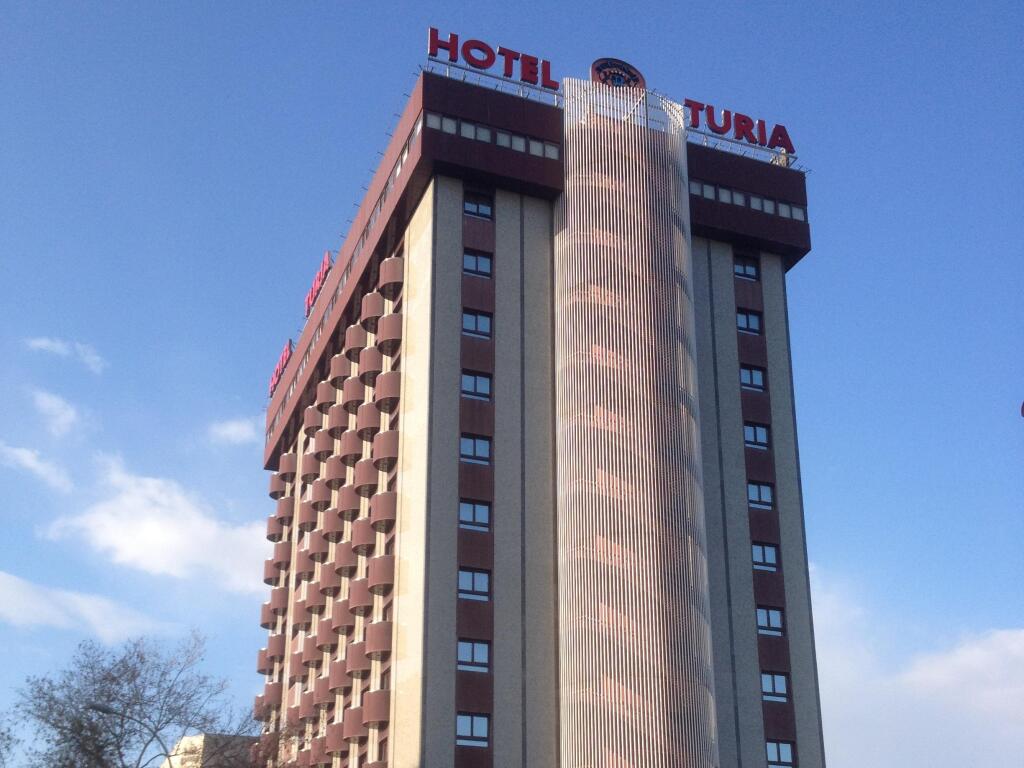
Hotel Turia Valencia
Minutes from the city centre, close to the Hesperides Garden, with a bar, a restaurant and a fitness centre.
View on TRVL ↗
Hotel Ilunion Aqua
Near the Aqua shopping centre and the Oceanogràfic, with a bar, a restaurant, a café and a fitness centre.
View on TRVL ↗The Essence
Valencia is a city that makes time for itself. Spend the morning among the columns of the Silk Exchange and the stalls of the Central Market, cycle the riverbed to Calatrava's white buildings, sit down to paella at lunch, and end the day by the sea in the Cabanyal or on a boat on the Albufera as the light goes. Come in spring or autumn for soft warmth, in summer for the beaches, or in March for the noise and fire of the Fallas.