
The light at Melissani comes in through a hole in the roof. Around midday, when the sun stands straight overhead, it drops into the cave lake and turns the water a luminous blue, and the boats glide across it as if on nothing at all. That is Kefalonia in one image: an island where the sea runs underground, the mountains come down to the shore in white cliffs, and the best things are a short drive and a long look away.
Kefalonia is the largest island in the Ionian Sea, and it has room for a lot. There is a capital with a long cobbled street and a stone bridge across its lagoon, pastel harbour villages at the northern tip, a Venetian castle on a peninsula, and a mountain of rare fir trees above vineyards that make one of Greece's distinctive white wines. Give it a week and a car, and it will fill both.
The Areas
Fiskardo is about 50 km from Argostoli, and the roads wind. Choose a base by what you want to do most, and plan day trips around it.
- Argostoli — the capital, on a narrow peninsula in the south-west, 8 km from the airport. Best for first-timers and anyone who likes a town with cafés, a theatre and shops, and the sandy beaches of Makris Gialos and Platis Gialos 3 km to the south.
- Lixouri — the island's second town, about 3,500 people, across the bay from Argostoli and around 30 minutes away by ferry. A quieter base with a waterfront, old-fashioned cafés on Petritsi Square and the beaches of the Paliki peninsula, Xi and Petani among them.
- Sami and Karavomylos — the main port on the east coast, facing Ithaca, with Melissani and Drogarati caves close by and Antisamos beach 5 km away. Good for families and for anyone planning island hops.
- Assos — a village of under 100 people on a small peninsula on the north-west coast, its pastel houses set above a 50 m isthmus, with a castle above and Myrtos about 11.5 km away. For couples who want quiet evenings.
- Fiskardo — the northernmost village, about 50 km from Argostoli, its harbour packed with yachts in summer and its promenade lined with tavernas and bars. Lively and polished, and priced accordingly.
- The south: Lassi, Svoronata and Skala — beach country, from the coves near Argostoli to the sandy shores of Avithos, Lourdas and Skala. Easy for families and close to the airport.

What to See and Do
Start in Argostoli. Its spine is the Lithostroto, an 800 m pedestrian street that runs from Kampana Square towards Vallianos Square, the town's main square, lined with shops and cafés. On the square stands the Kefalos Theatre, opened in 1858, the largest on the island, with 450 seats; the Korgialeneios Library, founded in 1924, also houses the town's Folklore Museum. Out on the water, the De Bosset Bridge crosses the bay for about 950 m. Built in 1813 under the Swiss engineer Charles Philippe de Bosset and rebuilt in stone in 1842, it closed off the Koutavos lagoon, where loggerhead turtles favour the southern end.
Follow the coast road north of town to the Katavothres, about 3 km out, where seawater disappears into cracks in the rock and flows underground across the island towards Melissani. A little further on, the round, Doric-style lighthouse of Agioi Theodoroi, first raised in 1828 under the British administrator Charles Napier and rebuilt in 1964 to the original plan, is the town's sunset spot.
Inland, in the Omala valley below Mount Ainos, the Monastery of Agios Gerasimos near Valsamata keeps the relics of the island's patron saint, who founded a convent here in 1560. Three plane trees he is said to have planted still stand. On 16 August a grand procession carries his sarcophagus out under the plane tree, and he is celebrated again on 20 October.
In the north, walk up to the Castle of Assos, built by the Venetians in the 16th century on a peninsula 155 m above the sea. Its outer walls run for about 2,000 m, and from 1585 to 1707 it was the seat of the Venetian governor. Entry is free. At Fiskardo, a 15-minute footpath leads to two lighthouses at the mouth of the bay: a 16th-century Venetian tower and a Victorian one of 1892.

Caves, Coast and Mount Ainos
Kefalonia's limestone is full of holes, and two of them are among the island's great sights. Melissani, just outside Sami, is a cave lake 20 to 30 m deep whose roof fell in long ago; you walk down a tunnel and cross the water by boat. It is named after the nymph Melissanthi, and excavations in 1962 found figures of nymphs and other objects from the 4th and 3rd centuries BC. Drogarati, about 5 km south of Sami, goes the other way: down about 60 m into a chamber of stalactites and stalagmites at a steady 18°C. It opened to the public in 1963, and its largest hall, the Chamber of Exaltation, has such good acoustics that it sometimes hosts cultural events for up to 500 people.
The beaches are the other reason people come back. Myrtos, 29 km north of Argostoli, is a curve of white pebbles under white cliffs, with part of it organised with umbrellas and part left bare; the road down gives one of the island's great views. Antisamos, 5 km from Sami, sits in a bay of green hills and became famous after scenes of Captain Corelli's Mandolin were shot there. On the Paliki peninsula, Petani lies 35 km north-west of Argostoli, and Xi has coarse red sand and grey clay that visitors smear on as a home spa. Near Fiskardo, Foki is a pebbled cove shaded by trees, named after the Mediterranean monk seals that visit it, and Emblisi is small and good for snorkelling. The island is also a refuge for loggerhead turtles.
Above it all rises Mount Ainos. Its highest peak, Megas Soros, reaches 1,628 m, the highest point in the Ionian Islands, and the mountain has been a national park since 1962. The Cephalonian fir, one of the rarest firs in Europe, covers about two-thirds of it, and its dark trunks gave the mountain its old Venetian name, Monte Nero. Forest paths wind through it, wild horses graze its slopes, and the summit views take in most of the island.
What to Eat and Drink
Kefalonia's best-known dish is its meat pie, kreatopita. Local cooks make it from three kinds of meat, browned with onion, garlic and tomato paste, deglazed with Robola, then mixed with rice, marjoram and egg and baked in pastry. Look also for bakaliaropita, a salt-cod pie with rice and marjoram, and for fried salt cod with aliada, the island's garlic sauce. Tsigaridia, wild greens cooked with onion, tomato and rice, appear in winter and spring. Rooster cooked in wine is one of the island's most popular dishes, goat comes braised red with cinnamon and cloves over thick spaghetti, and Fiskardo is known for its lobster spaghetti.
Robola is the wine to order. It is a white grape grown mainly on Kefalonia, often on its own roots in limestone soil, and it makes dry, medium-bodied wines with high acidity, a lemon note and sometimes a flinty edge. The heart of the Robola zone is the Omala plateau, about 700 m up and 15 km north-east of Argostoli, between Mount Ainos and the sea. There, growers from Omala and the surrounding villages founded the Robola Cooperative in 1982; its winery takes in around 80% of the Robola grown in the designated zone and welcomes visitors for tastings.
Getting There and Around
Kefalonia International Airport, Anna Pollatou, is 8 km from Argostoli. Flights from Athens take about 50 minutes with Aegean, Olympic Air and Sky Express, and in summer there are direct flights from the UK, Italy, Austria and elsewhere. KTEL buses link the airport with Argostoli from May to around October, roughly every 1.5 hours; there is also a taxi rank outside the terminal, though in summer you may have to wait.
By sea, the shortest crossing from the mainland is Kyllini to Poros, about 1 hour 30 minutes with Levante Ferries, with several sailings a day. Ferries also run from Patra to Sami (about 3 hours) and from Astakos to Sami (about 2 hours 20 minutes). In summer, boats link Fiskardo with Lefkada, and in high season there are sailings from Pessada to Zakynthos and from Sami to Bari in Italy. A small ferry crosses between Argostoli and Lixouri in around 30 minutes, with frequent daily sailings from mid-April.
For Ithaca, take the ferry from Sami to Pisaetos, a crossing of about half an hour, or in high season one of the boats from Fiskardo, about 45 minutes. Vathy, Ithaca's capital and harbour, with its tiled roofs and stone-paved lanes, makes an easy day out. On Kefalonia itself, KTEL buses connect the towns, but they are infrequent; a hire car is the practical way to see the island.
When to Go
June to September is the swimming season, with the sea from about 22.5°C in June to 26.5°C in August. The shoulder seasons are the island at its best for walking, caves and villages. May averages about 19.5°C, with only around three rainy days and a sea that is still cool at about 19°C. September keeps the warmest water of the year, about 25.5°C, with the air at 23.6°C and only a few more rainy days. October is still warm, around 20°C with the sea at 23°C, but it has the most rain of the season, about seven days. May and early October are the best times for sightseeing without the heat.
Kefalonia quietens from November to April, when work is scarce and many islanders leave, so plan winter visits around Argostoli. If you are on the island on 16 August, the procession of Agios Gerasimos in the Omala valley is its biggest religious day.
Good to Know
July and August are busy, especially at Myrtos, Antisamos and Fiskardo; go early, or stay late for the evening light. Myrtos has a steep shore break, so it is not the beach for weak swimmers. Foki and Emblisi have no sunbeds or umbrellas, so arrive early for the shade. At the Castle of Assos there are no facilities, so bring water and a hat. And allow time for the roads: the island is big, and the most beautiful stretches are the slowest.
Our Picks
- To seeMelissani Cave
A boat ride across an underground lake lit from above; go around noon, when the sun turns the water blue.
- To seeDrogarati Cave
A 60 m descent into a hall of stalactites with a constant 18°C and fine acoustics.
- To walkCastle of Assos
Venetian walls on a peninsula 155 m above the sea, with free entry and views over the village.
- To walkFiskardo lighthouses
A 15-minute footpath to a Venetian tower and a Victorian lighthouse at the mouth of the bay.
- To swimMyrtos
White pebbles under white cliffs, 29 km north of Argostoli; arrive early in summer.
- To swimFoki
A tree-shaded pebbled cove within walking distance of the village, named after the monk seals.
- To drinkRobola Cooperative of Kefalonia
The winery at the heart of the Robola zone, founded in 1982, with tastings of the island's white.
- To drinkGentilini Winery
A family-run boutique winery near Argostoli making wines from Kefalonian varieties, open daily from Easter to September.
- To eatTasia
A family restaurant since 1972, known for lobster spaghetti and Kefalonian meat pie.
Where to Stay
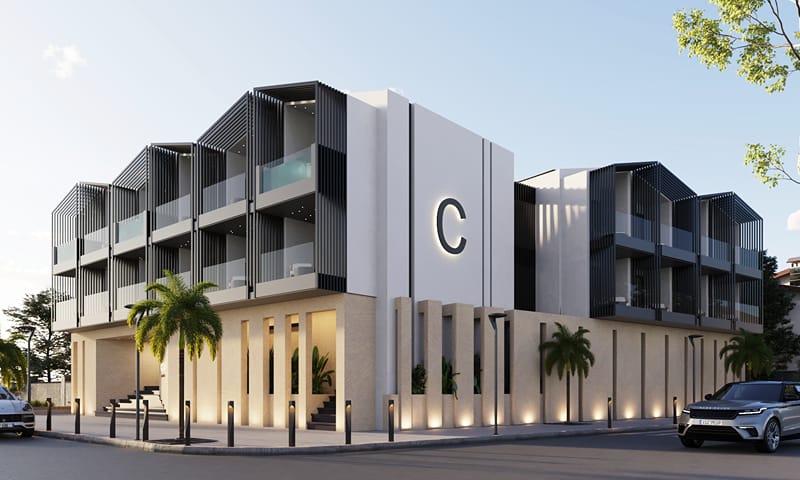
Casaly Hotel & Spa
An adults-only five-star boutique hotel and spa on the seafront in Argostoli, a new build of modern architecture with uninterrupted sea views and island recipes reimagined at its restaurant.
View on TRVL ↗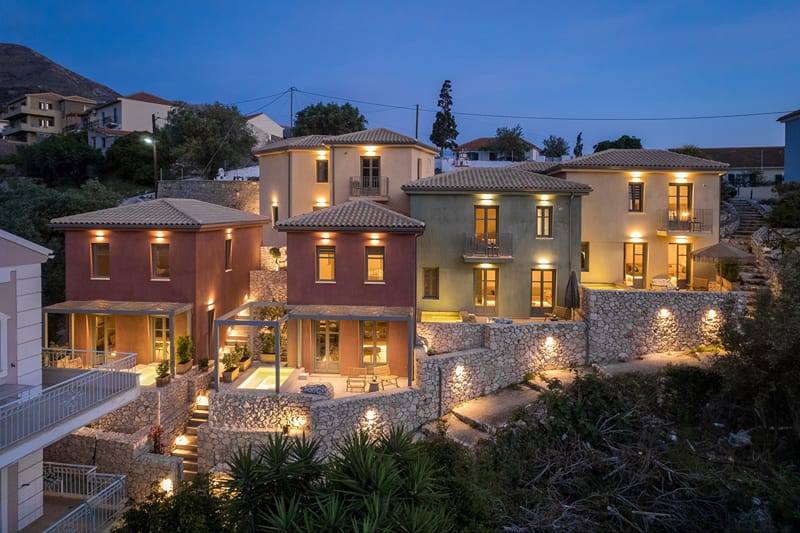
Chromata Assos Villas
Four villas less than 200 m from the centre of Assos and under 100 m from the beach, each with its own plunge pool and veranda facing the sunset.
View on TRVL ↗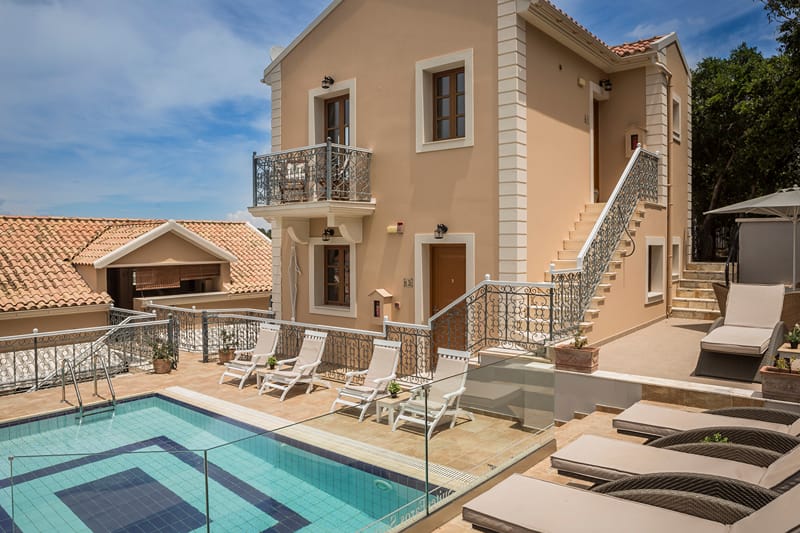
Faros Suites Fiscardo
A small boutique property of seven suites inside the village, five minutes on foot from the waterfront, with a pool and breakfast on a deck over the bay and its yachts.
View on TRVL ↗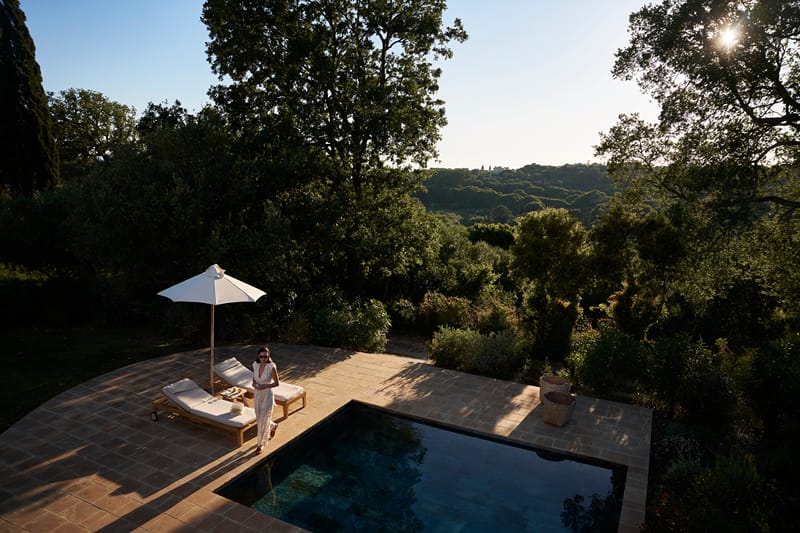
Eliámos Villas Hotel & Spa
A Relais & Châteaux spa hotel of 12 villas and suites, each with its own garden and private pool, on the southern coast above a quiet beach.
View on TRVL ↗The Essence
Kefalonia rewards the traveller who takes it slowly. Spend a morning on a boat inside Melissani and an afternoon on the white pebbles of Myrtos, drive up through the firs of Mount Ainos and down to the vineyards of Omala, and end the day in a harbour at Assos or Fiskardo with a slice of meat pie and a cold glass of Robola. Then take the short ferry to Ithaca. One summer is rarely enough.