
Florence is small enough to cross on foot and big enough never to finish. Brunelleschi's dome sits over the rooftops like a fixed point, the Arno runs under the Ponte Vecchio, and from Piazzale Michelangelo the view carries on to the hills of Fiesole. The paintings, statues and chapels of the Renaissance are packed into a few dozen streets, alongside market halls, gelato counters and tripe stalls doing a brisk lunchtime trade.
The trick is to give the great museums a booked morning each and leave the afternoons loose. Cross the river to the Oltrarno for workshops and a slower piazza, climb to San Miniato for the view at dusk, and take a train out to Siena or Pisa when you want a change of scale. Come in the quieter months and the city is almost generous with its time.
The Areas
The historic centre is small, so you are never far from anything. What changes from quarter to quarter is the pace, and that is the best way to choose.
- Duomo and the centro — the streets between the cathedral, Piazza della Signoria and the river, with Palazzo Vecchio, the Uffizi and the San Lorenzo market close by. Best for first-timers and short stays, when every minute of walking counts.
- Santa Croce and Sant'Ambrogio — east of the centre, around the great Franciscan basilica and the city's oldest food market. Sant'Ambrogio keeps a neighbourhood feel, with a flea market, Piazza dei Ciompi and Vasari's Loggia del Pesce, and plenty of pubs thanks to a university department. Good for food lovers and evenings out.
- Oltrarno — the city "beyond the Arno", across the Ponte Vecchio, with Palazzo Pitti, the Boboli Gardens and streets full of artisan workshops; Via Maggio is lined with antique dealers. Suits travellers who want the centre within reach but a quieter base.
- Santo Spirito — the heart of the Oltrarno, a lively square in front of Brunelleschi's basilica, with a craft and organic fair, the Fierucola, on the third Sunday of the month. The Carmine church and its Brancacci Chapel are a few streets away. For couples and anyone who likes to sit in a piazza with a glass in the evening.
- San Niccolò — the stretch of the Oltrarno below Piazzale Michelangelo, between the river and Forte Belvedere, which the city's own tourism office describes as far from mass tourism. Old gates, artisan shops and trattorias, with the climb to San Miniato al Monte starting at your door. For repeat visitors and walkers.

What to See and Do
Start in Piazza del Duomo. The Cathedral of Santa Maria del Fiore was consecrated in 1436, when it was the largest cathedral in Europe, and entry to the church itself is free. Above it, Brunelleschi's dome was begun in 1420 and the vault completed in 1436; inside, the 16th-century frescoes of the Last Judgement are attributed to Giorgio Vasari and Federico Zuccari. You can climb all 463 steps to the base of the lantern, with no lift, for a view over the city and the hills around it.
The Uffizi holds paintings from the 13th to the 20th century, from Giotto and Simone Martini through Piero della Francesca, Botticelli, Leonardo, Raphael and Michelangelo to Caravaggio. The Vasari Corridor, the elevated passage that crosses the Ponte Vecchio to Palazzo Pitti, is open again by reservation, and in 2026 it also opens on Friday evenings until 20 November. Across the river, Palazzo Pitti gathers several museums, from the Palatine Gallery to the Museum of Costume and Fashion, with the Boboli Gardens rising behind it.
Michelangelo's David stands in the Galleria dell'Accademia, which has more of his sculptures than any other museum in the world. Santa Croce, designed by Arnolfo di Cambio in 1296, is the largest Franciscan church in the world and holds the tombs of Michelangelo, Galileo and Machiavelli; Giotto's Bardi Chapel is visible again after its restoration. In the Oltrarno, the Brancacci Chapel has the frescoes Masolino and Masaccio began around 1423 and Filippino Lippi completed around 1485, among the highest expressions of Renaissance painting.
Then go up. From San Niccolò, walk through the Porta San Miniato and up Via del Monte alle Croci, or take the ramps behind the San Niccolò tower, to Piazzale Michelangelo, laid out by Giuseppe Poggi and finished in 1875. The whole city is spread out below, from the dome to Santa Croce and the Ponte Vecchio. A little higher stands San Miniato al Monte, a Romanesque basilica whose abbey marked its thousandth year in 2018 and whose restoration has now been completed. The Bardini Garden, on Via de' Bardi, has a Baroque staircase rising to a belvedere with one of the best views of the skyline.

Booking Ahead and Day Trips
Three sights reward a little planning. For the Uffizi, a full ticket costs €25 on the day or €29 bought in advance, and from 2026 entry after 4pm costs €16. The gallery is open Tuesday to Sunday from 08:15 to 18:30 and closed on Mondays. A five-day PassePartout covering the Uffizi, Palazzo Pitti and the Boboli Gardens costs €40, or €58 with the Vasari Corridor, which always needs a booked slot. Buy on the official site, tickets.uffizi.it.
At the Accademia, a full ticket is €20, with a €4 booking fee; reservations are strongly recommended, as the wait without one can be long. It is open from 08:15 to 18:50, closed on Mondays. Since March 2026 a 48-hour ticket for the Accademia and the Bargello costs €26.
For the Duomo complex, the Brunelleschi Pass at €30 covers the dome, Giotto's bell tower, the Baptistery, the Opera del Duomo Museum and the remains of Santa Reparata for three days. The dome climb needs a time slot chosen when you buy, which cannot be changed, and the pass is in your name, so bring photo ID. Book on tickets.duomo.firenze.it and be in line ten minutes before your slot. The bell tower is under a restoration expected to last about four years, but stays open throughout.
For a change of scale, take the train. Regional trains reach Siena from Santa Maria Novella in under two hours for no more than €10, and the station is about 20 minutes' walk from the centre, where Piazza del Campo and the Torre del Mangia wait; Siena was the first city in Europe to close its old centre to traffic, back in 1966. Pisa Centrale is around an hour away by regional train, and the Piazza dei Miracoli about 25 minutes on foot from the station; timed tickets for the Leaning Tower are sold on opapisa.it. Between the two lies the Chianti, a hill country of vineyards, olive groves and castles; Greve in Chianti, with its porticoed Piazza Matteotti, hosts the Chianti Classico Expo in the first half of September.

What to Eat and Drink
Florentine cooking is plain and generous. The bistecca alla fiorentina is the classic: a thick T-bone grilled over hot coals and served rare. Soups are made to use up good bread, so look for ribollita, with black cabbage and cannellini beans, and pappa al pomodoro, with tomato, garlic, basil and olive oil. Beans all'uccelletto come with tomato, garlic and sage, and peposo, from Impruneta, is a beef stew cooked slowly with black pepper and red wine.
The city's street food is lampredotto, the fourth stomach of the cow, simmered in broth and served in a crusty roll with green sauce and a spicy one. The trippai, the tripe sellers, work from stalls at the San Lorenzo market, at Sant'Ambrogio, by the Loggia del Porcellino and in Piazza dei Cimatori, and you eat standing at the counter. For a quick bite, a slice of schiacciata, the local flatbread, does the job.
The markets are the best place to start. San Lorenzo's 19th-century iron-and-glass hall has two floors: fresh produce, meat and fish downstairs, and upstairs the Mercato Centrale, a food hall open every day from 08:00 to midnight. Sant'Ambrogio, the oldest market in Florence, trading since 1873, is open Monday to Saturday from 07:00 to 14:00. In autumn, look for roasted chestnuts and the year's new red wine at village festivals outside the city. Chianti Classico, the wine of the black rooster, comes from the hills between Florence and Siena.
Getting There and Around
Florence's airport is at Peretola, on the edge of the city. The T2 tram stops two minutes' walk from arrivals and runs into the centre in about 20 minutes, from 05:00 until after midnight, and until 02:00 on Friday and Saturday nights. One suitcase up to 55x40x20 cm travels free; a bigger bag needs its own ticket. Santa Maria Novella is the main railway station, with high-speed trains to Rome in about an hour and a half, Bologna in about 35 minutes and Milan in about 1 hour 40.
In the centre, walk. For longer hops, a tram or bus ticket costs €2 and is valid for 90 minutes, or you can simply tap a contactless card or phone on the readers on board. Tickets are also sold at machines at every tram stop and in the at-bus app.
When to Go
Florence is open all year, and its quieter months are its best-kept advantage. Outside the summer peak, booked slots are easier to find and the afternoon Uffizi ticket, €16 after 4pm, makes a short late visit easy. Autumn brings chestnuts and new wine, and the countryside harvest in October and November; December brings a Christmas market to Piazza Santa Croce. State museums are free for everyone on the first Sunday of each month, and on 25 April, 2 June and 4 November, though expect crowds on those days. In summer, the city celebrates its patron saint with fireworks over Piazzale Michelangelo on the evening of 24 June.
Good to Know
The Uffizi and the Accademia both close on Mondays, so plan that day for churches, gardens and walks; the Brancacci Chapel is open on Mondays and closes on Tuesdays instead. The cathedral itself is open to visitors Monday to Saturday from 10:15 to 15:45 in 2026. Buy tickets on the official sites named above. Hotels collect a city tax per person per night, set by the property's category and charged for up to seven consecutive nights. The Bardini Garden closes on the first and last Monday of the month. Climbing the dome is not advised if you suffer from heart conditions, vertigo or claustrophobia.
Our Picks
- To seeBrancacci Chapel
Masaccio's frescoes of the life of St Peter, among the high points of Renaissance painting; open on Mondays, closed on Tuesdays.
- To seeBasilica di Santa Croce
Giotto's restored Bardi Chapel, Brunelleschi's Pazzi Chapel and the tombs of Michelangelo and Galileo, for a €10 ticket.
- To seeGalleria dell'Accademia
The David, with timed booking; take the first slot of the morning.
- To walkSan Miniato al Monte
A Romanesque basilica on the hill, newly restored, and the finest way to end a walk up from San Niccolò.
- To walkBardini Garden
A Baroque stair to a belvedere over the rooftops, with an English-style wood beside the old city walls.
- To eatDa Nerbone
Lampredotto in a roll, served since 1872; go before 14:00, when the ground floor starts to close.
- To eatMercato di Sant'Ambrogio
The city's oldest market, since 1873, with tripe sellers inside and nearby; Monday to Saturday mornings.
- To eatMercato Centrale
Delicatessen counters and small restaurants under an iron-and-glass roof, open until midnight every day.
- To eatVivoli
The same family has made gelato here since 1930; order the affogato, which they call la gran crema al caffè.
Where to Stay
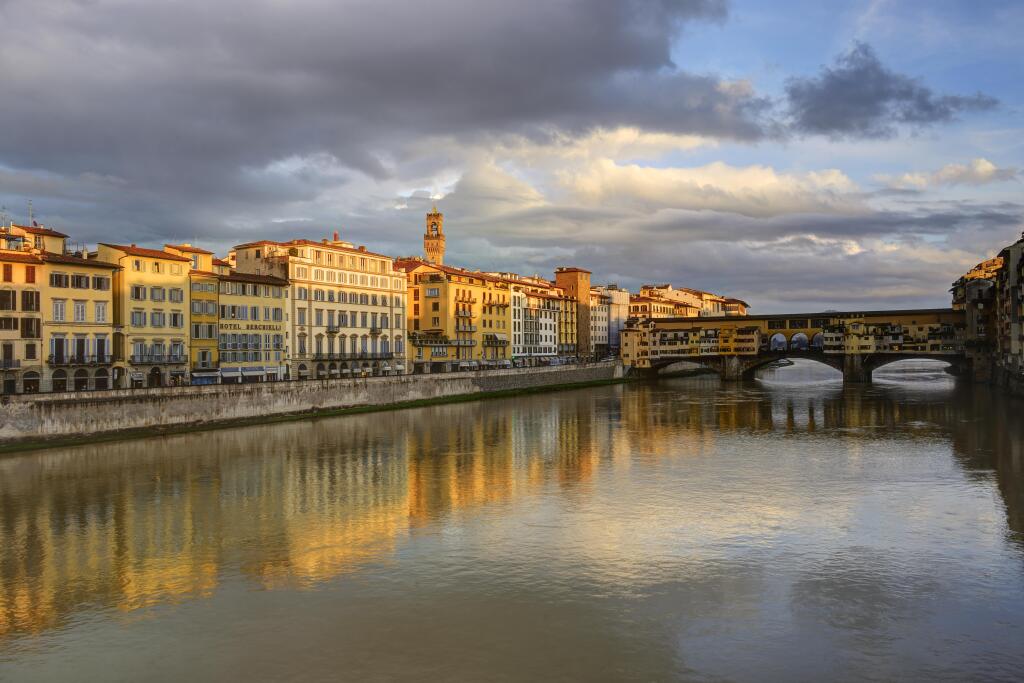
Hotel Berchielli
Offering views of the River Arno and the Ponte Vecchio, the hotel is centrally located on the riverfront, just 250 metres from the Uffizi Gallery.
View on TRVL ↗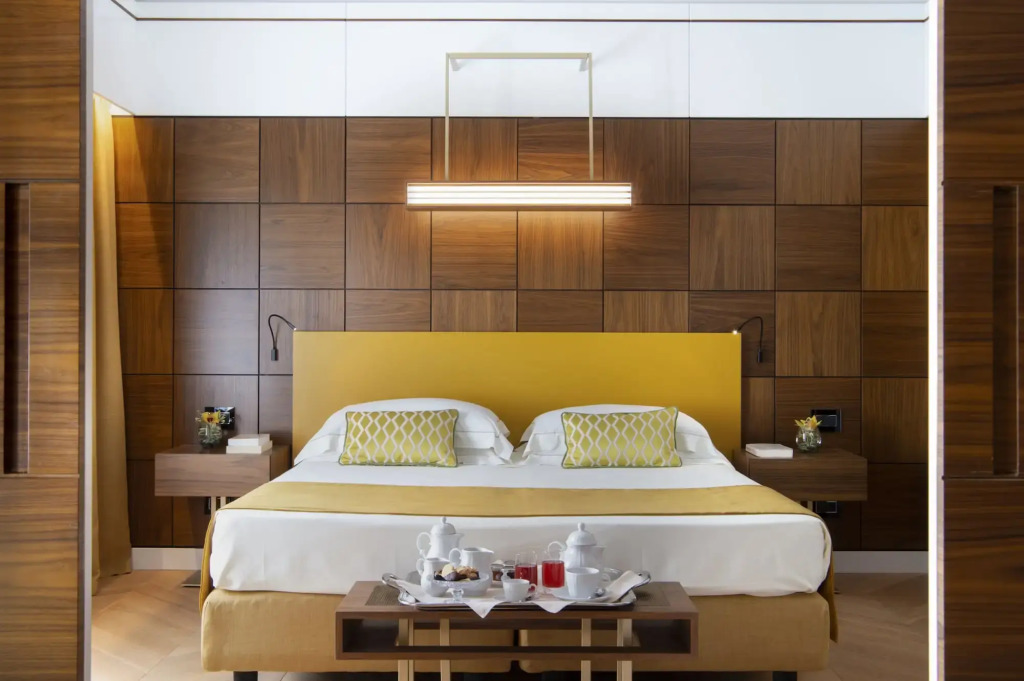
Hotel degli Orafi
In the city centre, with the Ponte Vecchio, the Galileo Museum and the Uffizi Gallery close by.
View on TRVL ↗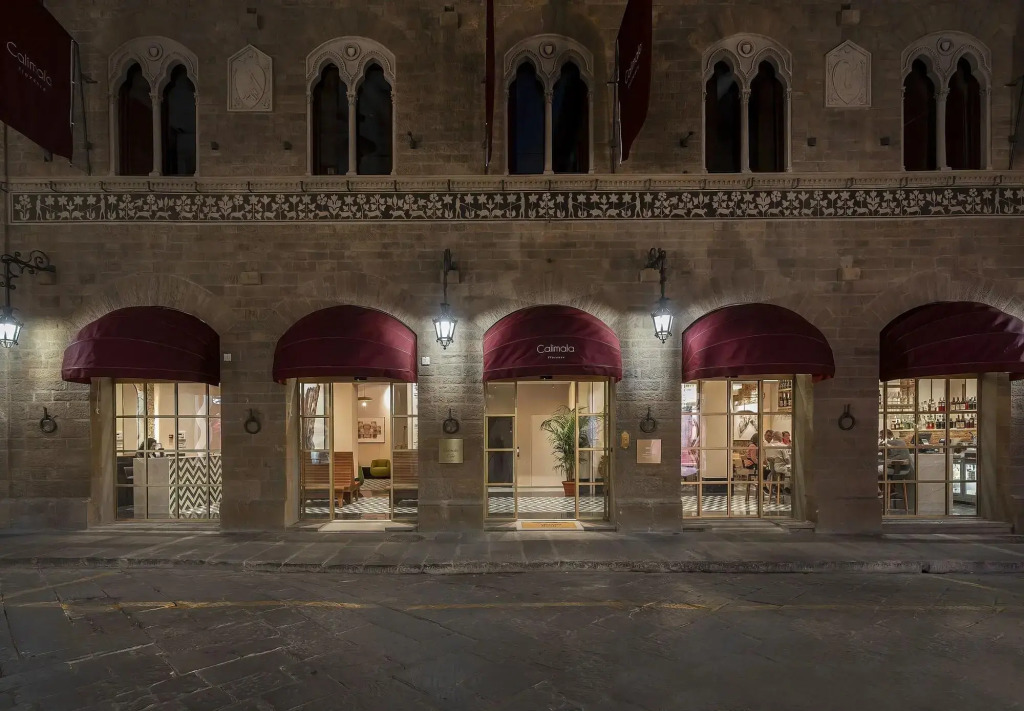
Calimala Hotel
In the centre of the city, a short walk from Piazza della Signoria, Piazza della Repubblica and Palazzo Vecchio.
View on TRVL ↗
B&B Hotel Firenze
In the very centre of the city, with the Ponte Vecchio, Palazzo Pitti and the Galileo Museum nearby.
View on TRVL ↗The Essence
Florence asks for a little planning and pays it back many times over. Book the dome, the David and the Uffizi, and everything else can be left to chance: a lampredotto roll at a market counter, a gelato in Santa Croce, an evening drink in Piazza Santo Spirito, the long walk up to San Miniato as the light goes. Then take a train out to Siena or the Chianti hills, and come back to find the city has kept your place.