
Los Angeles is less a single city than a string of places that share a sky: a 1909 pier with a Ferris wheel on the ocean, canals in Venice laid out more than a century ago, a hilltop observatory that looks straight at the Hollywood Sign, a market Downtown that has fed the city since 1917. Light, sea air and food from every corner of the world tie them together. The trick is to choose one or two bases and let each day have its own neighbourhood.
This guide is for planning that kind of trip: which areas suit whom, which museums deserve a morning, where to eat tacos and Korean barbecue, whether you need a car, how to get in from LAX by train, and when the weather is kindest. Prices are in US dollars and were checked on 16 October 2026; fares and opening hours change, so confirm before you go.
The Areas
Distances are long and traffic is real, so where you sleep shapes the whole trip. Metro rail reaches Downtown, Koreatown, Hollywood, Pasadena, Culver City and Santa Monica; the beach towns and Malibu are easier with a car.
- Santa Monica — the pier, which dates to 1909, with Pacific Park’s rides and Ferris wheel above the sand, and the Metro E Line running from here to Downtown. Suits first-timers, families and anyone who wants the ocean outside the door.
- Venice — Ocean Front Walk with its stalls, bike rentals and street performers, the outdoor weights of Muscle Beach, the surviving canals of Abbot Kinney’s seaside town, and Abbot Kinney Boulevard’s mile and a half of boutiques, galleries and cafés. Suits walkers, cyclists and people-watchers.
- Silver Lake and Los Feliz — hillside neighbourhoods of cafés and dive bars, with Griffith Park and the Observatory just above Los Feliz. Suits repeat visitors, coffee lovers and anyone who prefers a local street to a big sight.
- Hollywood — the Walk of Fame, the TCL Chinese Theatre and the Hollywood Bowl, all on the B Line subway to Downtown. Busy and a little brash, but central. Suits film lovers and first-timers on transit.
- West Hollywood — a 1.9-square-mile city of its own, home to the Sunset Strip, the Rainbow District at the heart of LGBTQ+ life in LA, and a Design District of fashion flagships and showrooms. Suits couples, night owls and shoppers.
- Downtown and the Arts District — The Broad, Grand Central Market and Union Station, with the Arts District’s studios and restaurants to the south-east. Suits culture lovers, food lovers and travellers who want rail links in every direction.
- Malibu — the Pacific Coast Highway, the Getty Villa, Surfrider Beach’s famous breaks and Zuma’s wide sand. Suits beach days and a road trip; you will want a car.
- Pasadena — on Metro rail from Downtown, with the Norton Simon Museum and the Rose Parade every New Year’s Day. Suits slower stays, gardens and art.

What to See and Do
Start high. Griffith Observatory opened in 1935 on a hill in Griffith Park, paid for by the bequest of Griffith J. Griffith, and it is still one of the best places to look at the Hollywood Sign. Entry to the building is free; it opens from noon to 10pm Tuesday to Friday and 10am to 10pm at weekends, and is closed on Mondays. On clear evenings you can look through its Zeiss 12-inch refracting telescope at no cost, and the Samuel Oschin Planetarium shows run inside.
The Getty has two homes, and both are free with a timed-entry reservation. The Getty Center, in the hills of West L.A., shows art from the Middle Ages to today among modern architecture and gardens; it opens 10am to 6.30pm Tuesday to Friday and Sunday, until 9pm on Saturday, and is closed on Mondays. The Getty Villa in Malibu holds Greek and Roman antiquities in a re-created Roman country house with gardens and ocean breezes, open 10am to 5pm and closed on Tuesdays. Parking at either is $25 a car, $15 after 3pm, and payment is cashless.
On Wilshire Boulevard, LACMA is open every day except Wednesday (from 11am on weekdays, 10am at weekends, until 8pm on Fridays); adult tickets are $30, or $25 for Los Angeles County residents, and advance timed tickets are recommended. Look for the new David Geffen Galleries. Downtown, The Broad on Grand Avenue has free general admission, is closed on Mondays and stays open until 8pm on Thursdays; Yayoi Kusama’s Infinity Mirrored Room needs a separate advance reservation.
In Hollywood, the TCL Chinese Theatre opened in 1927 and its forecourt of hand and footprints is free to visit; the Walk of Fame runs along Hollywood Boulevard and Vine Street with more than two thousand stars. In summer, the Los Angeles Philharmonic plays under the sky at the Hollywood Bowl.

The Beaches
The coast is the reason many people come, and each stretch has its own mood. Santa Monica beach and its pier are the classic first stop, with rides at Pacific Park; the beach gets very crowded in summer. Walk or cycle south along the shore to Venice, where Ocean Front Walk between Washington Boulevard and Navy Street is free, busy and full of stalls, and Muscle Beach holds bodybuilding contests in summer, including on 4 July.
Further north, Malibu’s Surfrider Beach is narrow and known for its surf, while Will Rogers State Beach in Pacific Palisades is wider. Zuma Beach in Malibu has about 1.8 miles of sand on 105 acres, with lifeguards during the day; Los Angeles County currently reports its parking lots and restrooms closed after a power outage, so check the county beaches site before you drive up.
The Pacific here is cool: the sea averages about 14°C in January and 20°C in August. Pack a sweater for dinner by the coast, even in summer.

What to Eat and Drink
Tacos are the city’s common language. In Boyle Heights, Guisados serves homestyle braises on corn tortillas made to order, and Mariscos Jalisco is known for its fried shrimp tacos. Downtown, Sonoratown in the Fashion District fills large flour tortillas with carne asada, and Villa’s Tacos in Grand Central Market presses blue corn tortillas to order. In Los Feliz, HomeState does breakfast tacos. Taco trucks turn up in most parts of the city, and Kogi serves Korean-inspired tacos and burritos.
Koreatown, along Wilshire Boulevard on the D Line, is one of the most diverse neighbourhoods in LA, with one of the country’s largest concentrations of 24-hour restaurants and businesses. For Korean barbecue, Soot Bull Jeep still grills over charcoal, and Park’s BBQ has been known for the quality of its meat since 2003.
For grazing, Grand Central Market at 317 South Broadway has been a Downtown landmark since 1917 and opens daily from 8am to 9pm, though each stall keeps its own hours. The Original Farmers Market at 3rd and Fairfax began in July 1934, when a dozen farmers parked their trucks on the corner; it is still the place to wander from stall to stall. Downtown, Philippe the Original serves the French dip with pickled eggs on the side.
Getting There and Around
LAX now has a rail link. The LAX/Metro Transit Center, at Aviation Boulevard and 96th Street, opened in June 2025 and is served by the C and K light rail lines and many bus routes. Free shuttle buses run by the airport connect it with the terminals about every 10 minutes. An automated people mover train between the terminals and the station has been scheduled for 2026, so check on the airport’s site whether it is running when you land.
Metro fares are low: $1.75 a ride, with a cap of $5 a day and $18 over seven days. Tap a contactless bank card, phone or watch at the gate or on the bus, or load a TAP card; caps apply to card and digital payments but not to cash on buses. The B Line subway runs from Downtown to Hollywood, the D Line along Wilshire through Koreatown, and the E Line from Downtown past Exposition Park to Culver City and Santa Monica. In Santa Monica, the Big Blue Bus covers the beach towns and Westwood.
So, do you need a car? For a stay built around Downtown, Hollywood, Koreatown, Pasadena and Santa Monica, the Metro does the job and often beats the traffic, especially between Hollywood and Downtown. For Malibu, the Getty Villa and long coastal days, a car makes life easier. Freeways can clog at any hour, and hotels in Downtown and Hollywood often charge steep parking fees or offer valet only, so ask before you book, and budget for Getty parking too.
When to Go
Los Angeles is mild most of the year. Autumn is usually warm and dry; the hottest months are August and September, with Downtown highs around 28°C. Winter, from December to March, brings most of the year’s rain and highs near 20°C, good for museums and clear-day views from the Observatory. In late spring, “May Gray” and “June Gloom” often cover the coast in morning fog, so plan beach days for later in the summer. The coast is always cooler than the valleys inland.
For events, the Hollywood Bowl’s summer season and the Rose Parade in Pasadena on New Year’s Day are the big draws. Santa Ana winds, hot and dry from the desert, come mostly in autumn and winter and raise the fire risk; follow local alerts if you plan to hike.
Good to Know
- ESTA — visitors from Visa Waiver Program countries need an approved ESTA and an e-Passport. Apply only on the official site, esta.cbp.dhs.gov, and do it early, ideally before you buy your flights; the fee is shown on the site.
- Tipping — 18 to 25 per cent in full-service restaurants; at bars, $1 a drink or 15 to 20 per cent; 18 to 20 per cent for Uber or Lyft drivers; $1 to $3 for a parking valet; $2 to $5 a day for hotel housekeeping. Large groups may find a service charge already on the bill.
- Sales tax — it is added at the till, so the price on the menu or shelf is not the final price.
- Cards — tap the same card or phone each time on Metro so the daily and weekly caps count.
- Reservations — the Getty Center and Getty Villa are free but need a timed-entry booking, and The Broad’s mirror room needs its own.
- Free things — Griffith Observatory, the Getty museums (apart from parking), The Broad, the TCL Chinese Theatre forecourt and every public beach.
Our Picks
- To seeGriffith Observatory
Free telescopes on clear evenings and the best view of the Hollywood Sign.
- To seeGetty Center
Art from the Middle Ages to today among gardens, free with a timed reservation.
- To seeGetty Villa
Greek and Roman antiquities in a re-created Roman country house by the ocean.
- To seeLACMA
The county’s great art museum, open until 8pm on Fridays.
- To seeThe Broad
Contemporary art with free general admission.
- To walkVenice Canals and Ocean Front Walk
Quiet canals a few streets from the busiest boardwalk on the coast.
- To eatGrand Central Market
A market since 1917, with Villa’s Tacos among its stalls.
- To eatGuisados
Homestyle braises on corn tortillas made to order.
- To eatSoot Bull Jeep
Korean barbecue still grilled over charcoal.
- To swimSanta Monica beach
Wide sand under a pier that has stood since 1909.
Where to Stay

The Pierside Santa
Near Original Muscle Beach and the Santa Monica Pier, with a bar, restaurant, outdoor pool and fitness centre.
View on TRVL ↗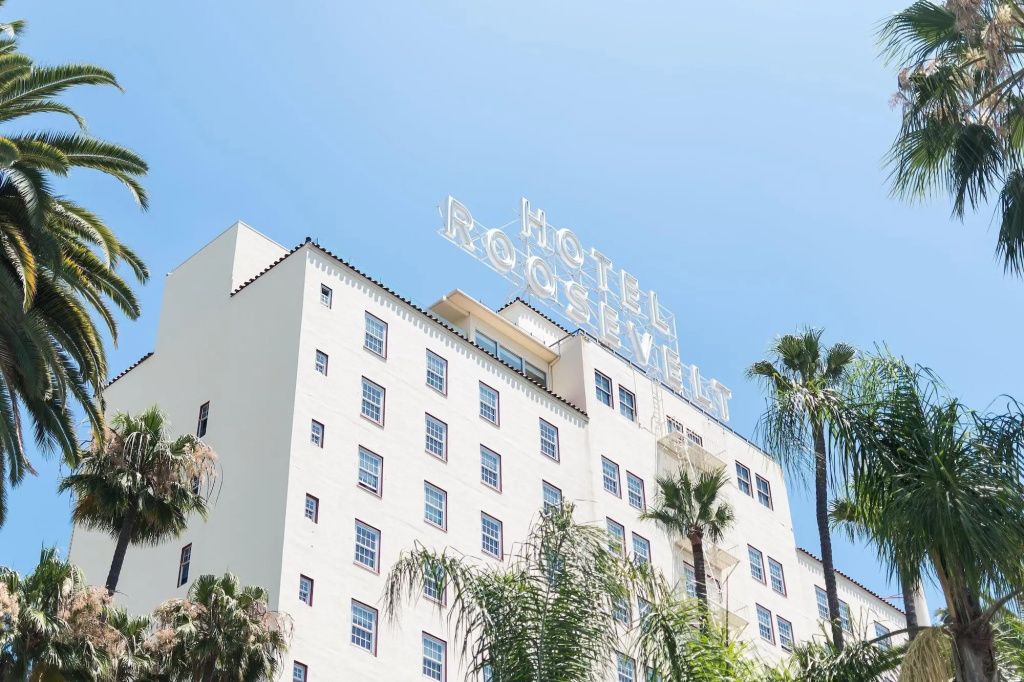
The Hollywood Roosevelt
Close to the TCL Chinese Theatre, with a bar, restaurant, outdoor pool, bowling club and fitness centre.
View on TRVL ↗
Hotel Figueroa
Within walking distance of the Grammy Museum and L.A. Live, with a bar, restaurant and café.
View on TRVL ↗
The Biltmore Los
Centrally placed within a 10-minute drive of Walt Disney Concert Hall, with 683 air-conditioned rooms.
View on TRVL ↗The Essence
Los Angeles opens up when you stop measuring it in miles and start counting it in moments: tacos on a Downtown corner, the Pacific turning silver below Santa Monica pier, a Roman garden in Malibu, the city lights spread out beneath the Observatory dome at night. No one sees all of it, and no one needs to. Pick a corner, let the light do its work, and leave something for next time.