
Evening on Folegandros starts on a path. From Pounta square at the edge of Chora, a zigzag track climbs the rock above the village to the church of Panagia, and in fifteen minutes you are looking down on the rooftops, the cliff and the open sea. Chora itself sits about 200 metres above the water, its old core a medieval Kastro whose north side is built on the lip of the cliff. Cars stay outside the village, so the lanes and the run of small squares belong to people on foot.
This is a small island, about 32 square kilometres with some 700 residents at the 2021 census, and it suits travellers who like to arrive somewhere and slow down. The days follow a simple pattern: a boat from the port or from Agali to a beach you cannot drive to, a walk on old stone-paved paths through the farmland of Ano Meria, and dinner in Chora, where the island's own dish is matsata, handmade pasta in a red sauce or with braised rooster or rabbit.
The Areas
Chora is the obvious base for a first visit. The municipality describes paved lanes, a string of connected squares that it calls unique in the Cyclades, cared-for houses with small whitewashed courtyards, and the Kastro. Three squares set the rhythm of the day: Pounta for the view of the Kastro's sheer north face, Dounavides for a shaded midday pause, and Piatsa for the evening. With restaurants, bars, a pharmacy and a doctor, it suits anyone who wants to walk to dinner and back.
Karavostasis, 3.5 kilometres below Chora, is the port. It is quiet, with its own family beach, Chochlidia, and a scatter of small coves around it, and the local excursion boats leave from here in summer. A bus waits for every ferry, whatever time it arrives. Stay here to swim before breakfast or keep ferry days simple.
Ano Meria, about 6 kilometres from Chora, is the island's second village, strung out along the north-west end. Life here is still agricultural: most houses are themonies, small self-contained farmsteads with fields, animals and dry-stone walls. It is the place for walkers and for anyone who wants space and silence, with paths down to Livadaki, Ambeli and the lighthouse, and frequent buses to Chora.
Agali sits in the bay of Vathi, 4 kilometres from Chora, with rooms, tavernas, cafés and a mini market. Its sandy beach suits families, and boats leave here for Agios Nikolaos and Livadaki. Livadi, 1.5 kilometres from the port, is a sparsely built farming area with a long sandy beach and a campsite.

What to See and Do
Start with the Kastro, the oldest part of Chora, built as a refuge from pirate raids and lived in without a break ever since. Its two gates, the Lotzia and the Paraporti, face the rest of the village. Inside, two parallel lanes, Kato Rouga and Mesa Rouga, run to the only square in the Kastro, the courtyard of the church of Pantanassa, which the Blue Star Ferries island guide recommends as a sunrise viewpoint towards Milos, Sifnos and Kimolos.
Then climb to Panagia, the island's largest church, dedicated to the Dormition of the Virgin. It stands on the site of what was probably an ancient temple, and ancient inscriptions, sculpture and statue bases can be seen in the courtyard and inside. A marble inscription records a renovation in 1687, and the church took its present form in a rebuilding between 1816 and 1821. The path from Pounta takes about fifteen minutes, and the top is a favourite place to watch the sunset.
In Ano Meria, the Ecomuseum has shown traditional rural life since the summer of 1988. It occupies an old farmstead, with a house, cellar and oven under a roof of schist slabs laid on wild cypress beams.
At the island's western tip, the Aspropounta lighthouse was built in 1919, 58 metres above the sea, and has run on solar power since 1986. You reach it on foot, in about 15 minutes from Livadaki beach or an hour from Ano Meria. On the north-east coast, Chrysospilia, the Golden Cave, is 300 metres long, with Roman cisterns, stalactites and some 400 ancient names, mostly of the 4th century BC, written on its walls. The municipality notes that visits are not permitted while archaeological research continues, but the island boats pass the coast, and the Georgitsis sea cave near Karavostasis is a regular stop on the way to Katergo.

Beaches by Boat and on Foot
Folegandros keeps many of its best beaches out of reach of the car, which is half their charm. In summer, small local boats leave Karavostasis every day for the beaches, and on certain days of the week the same boats sail around the whole island. Boats also run from Agali to the beaches along the south-west coast.
Katergo is the one people come for: a wild shingle beach with clear water, ten minutes by boat from the port. There is no shade and the sun is fierce, so bring an umbrella and water. If you prefer to walk, a path from Livadi takes about 30 minutes. Agios Nikolaos is five minutes by boat from Agali or a 20-minute walk, with sand, shade under the trees and two tavernas nearby. Livadaki, on the south-west side, is 15 to 20 minutes by boat from Agali, which runs about every hour, or a 45-minute to one-hour walk on one of three paths from Ano Meria, and pairs well with the short walk on to the lighthouse.
For days when the north wind blows, look south. Galyfos, a ten-minute walk between Agali and Agios Nikolaos, and Ambeli, below Ano Meria, are both small, sheltered from the northerlies and popular in summer; Ambeli's pebbles and clear water are good for snorkelling. Fira, a quiet sandy beach 15 minutes on foot from Agali, faces south-west and is a fine place for sunsets in September and October.
The walking does not stop at the beaches. The Blue Star Ferries island guide counts about 20 kilometres of old stone-paved trails linking the island's settlements, chapels and coves, and the municipality runs a dedicated paths site, routes.folegandros.gr. A 3-kilometre track joins the old farming hamlet of Petousis to Livadi. Wear proper shoes, carry water, and start early in summer.
What to Eat and Drink
Matsata is the dish to order: handmade pasta served with a red sauce or with braised meat, most often rooster or rabbit. Around it sits a whole family of island pies. Kalatsouna, also called sourotenia, is made with souroto, the local soft cheese; manouropita uses manouri; hortenia combines meat and wild greens; kolokithenia is made with pumpkin; and ladenia is the oil-rich bread topped with onion and tomato.
Look out too for baked chickpeas, slow-cooked wild capers and karavolous, snails in onion and tomato sauce. For something sweet there is karpouzenia, a baked pie of watermelon, honey and sesame. Kouloura, a bread flavoured with sesame and aniseed, is eaten with souroto, and methismena are small biscuits made with wine.
Food and music go together at the island's feast days, which usually follow a religious holiday and its evening service, with violin and lute, traditional dancing, and local food and drink offered by the residents.
Getting There and Around
Folegandros has no airport, so you arrive by sea. From Piraeus, Seajets and Fast Ferries both serve the island; Ferryhopper lists high-speed crossings from about 3 hours 40 minutes, with Fast Ferries taking roughly 5.5 to 7 hours depending on the stops. Seajets sails daily in June and three or four days a week in July and August, and Fast Ferries four or five days a week in summer and three or four in winter. Departures are normally from gates E7 and E9; check your ticket.
Folegandros sits on the western Cyclades line between Milos and Santorini, which makes it an easy link in an island-hopping trip. Ferries connect it with Milos, Kimolos, Sifnos and Serifos to the west, and with Sikinos, Ios, Santorini, Paros, Naxos and Syros to the east. Blue Star lists Sikinos from 40 minutes and Ios at about 1 hour 15 minutes. If you would rather fly part of the way, Visit Greece suggests flying from Athens to Milos, about 40 minutes, and taking a ferry on from there.
On the island, buses connect the port with Chora and run frequently from Chora to Ano Meria and down to the beach areas, including Agali. Cars and scooters can be rented in Chora. For the beaches without roads, take the boats from Karavostasis and Agali, or walk.
When to Go
The municipality's own advice is clear: Easter, the island's most important feast, is the best time to visit. Over three days, the icon of Panagia is carried on foot from the church above Chora through the houses of Chora, Ano Meria, Petousis, Livadi and Karavostasis, where it blesses the boats, while households offer visitors Easter food and drink. The countryside is green, and the island is quiet.
After the summer peak, September and October are the quiet shoulder months, when the municipality recommends Fira for its sunsets. In June the beach boats are running and Seajets sails daily from Piraeus, and even in winter Fast Ferries still call three or four days a week.
Good to Know
There is no bank on the island. Chora has Alpha Bank and Eurobank ATMs below the community office, and Karavostasis has a Piraeus Bank ATM; it is wise to carry some cash for boats and small shops.
The summer north wind, the meltemi, can blow hard. The ancient steps towards the Golden Cave are dangerous in a strong northerly, and on windy days the sheltered coves of Galyfos and Ambeli are the better choice for a swim.
At Katergo, Livadaki and other remote beaches there are no facilities: take shade, water and something to eat.
Chora is closed to traffic, and parking is in car parks outside the village.
Our Picks
- To seeKastro
The medieval core of the village, entered through the Lotzia and Paraporti gates, with Kato Rouga's outside stairs and the courtyard of Pantanassa at its western end.
- To walkPath to Panagia
Fifteen minutes uphill to the island's largest church, rebuilt between 1816 and 1821 on the site of an ancient temple, for sunset over Chora.
- To seeEcomuseum
An old farmstead with a house, cellar and oven, open since 1988 and showing how the island's farming families lived.
- To walkAspropounta Lighthouse
The 1919 lighthouse 58 metres above the sea, a 15-minute walk from Livadaki or an hour from Ano Meria.
- To swimKatergo
Ten minutes by boat to the island's wildest beach; bring shade and water, as there is none.
- To swimAgios Nikolaos
Sand, shade under the trees and two tavernas, five minutes by boat or twenty on foot from Agali.
- To swimLivadaki
A remote mix of sand and broad rocks, reached by boat from Agali or on foot from Ano Meria, with the lighthouse ten minutes away.
- To swimAmbeli
A small pebble cove sheltered from the north wind, good for snorkelling on meltemi days.
Where to Stay
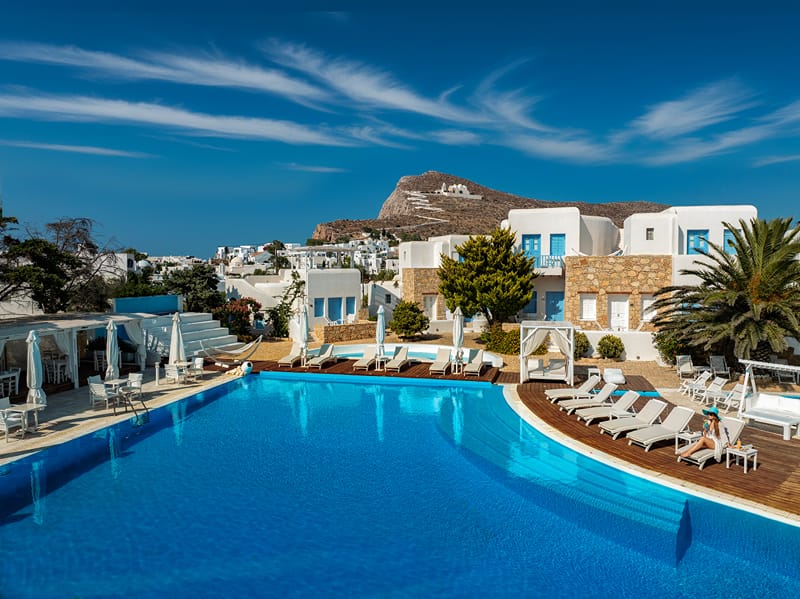
Chora Resort Folegandros
Set in the island's main village, 3 km from the port of Karavostasis, with views of the Aegean and the 13th-century Venetian fortress close by.
View on TRVL ↗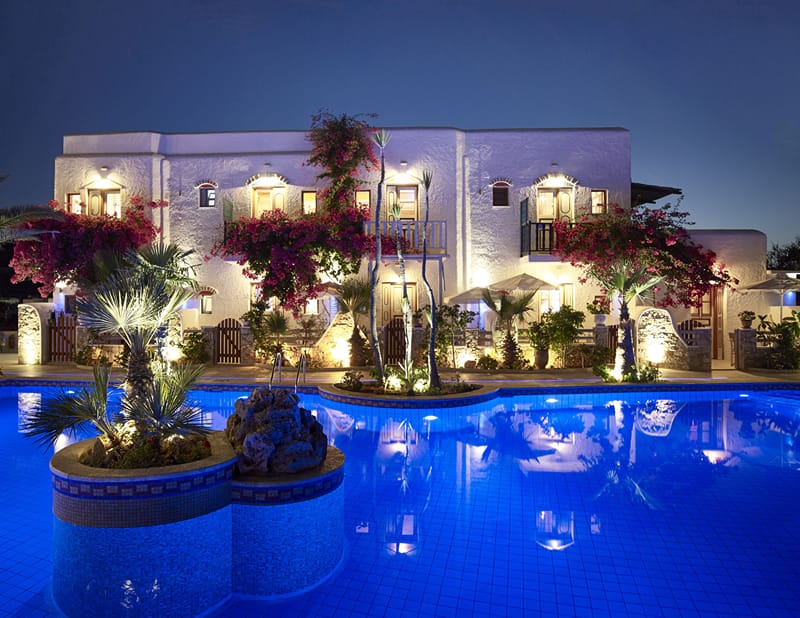
Polikandia Hotel Folegandros
A family-run hotel just 60 metres from the heart of the traditional village of Chora, with hanging gardens, palm trees, a 128-square-metre pool and a Jacuzzi.
View on TRVL ↗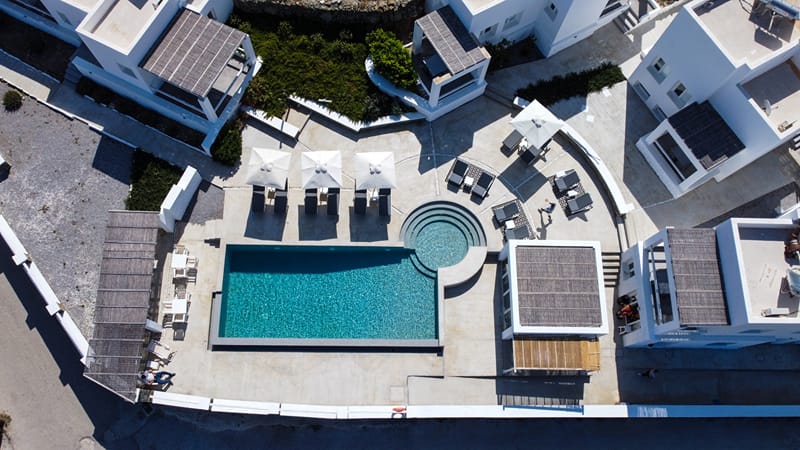
Lemon Tree Houses
Five boutique villas in a minimal Cycladic style, set among cultivated fields and dry-stone walls, each with two private verandas looking out over the Aegean.
View on TRVL ↗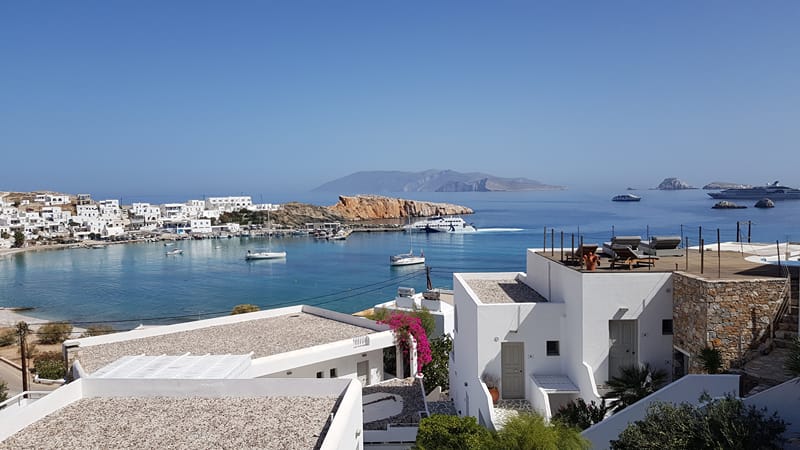
Vrahos Boutique Hotel
Built amphitheatrically on the rocky slope opposite the port, looking over the harbour and the Aegean towards Sikinos and Santorini, with Vardia, Chochlidia, Vitsentzou and Latinaki beaches close by.
View on TRVL ↗The Essence
Folegandros asks very little of you: a pair of walking shoes, a seat on a small boat, and an appetite. Climb to Panagia at sunset, wander the Kato Rouga in the Kastro after dark, take the morning boat to Katergo, follow a stone path through the fields of Ano Meria to the lighthouse, and finish with a plate of matsata in Chora. Come at Easter, when the whole island walks with its icon, or in September, when the sea is warm and the light turns gold, and the island will have shown you its best side.