
On the north coast of Milos there is a stretch of shore where the rock is so pale and smooth that people call it the moon. Sarakiniko is greyish-white volcanic stone, carved by north winds and waves into ridges and hollows, with a small strip of fine white sand. Swimmers spread their towels on the rock itself and jump from its edges. It is one of the most photographed landscapes in the Aegean, and it is only the start: Greece's tourism board describes Milos as a volcanic island of black, white, red and yellow rock, with more than 70 beaches.
This guide is for planning a trip around that geology. Milos sits in the southwestern Cyclades, roughly halfway between Piraeus and Crete, and its stone has shaped everything here, from the obsidian islanders traded thousands of years ago and the minerals still quarried today to the fishermen's boathouses cut into soft rock at the water's edge. Add a clifftop village built for sunsets, a boat trip to the sea caves of Kleftiko and a short list of excellent island pies, and Milos makes a strong case for a week rather than a weekend.
The Areas
Adamas (also written Adamantas) is the harbour town, on the island's great sheltered bay. It is the practical base: the ferries arrive here, the main bus terminal is about 100 m east of the port, many boat trips leave from the quay, and the Mining Museum is in town. Choose it if you are without a car or want restaurants and bars on your doorstep.
Plaka, the chief town, sits on a plateau above the bay, crowned by the hill of the Venetian castle. Trypiti, just below it, is a traditional village with white houses and windmills, close to the catacombs and the site of the ancient city. These two suit travellers who want evenings in lanes rather than on a harbour front, and the best sunset views on the island.
Pollonia, in the northeast, is the island's second harbour, a fishing village with a sandy main beach and seafood tavernas; small boats cross from here to neighbouring Kimolos. It is a good choice for a quieter stay with an easy swim.
Then there are the fishing hamlets. Klima, Mandrakia, Firopotamos, Areti and Fourkovouni are small harbours in coves, lined with syrmata: semi-underground boathouses cut into the soft rock at the waterline, painted in bright colours. They were built to shelter fishing boats in winter and bad weather, and many are now used for summer stays. Klima, below Trypiti, is the best known, and staying there means waking up a few steps from the sea.

What to See and Do
Start in Plaka. Climb towards the castle for the views over the bay, and time the walk so you reach Panagia Korfiatissa, the church that serves as Plaka's sunset viewpoint. The Folklore Museum is just behind it. The Archaeological Museum is housed in a neoclassical building designed by Ernst Ziller, and a copy of the Venus de Milo greets visitors at the entrance.
The original was found by a farmer on 8 April 1820, near the ancient city of Melos, and has been in the Louvre since 1821. The ancient town lay between Trypiti and Klima, and what you can see today is above all its theatre, of Roman date. A short way off are the catacombs, an early Christian communal cemetery used from the 1st century AD and among the largest in Greece. Their corridors, cut into the volcanic rock, run to about 200 metres, between 1 and 5 metres wide; they are open to the public, with the entrance through one of the three groups of galleries. Walking from the catacombs to the theatre and down to Klima makes a good morning.
In Adamas, the Mining Museum tells the island's longest story. Milos obsidian was a traded commodity as early as 15,000 years ago, and bentonite, perlite and pozzolana are still extracted in open pits today, with small quantities of kaolin. The museum was founded in 1998 by the mining company S&B Industrial Minerals and has an audio guide in five languages. If it whets your appetite, the island's Miloterranean geotourism initiative maps seven geological walking routes. On the road to Pollonia, Fylakopi is one of the most important prehistoric settlements of Cycladic culture.
Milos also has two climbing areas, Tourla of Vanios and Glaronisia, and hot springs that were noted in antiquity, including by Hippocrates.

Beaches by the Wind
With more than 75 beaches on a horseshoe-shaped island, the question on Milos is not where to swim but which side to choose. The island's tourism office gives a simple rule: when the meltemi or another northerly wind blows, go to the beaches inside the bay or, better still, to the south coast; when the wind comes from the south, go north. The meltemi blows roughly from mid-May to mid-September, is usually strongest in the afternoon and often eases at night.
North coast, for calm days: Sarakiniko, Papafragas, Firopotamos, Plathiena, Mandrakia and the beaches around Pollonia. Sarakiniko is the famous one; there are only a couple of trees for shade at the back, so go early or late. Firopotamos pairs a beach with a tiny fishing harbour of syrmata.
South coast, for the meltemi: Paliochori, Firiplaka, Tsigrado, Provatas, Agia Kyriaki, Gerakas and Kipos. Paliochori is backed by coloured volcanic cliffs, has tavernas, and there are warm patches in the shallows.
Kleftiko is the island's set piece and is reached by boat. On the south coast, grey-white rocks rise from the water, hollowed by wind and sea into caves and arches; many people call it the sea Meteora, and pirates once used it as a hideout, which gave it its name. Caiques, boats and sailing yachts leave daily from Adamas and Pollonia on trips around the island, stopping at beaches reachable only from the sea. Much of the west of the island cannot be reached by ordinary vehicles, so a day on the water is the way to see it.

What to Eat and Drink
The dish to look for is pitarakia, small pies filled with a peppery dry cheese or with myzithra and mint; the island's tourism office calls them among its most representative foods. Ladenia is a flatbread-style pie topped with olive oil, tomato and onion. Karpouzopita, a sweet, fragrant pie made with watermelon, belongs to summer.
Tavernas cook octopus grilled or braised in wine, local rooster in a red sauce or in wine, oven-baked lamb with tomato paste, fresh fish and lobster pasta. Kakavia, the fishermen's soup, and goat cooked in a wood oven turn up on menus too. For something to take home, look for manoura cheese, capers, kritamo (rock samphire), sun-dried tomato paste and koufeto, a sweet of soft squash with honey and almonds that is traditionally served at weddings and engagements by the bride's mother.
Getting There and Around
Milos Airport is about 4 km from Adamas, around five minutes by car, and there is no bus to or from it. Sky Express flies from Athens year-round, and the flight takes about 30 to 40 minutes; Aegean Airlines adds a seasonal service from Thessaloniki.
Ferries leave from Piraeus and arrive at Adamas, and the route runs all year. Crossings take from about 2.5 hours on a Seajets high-speed boat to around 7 hours on conventional ferries that stop at Kythnos, Serifos, Sifnos and sometimes Kimolos on the way. Operators include Seajets, Blue Star Ferries, Minoan Lines, Aegean Sea Lines, ANEK Lines and Fast Ferries, with fares from around €33. In summer tickets sell out fast, so book well ahead. In summer there are also frequent connections to other Cyclades, Crete and Rhodes.
On the island, Milos Buses runs from the Adamas terminal to Plaka, Trypiti, Pollonia, Paliochori, Achivadolimni, Sarakiniko and Provatas, with tickets bought on board; schedules change with the season, so check milosbuses.com shortly before you arrive. There are only about 15 taxis, found at the port and the airport. Scooters, quad bikes, buggies and cars can all be hired; parking is tight in the villages, and offline maps help on the dirt roads.
When to Go
Milos is reachable all year by ferry and plane, but its season runs from late spring into autumn. June and September are a good balance: the boats and buses are running, and you avoid the weeks when ferry tickets are hardest to get. The meltemi season, from mid-May to mid-September, is the time to plan around the wind, swimming in the south when it blows and in the north when it drops. July and August bring the longest days and the most company; book ferries, cars and boat trips early. In the shoulder months, keep a day or two in hand for boat trips, which depend on the sea.
Good to Know
- Book your ferry early for summer; Piraeus sailings are the cheapest way in but sell out.
- There is no airport bus, so arrange a transfer, taxi or hire car for arrival.
- With about 15 taxis on the island, a car or scooter gives you much more freedom.
- Check the wind forecast each morning and choose north or south coast accordingly.
- Boat trips to Kleftiko depend on the weather; keep a spare day in your plans.
- Sarakiniko has almost no shade; bring water, a hat and shoes for the rock.
- The Milos Tourist Office is in Plaka, tel. +30 22870 22445.
Our Picks
- To swimSarakiniko
Bone-white volcanic rock shaped by wind and waves; come early or late and only on a day without a north wind.
- To seeKleftiko
Sea caves and arches in grey-white rock, once a pirates' hideout, best seen on a calm-day boat trip around the island.
- To seeThe Catacombs
Early Christian galleries cut into the volcanic rock, about 200 metres of corridors; combine with the Roman theatre and the walk down to Klima.
- To seeMilos Mining Museum
The island's geology and mining story, with an audio guide in five languages.
- To walkPlaka to Panagia Korfiatissa
The castle hill and the clifftop church for sunset, with the Folklore Museum just behind.
- To walkKlima and the syrmata
A row of brightly painted boathouses cut into the rock at the water's edge.
- To swimPaliochori
Coloured volcanic cliffs, tavernas and warm shallows; the place to go when the meltemi blows.
- To swimFiropotamos
A small beach beside a fishing harbour of syrmata, for a still day.
- To eatEnalion
A family-run seafood taverna serving fish from local fishermen, on the waterfront of the island's second harbour.
Where to Stay
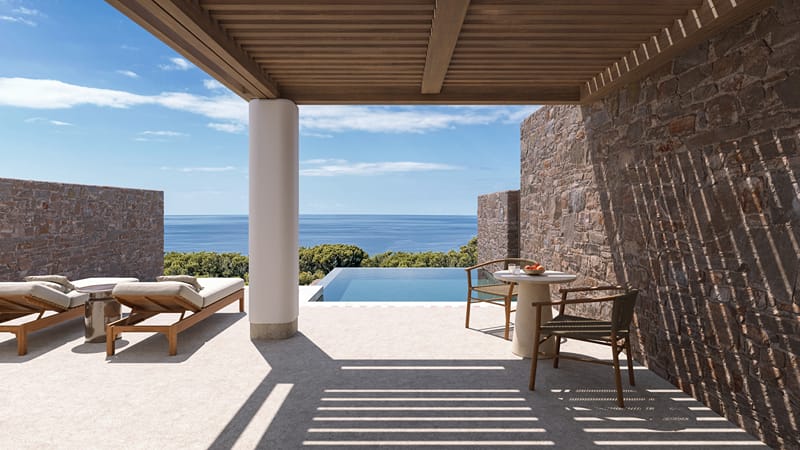
Eréma
41 suites, each with a private pool and panoramic views of the Aegean, in a hotel designed to achieve LEED Gold certification.
View on TRVL ↗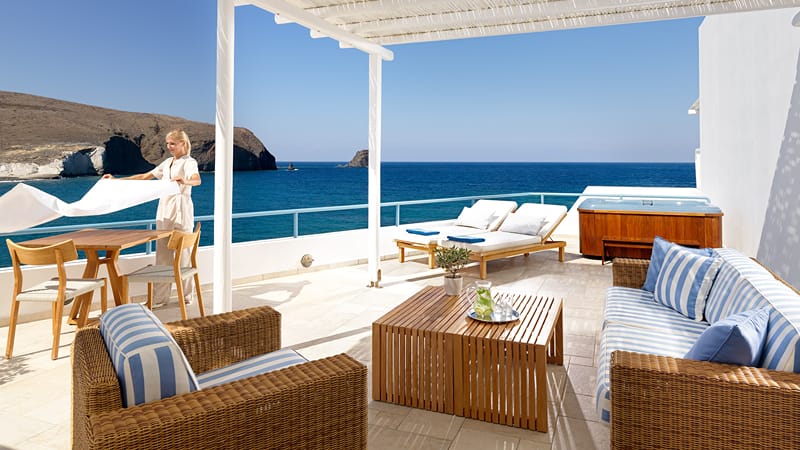
Melian Boutique Hotel
A traditionally designed boutique hotel in the fishing village of Pollonia, with individually designed suites, handcrafted furniture and private terraces, many with their own Jacuzzi.
View on TRVL ↗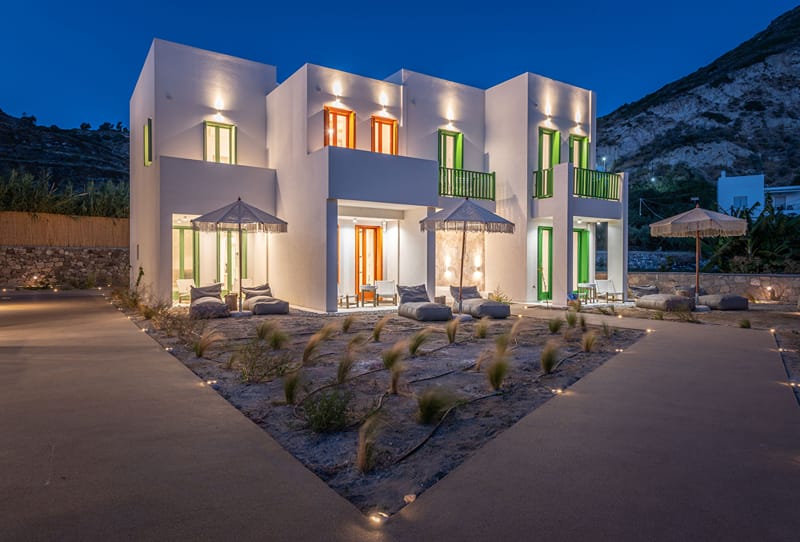
Klima Bay Beachfront
Beachfront houses in the fishermen's village of Klima, blending traditional Cycladic architecture with modern amenities, with panoramic views of the bay.
View on TRVL ↗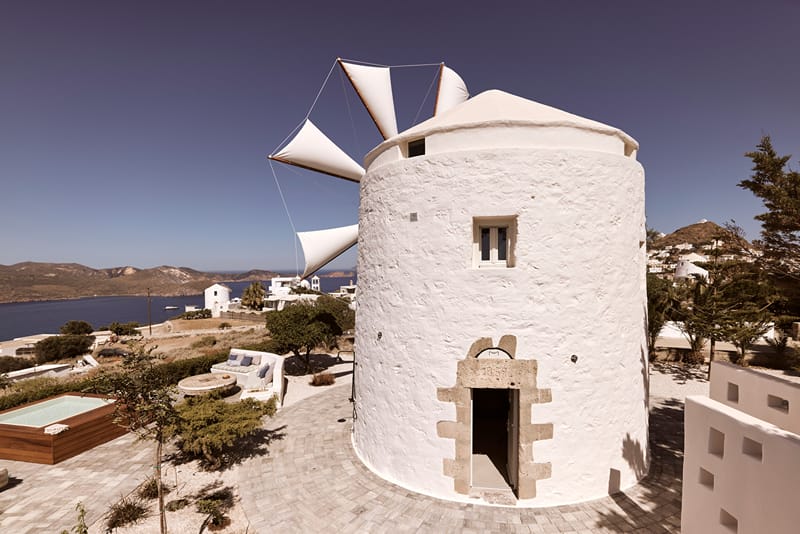
Windmill Karamitsos since
A renovated, amphitheatrically built windmill with sea views, a short distance from Milos port.
View on TRVL ↗The Essence
Milos rewards the traveller who reads its stone and its wind. Swim off white rock on the north coast on a still morning and under coloured cliffs in the south when the meltemi rises; take a boat to the caves of Kleftiko; walk from the catacombs past the theatre down to the painted boathouses of Klima; eat pitarakia; and climb to Plaka for the evening light. It is an island made of rock, and it is very good at giving you somewhere new to swim every day.