
The boat swings in between two old bastions, and the whole town is there at once: grey stone mansions climbing an amphitheatre of rock around a harbour full of yachts and fishing boats. Then you step ashore and notice what is missing. No cars, no scooters, no traffic. On Hydra vehicles are not allowed, so people walk, luggage goes on the backs of donkeys and mules waiting on the quay, and anything further away is reached by water taxi.
The mansions were built by the captains and shipowners who made the island rich in the 18th century and then gave their ships to the Greek War of Independence in 1821. In the 20th century painters, writers and musicians came for the light and the quiet, and some stayed. Today Hydra is the easiest island escape from Athens that still feels like a different world: an hour or so by fast boat from Piraeus, then nothing but stone lanes, sea ladders and a long coastal path.
The Areas
Almost everything happens on the north coast, within walking distance of the port. The interior is mountain, pine and monastery, crossed only by paths.
- Hydra Town — the harbour and the lanes rising behind it, with the museums, most of the tavernas, the bars on the quay and almost all the hotels. Stay here for the evenings and for the ease of arriving on foot; be ready for steps, since some houses sit well up the slope.
- Kamini — about 1 km west of the port along the coast road, a small fishing harbour with fish tavernas. It suits anyone who wants a quieter base close to town and a swim on the doorstep.
- Vlychos and Plakes — around 2 to 3 km west, a pebble bay with tavernas and, just beyond it, the cove at Plakes. A good choice for long beach days, and a pleasant walk or a short water-taxi ride from town.
- Mandraki — 2.5 km east of the port, the island’s sandy bay, an organised beach linked to the harbour by boat. Suits families and those who want the sea first and the town second.

What to See and Do
Start at the mouth of the harbour, where the bastions still hold their cannons and a statue of Admiral Andreas Miaoulis, born on Hydra, stands above the left-hand battery. From there the quay leads round to the Church of the Assumption, founded in 1643, with a tall bell tower of Tinos marble; inside is a small ecclesiastical museum of icons and vestments from the 18th and 19th centuries.
On the waterfront, a large stone mansion that belonged to the shipowner Gikas Koulouras houses the Historical Archives Museum of Hydra, founded in 1918. It holds manuscripts from the Revolution, maps, ship models, naval instruments, costumes and paintings, along with a library of old books.
The finest house to visit is the Lazaros Koundouriotis Historical Mansion on the west side of the harbour, built in the late 18th century for one of the island’s leading figures, who put his ships and fortune into the War of Independence. Run by the National Historical Museum, it shows family heirlooms on the ground floor, island folk art and paintings of Hydra by Panayiotis Tetsis on the first, and works by Periklis Vyzantios and his son Dikos in the old cellars. It opens daily, 10:00–16:00, from 25 March to 31 October; a full ticket is €10, €5 reduced, free under 18.
Hydra’s art scene has deep roots. The Tombazis mansion, built around 1800 for the admiral Manolis Tombazis, has belonged to the Athens School of Fine Arts since 1936, housing students and artists and hosting exhibitions. The former home and studio of Panayiotis Tetsis is now a small museum. And in an old slaughterhouse by the sea, the DESTE Foundation has run a contemporary art project space since 2009, with a Jeff Koons sun on its roof that has stayed for good. This year’s show, Nari Ward: Until That Day, runs until 31 October 2026, open daily except Tuesday, 11:00–13:00 and 18:00–21:00 in October.
If you have a morning and good legs, climb to the Monastery of Profitis Ilias, founded in 1813 by monks from Mount Athos at around 500 metres, just below the island’s highest peak. The cobbled path starts at the church of Agios Konstantinos; allow a good two hours from the port. Theodoros Kolokotronis, hero of the Revolution, was once held in its cells for four months. The view back over the town and the sea is the reward.

Walks and Swimming Spots
With no roads to speak of, the coastal path west of the port is Hydra’s main street for swimmers. Walk out past the cannons and you reach Spilia, rocks with ladders into deep water right at the edge of town, and Hydronetta just beyond, also rocky, both with a bar nearby. Mind the sea urchins and wear something on your feet.
Keep going for about 20 minutes and the path drops into Kamini, with its little harbour and tavernas. Another stretch along the shore brings you to Vlychos, a pebble bay with sunbeds and tavernas; count on 30 to 45 minutes from the port in all. Water taxis wait in the centre of the harbour if you would rather walk one way and ride back. The quieter Avlaki, below the path, has no facilities at all.
For sand, take the boat or walk east to Mandraki. Further away, Molos, Bisti and Agios Nikolaos on the southwest coast are reached by water taxi or excursion boat, and they are worth it on a calm day: white or grey pebbles, pine slopes and far fewer people. Bisti has sunbeds for rent; Molos has none.
What to Eat and Drink
Hydra grows very little, so the table is about the sea and about the island’s cooks. Look for local squid, fish of the day on the grill and the classic oven dishes of the old tavernas, followed by coffee on the quay.
The sweet to bring home is the Hydra amygdalota: almonds, flower water, semolina and sugar, shaped like small pears, baked, dusted with icing sugar and finished with a clove. The Tsagaris family has made them since Aristides Tsagaris began selling them in 1930 at his café near the harbour; the shop is on Tombazi.
Xeri Elia Douskos, in a square shaded by an old wisteria, is a taverna of about 180 years with traditional cooking, squid, fish and grilled meats, and often music in the evenings in season. Kryfo Limani, in a family courtyard with a lemon tree and a vine about 200 metres up from the harbour, serves grilled fish of the day and homemade dishes. At Vlychos, Marina has cooked on its rocky perch above the beach since 1963: marinated anchovies, pies with wild greens, moussaka and galaktoboureko. For something more modern, Caprice, in a former sponge warehouse just behind the port since 1994, does handmade pizza, fresh pasta and cuttlefish risotto.
Getting There and Around
Hydra is a classic weekend away from Athens. High-speed boats leave from Piraeus; operators on the route include Blue Star Ferries, Alpha Lines and Magic Sea Ferries, and the crossing usually takes between 1 hour 5 minutes and 1 hour 30 minutes, with some slower sailings longer. In summer, roughly May to September, there are around ten departures a day; for the rest of the year expect at least two. The boats carry no vehicles. Timetables change by season, so check and book with the operators or a ferry booking site before you travel; at peak times the boats fill up.
By car, drive to Metochi on the Peloponnese coast opposite the island, about 2 hours 25 minutes from Athens via the Attiki Odos, the Athens–Corinth road and the road to Epidavros, then leave the car and cross by small ferry or water taxi.
On the island you walk. Donkeys and water taxis wait at the centre of the harbour, the first for luggage and the hill, the second for the beaches and Kamini. Ask the price before you set off.
When to Go
Late spring and early autumn are the easy months: the sea is warm enough, the paths are pleasant to walk, and the Koundouriotis mansion is open until the end of October. Summer brings the crowds and the festivals. The Miaoulia, over three days at the end of June, remembers the island’s sailors in the War of Independence with a fireworks re-enactment of a naval battle in the harbour, boat races and dancing.
Easter is the other great moment. On Good Friday the Epitaphios procession in Kamini ends at the harbour, where the bier is carried into the sea to bless the waters, and on Easter Sunday an effigy of Judas is burned in the port with fireworks.
Out of season Hydra has a charm of its own. The day boats thin out, the paths are cool enough for the climb to Profitis Ilias, and the town belongs to its residents again. The island’s largest religious feast falls on 14 November, for its own saint, Agios Konstantinos. Boats still run daily, and places such as the Isalos café on the waterfront stay open all year.
Good to Know
Pack light and pack a bag you can carry: lanes are stone, often stepped, and some hotels sit up long flights of stairs. Bring water shoes for the rocks and the urchins. Some tavernas, beach bars and hotels run only part of the year, and the Koundouriotis mansion opens to groups only by arrangement in winter, so book ahead and check opening days. In summer, book boats early, especially for Friday evening and Sunday evening returns.
Our Picks
- To seeLazaros Koundouriotis Historical Mansion
A captain’s house of the late 18th century with island folk art and paintings by Tetsis and the Vyzantios family; open until 31 October.
- To seeHistorical Archives Museum of Hydra
Revolution manuscripts, maps and ship models in a shipowner’s stone mansion on the quay.
- To seeDESTE Foundation Project Space
Contemporary art by the sea under a Jeff Koons sun; Nari Ward’s show runs until 31 October 2026.
- To walkCoastal path to Kamini and Vlychos
The island’s main promenade, past swimming rocks and fishing boats to a pebble bay and lunch.
- To walkMonastery of Profitis Ilias
A two-hour climb on a cobbled path to an 1813 monastery and the widest view on the island.
- To swimSpilia
Ladders into deep water a few minutes from the port, for an early swim before the boats arrive.
- To eatXeri Elia Douskos
A 180-year-old taverna under a wisteria, with squid, grilled fish and, many evenings in season, music.
- To eatMarina
Since 1963 on the rocks above the beach, with wild-green pies, anchovies and galaktoboureko.
- To eatTsagaris almond sweets
The pear-shaped Hydra amygdalota made by the same family since 1930.
Where to Stay

Mandraki Beach Resort
A luxury hotel on the historic bay where ships were built and launched in the 1800s, permeated by an aura linked to Admiral Andreas Miaoulis.
Read article
Bratsera Hotel Hydra
A sponge factory established in 1860 and restored into a boutique hotel close to the port, with a garden and pool and a restaurant in a restored traditional water mill.
View on TRVL ↗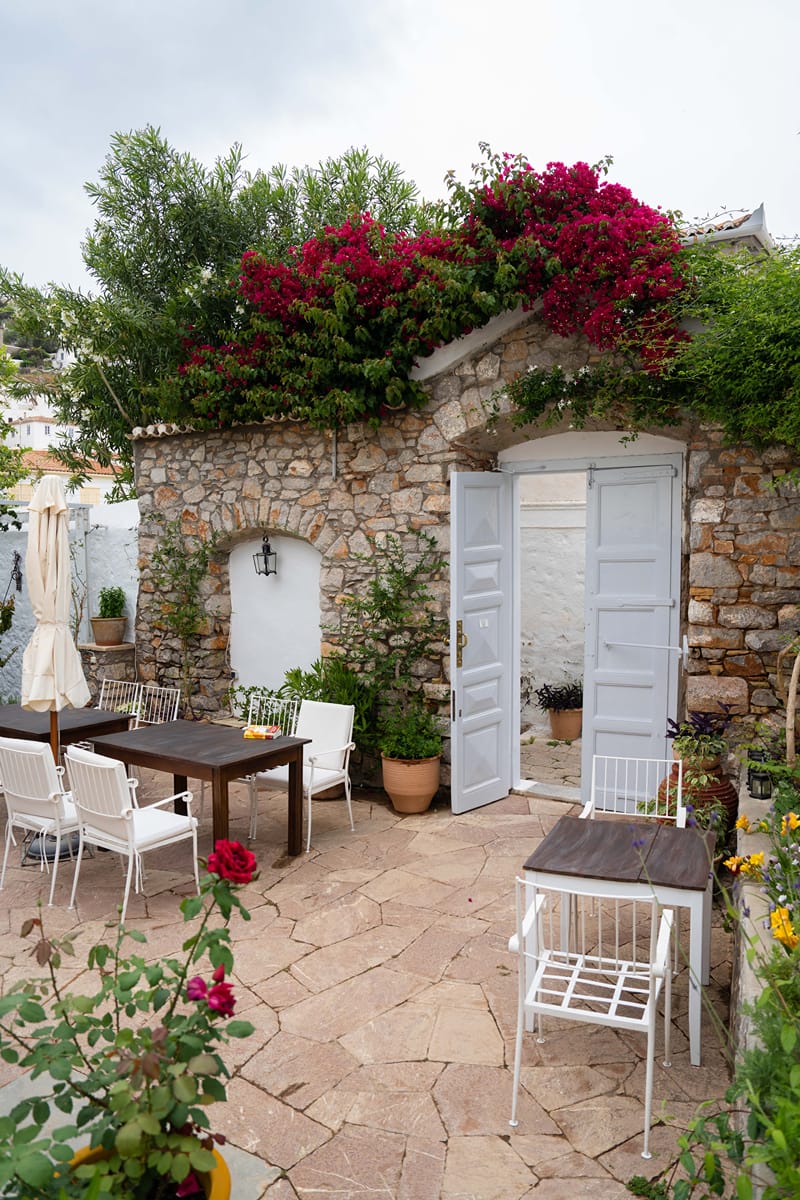
Miranda Hotel Hydra
A sea captain’s mansion built in 1810 and declared a building of National Heritage, a guest house since 1961 that has hosted many Greek and foreign art exhibitions.
View on TRVL ↗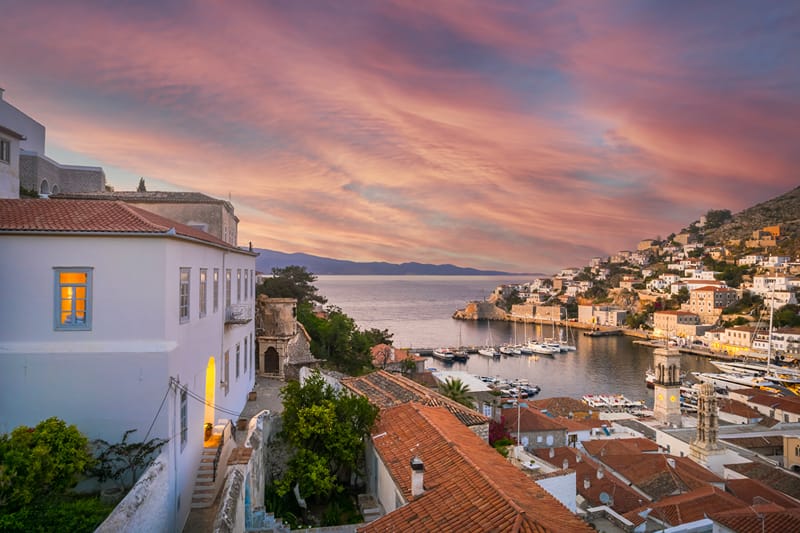
Hydra Hotel
A chic small hotel of eight rooms in a building from the turn of the century, with panoramic views over the town and the port, reached by 141 steps.
View on TRVL ↗The Essence
Hydra asks you to slow to the pace of your own feet, and repays it handsomely. A swim off the ladders at Spilia before breakfast, a morning among captains’ portraits and contemporary art, the coast path to lunch at Vlychos, a water taxi home at sunset, an amygdalo with your coffee on the quay. Come for a weekend from Athens in June, or for a quiet week in November; the boat is never more than a few hours away, and the island is always on foot.