
In Dublin the music starts in the pub. Every night in Smithfield, players gather in the front room of the Cobblestone with uilleann pipes, fiddles and a bodhrán; on Merrion Row, O'Donoghue's has live music seven nights a week; by the river, the Brazen Head, which traces its story to 1198, begins its session at nine. Between the pints lie Georgian squares of red brick and coloured doors, a university founded in 1592, and national museums you can walk into for free.
Then there is the sea. A train ride from the centre, Howth has a fishing harbour, cliff paths and seals between the boats, and Dalkey has bookshops, delis and a walk up Killiney Hill. Dublin rewards a long weekend in the centre, but it is at its best when you give a day to its villages: the cottages of Stoneybatter, the cafés of Portobello and Ranelagh, and the coast to the north and south, both reached by DART.
The Areas
The River Liffey divides Dublin into the northside and the southside. Most sights sit within walking distance of one another in the centre, and the neighbourhoods just beyond it are a short walk, bus or Luas ride away.
- Temple Bar — the cobbled district on the south bank of the Liffey, known since the mid-1990s for pubs, live music and nightlife, but also home to Photo Museum Ireland, the Irish Film Institute and a Saturday food market. Best for first-timers who want to be in the thick of it; quieter Cow's Lane, at the Christchurch end, has independent shops and cafés.
- The Georgian south side — Merrion Square, St Stephen's Green and the streets between them, built when 18th-century Dublin was one of Europe's largest cities. Red-brick façades, granite steps and coloured doors, with the National Gallery and National Museum close by. Elegant and central, and good for culture-led trips.
- Portobello — a fairly quiet residential neighbourhood of Georgian townhouses and cottages by the Grand Canal, just south of the centre. Historically the centre of Dublin's Jewish community, with the Irish Jewish Museum open on Sundays. Suits couples and longer stays.
- Ranelagh — red-brick townhouses, leafy squares and a main street of bookshops, restaurants and Italian cafés, with Luas stops at Ranelagh and Beechwood. Good for food lovers who want a neighbourhood feel.
- Stoneybatter — Dublin's original urban village, a streetscape of Victorian terraced cottages with gastropubs and cafés, named by Time Out one of the world's coolest neighbourhoods in 2019. Close to the Phoenix Park and the National Museum at Collins Barracks.
- Smithfield — a former warehouse district on the north bank where glass and steel apartments overlook a cobbled square, with the Jameson Distillery, the Light House arthouse cinema and the Cobblestone pub. Good for music and whiskey.
- Howth and Dalkey — seaside villages on the coast north and south of the city, both with their own DART station. Howth is about 25 minutes by train from the centre and Dalkey about half an hour. Easy day trips, or a quieter base for walkers.

What to See and Do
Start at Trinity College, Ireland's oldest university, created by royal charter in 1592. Its Old Library holds the 1,200-year-old Book of Kells. The Book of Kells Experience costs from €25, takes about 90 minutes and includes the Long Room and three digital exhibitions in the Red Pavilion; entry is timed and booking online is strongly recommended. Note that the Long Room's books have been removed for the Old Library redevelopment project, except in the first four bays. It opens daily from 8:30 (9:00 on Sundays) until 18:30, or 19:00 on Fridays and Saturdays.
Many of Dublin's best collections are free. The National Museum of Ireland on Kildare Street shows Ireland's archaeology, from the gold of Ór – Ireland's Gold to the Treasury and Viking Ireland; it is open Tuesday to Saturday from 10:00 to 17:00 and on Sundays and Mondays from 13:00 to 17:00. Across the river, the branch at Collins Barracks fills four floors of an 18th-century barracks with the Asgard yacht and a gallery for the designer Eileen Gray. On Merrion Square West, the National Gallery of Ireland is open seven days a week, until 20:30 on Thursdays, and entry to its permanent collection is free.
West of the centre, the Guinness Storehouse fills seven floors of what was once the brewery's fermentation plant at St James's Gate. The visit ends at the Gravity Bar, with 360-degree views across the city to the Wicklow Mountains and the Phoenix Park. Allow two to three hours and book a timeslot in advance; visitors under 18 get a soft drink instead. A little further on, Kilmainham Gaol, which held prisoners from 1796 to 1924, including leaders of the rebellions of 1798, 1803, 1848, 1867 and 1916, is now a museum seen by guided tour only. Tickets cost €8 for adults and must be booked online, only on the official site.
Back in the centre, St Patrick's Cathedral, founded in 1191, is the national cathedral of the Church of Ireland and the burial place of Jonathan Swift, who was its dean. Its choir, founded in 1432, still sings daily in school term.

Pubs and Live Music
The Dublin pub is less a bar than an institution, and the oldest ones are worth a visit for their rooms alone. The Brazen Head on Lower Bridge Street says there has been a hostelry on the site since 1198; the building you see dates from 1754, a coaching inn whose rooms once sheltered the United Irishmen. The Long Hall, established in 1766, keeps its mahogany bar, stained glass and Victorian port and brandy dispensers.
For traditional music, the Cobblestone in Smithfield calls itself a drinking pub with a music problem: a session every night in the front room, and a Wednesday session in the back for those learning to play. O'Donoghue's, where the Dubliners were launched in the 1960s, has music from 21:00 every night and from 17:00 on Saturdays. At the Brazen Head, the nightly sessions start at 21:00 with no entry fee, and in Temple Bar, Gogarty's and the Old Storehouse have music from the afternoon. In January, TradFest fills the pubs and venues of Temple Bar with a programme of its own.
Whiskey has its home in Smithfield, where the Jameson Distillery Bow St. stands on the spot where it was founded in 1780. Tours include a comparative tasting, and you can sample whiskey straight from the cask in the city's only maturation warehouse.

What to Eat and Drink
Irish cooking is built on seafood, meat, dairy, oats and the potato. Look for Dublin coddle, a casserole of potato, sausages, rashers and onion; bacon and cabbage with parsley sauce; lamb stew; boxty, a potato pancake of mashed and raw potato; and colcannon and champ, mash with kale or spring onions folded through. The full breakfast brings sausages, rashers, and black and white pudding. From the sea come oysters, Dublin Bay prawns, potted crab, smoked salmon on buttered soda bread and seafood chowder.
The Boxty House in Temple Bar makes its namesake the house speciality, John Kavanagh's in Glasnevin, known as the Gravediggers, is famous for coddle, and Leo Burdock's at Christchurch fries classic fish and chips. On Saturdays the Temple Bar Food Market takes over Meeting House Square, with farmhouse cheeses, Bretzel Bakery bread and an oyster stand where native Irish oysters come on seaweed with a glass of white wine. In Stoneybatter, L Mulligan Grocer pairs gourmet pub food with craft beers and rare whiskeys. In Howth, King Sitric at the start of the East Pier is the place for crab claws and lobster.
Getting There and Around
Dublin Airport has two terminals and direct flights from most major cities in Britain and continental Europe. Two coach companies run into town. Dublin Express departs every seven and a half minutes and can reach the city in as little as 14 minutes on its fastest service, with city stops that include Aston Quay, Trinity College and Heuston Station. Aircoach runs up to every 15 minutes, with fares to the city from €8.
In the city, buses, the Luas tram and the DART share the TFI Leap Card, which is up to 30 per cent cheaper than paying cash. With the TFI 90-minute fare, an adult pays €2.00 and can change between Dublin Bus, Luas, DART and commuter rail within Zone 1 for 90 minutes; Express and Nitelink buses cost €2.40. Fares are capped at €6.00 a day and €24.00 a week. The Leap Visitor Card gives unlimited travel in Zone 1 for 24 hours (€8), 72 hours (€18) or 7 days (€24), starting from first use; you can buy it at the airport, at WHSmith in Terminal 1 for 24-hour cards and at the Spar in Terminal 2. The DART coastal railway serves both Howth and Dalkey, and the centre itself is best on foot.
When to Go
Dublin is mild all year. Average temperatures are about 8°C in spring, 15°C in summer, 10°C in autumn and 5°C in winter, and Met Éireann notes that summer days inland normally reach 18 to 20°C. Summer suits the coast walks, and January brings TradFest. Pack a waterproof in any month.
St Patrick's Day, 17 March, is a national holiday, and the city celebrates over several days. The St Patrick's Festival 2027 runs from Saturday 13 to Wednesday 17 March. In 2026 the parade ran from Parnell Square to the junction of Kevin Street and Cuffe Street, watched by around half a million people; it is free to watch, with paid grandstand seats along the route. Expect trad gigs, céilí dancing and family events, and book accommodation well ahead.
Good to Know
The currency is the euro, and plugs are the three-pin type at 230V. A few big names are closed for now: Dublin Castle is closed to the public until the end of 2026, the Chester Beatty in its grounds is closed from 15 June to the end of December 2026, and the National Museum on Merrion Street, the Victorian natural history museum known as the Dead Zoo, is shut for refurbishment, with part of its collection on show at the Dead Zoo Lab at Collins Barracks. Check before you go.
Book the Book of Kells, the Guinness Storehouse and Kilmainham Gaol ahead; Trinity tickets are non-refundable, and Kilmainham tickets are valid only from its official website. Tourist information centres are on Upper O'Connell Street and at Barnardo Square near Dame Street, and the emergency numbers are 999 and 112.
Our Picks
- To seeThe Book of Kells Experience
The 1,200-year-old manuscript and the Long Room in one timed ticket; book online and go early.
- To seeNational Museum of Ireland, Kildare Street
Irish gold, the Treasury and Viking Ireland, free to enter.
- To seeNational Gallery of Ireland
A free permanent collection, open seven days and until 20:30 on Thursdays.
- To seeKilmainham Gaol
Guided tours through the cells of a prison that held the leaders of five rebellions; pre-booking is essential.
- To drinkThe Cobblestone
A trad session every night in the front room, and a learners' session on Wednesdays.
- To drinkO'Donoghue's
The pub that launched the Dubliners, with music from 21:00 every night.
- To eatThe Brazen Head
Bacon and cabbage, stews and a free nightly session in a pub that dates its story to 1198.
- To eatTemple Bar Food Market
Saturday stalls of Irish cheese, bread and native oysters on seaweed.
- To walkHowth Cliff Path Loop
Six kilometres of heather and sea cliffs, past Balscadden Bay, a short walk from the DART.
- To walkKilliney Hill
Follow the coast along Vico Road to the obelisk for a view over Killiney Bay as far as Wicklow.
Where to Stay

Wren Urban Nest
Within walking distance of the centre, near Powerscourt Townhouse, the Book of Kells and the Ha'penny Bridge, with a bar, restaurant and café.
View on TRVL ↗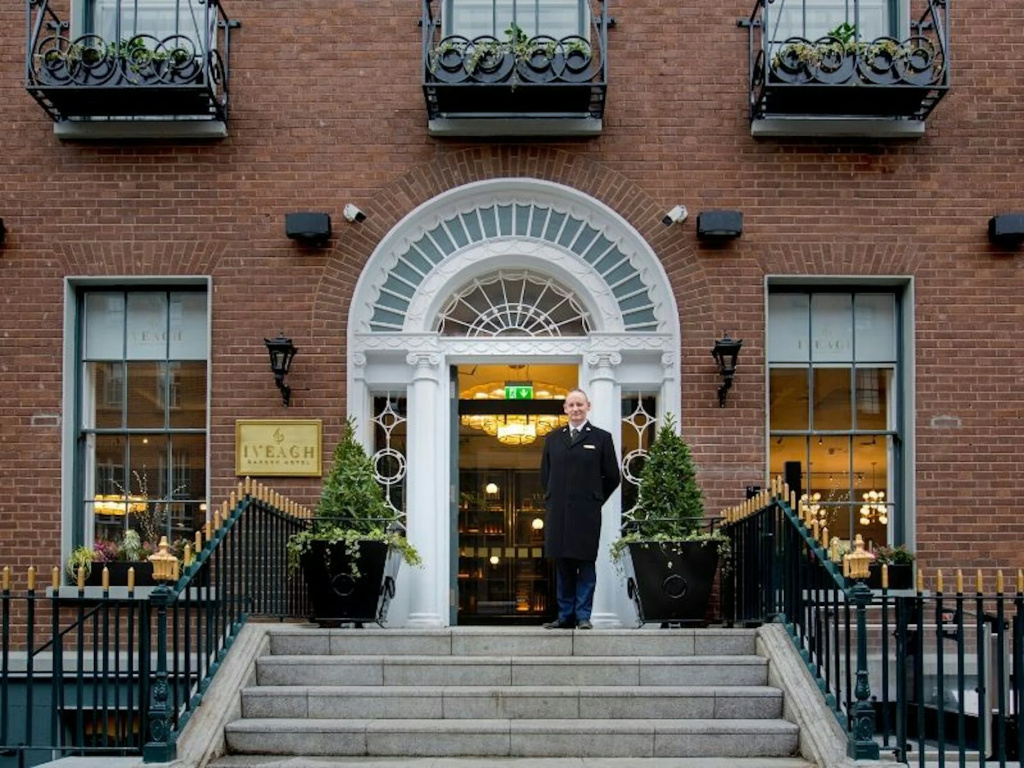
Iveagh Garden Hotel
Near St Stephen's Green, St Patrick's Cathedral and Powerscourt Townhouse, with a bar, restaurant and concierge.
View on TRVL ↗
Marlin Hotel
Within walking distance of the centre, close to St Stephen's Green and Powerscourt Townhouse, with a restaurant.
View on TRVL ↗
The Hendrick Smithfield
Within walking distance of the centre, near the Old Jameson Distillery, the Guinness Storehouse and Christ Church Cathedral, with a bar and restaurant.
View on TRVL ↗The Essence
Dublin is a city best taken at the pace of a pint. Spend the morning with the Book of Kells or the gold in Kildare Street, the afternoon in Stoneybatter or Ranelagh, and the evening in a front room in Smithfield while the pipes and fiddles start up. Then take the DART to the sea, walk the cliffs at Howth or climb Killiney Hill, and ride back into town in time for the next session.