
Evening on Mykonos has a fixed point: the row of windmills on the low ridge at the western edge of Chora, with Little Venice below, its painted wooden balconies hanging straight over the sea. People drift there from the lanes of the town to watch the sun go down, a glass in hand, and then turn back into the maze for dinner. Greece's tourism board calls Mykonos the island of the winds, and the wind explains much of what follows: where you swim, which side of the island you sleep on, even how the local ham is cured.
This guide is for planning a trip that gets the best of both sides of the island. The famous Mykonos of beach clubs, late nights and smart shops is real and easy to find. So is the other one: a 30-minute boat to Delos, one of the great archaeological sites of the Mediterranean, an inland village with a 16th-century monastery, a north-coast beach where lunch is cooked over charcoal, and a peppery cheese that has been made here for more than three centuries.
The Areas
Chora, the main town, is where most first-time visitors should stay. Its narrow paved lanes, churches, blue window frames and flower pots are at their best early in the morning and after dark. Little Venice (Alefkandra) and the windmills sit at its western end, and Kato Mili is the quieter edge of town between the windmills and the southern bus station at Fabrika. Staying here puts the museums, restaurants and the Old Port, where the Delos boats leave, within walking distance.
The south coast holds the busiest beaches and most of the hotels outside town. Ornos and Agios Ioannis, a short ride from Chora, suit families and anyone who wants an easy beach and a bus back to town. Platys Gialos and Psarou are set up for long beach days and are the starting point of the boats that hop east along the coast. Paradise and Super Paradise are the party beaches, with loud music from around four in the afternoon; Elia and Agrari are large and well organised but a little calmer.
Ano Mera, about 7 to 8 km east of Chora, is the only inland village, built around a big square lined with tavernas on three sides. It suits travellers who want a slower base with a car. The north coast, from Agios Sostis to Panormos and Ftelia, is wilder and windier, with fewer facilities and more space.

What to See and Do
Delos is the reason to set an alarm. The island, traditionally the birthplace of Apollo and Artemis, was inscribed on the UNESCO World Heritage List in 1990, and its ruins spread across almost the whole island: sanctuaries, houses, theatres and the Terrace of the Lions, dedicated by the Naxians to Apollo shortly before 600 BC, of which seven lions remain. Boats leave from the Old Port in Chora and the crossing takes about 30 minutes; the 2026 schedule of Delos Tours runs from 1 April to 30 November, with several departures a day in season. Admission to the site and its museum is €20 per person. A half-day guided tour with boat, entry and an English-speaking guide costs €79 per adult and leaves daily at 10:00. Timetables change with the weather, so check at the ticket office on the pier the day before, and go early, when it is cooler.
Back in Chora, Panagia Paraportiani, near Little Venice, is a cluster of chapels begun in 1425 and completed in the 17th century, and one of its chapels is open to visitors. The Archaeological Museum, near the northern bus station, is open all year and holds finds from the area. In Tria Pigadia, the Aegean Maritime Museum sits next to Lena's House, a restored 19th-century home that shows how a Mykonian family lived; both, like most of the town's smaller museums, keep summer hours from roughly April to October. The Folklore Museum occupies an 18th-century sea captain's house a few metres from Paraportiani.
In Ano Mera, the monastery of Panagia Tourliani, founded in 1542, is the focus of the square. Pair it with lunch in the village and an afternoon on one of the north-coast beaches.

Beaches and the Wind
In July and August the Cyclades are swept by the meltemi, a strong, steady wind from the north. On Mykonos this makes a simple rule: on windy days, head south. The best beaches are on the south coast, sheltered from the prevailing northerly, and that is where most visitors spend their days.
For a calm, easy swim, Agios Ioannis is small, good for snorkelling and rarely overcrowded; Ornos and Platys Gialos are busy family beaches with sunbeds, tavernas and frequent buses. Psarou is the polished, upmarket choice. Paranga has a quieter, undeveloped end on the right. Paradise and Super Paradise are for music and dancing, and Elia and Agrari, further east, are big and well equipped.
From Platys Gialos, converted fishing boats run along the coast to Paranga, Paradise, Super Paradise, Agrari and Elia during the day, which is the pleasant way to beach-hop without a car. There are also boats from Ornos.
The north and east coasts come into their own on still days. Agios Sostis is remote and quiet, with no sunbed rental. Panormos is long and has a beach club and restaurants; Fokos is small, with no facilities but a tavern. Ftelia faces north and is a windsurfing beach rather than a swimming one, and Kalafatis, on the east coast, is a favourite with windsurfers too. Megali Ammos, the beach nearest to town, catches the northerly wind and has no sunbeds or umbrellas.

What to Eat and Drink
Start with kopanisti, a salty, peppery Cycladic cheese with protected designation of origin that has been made on Mykonos for more than 300 years. Its heat comes from ripening and repeated kneading. The classic way to eat it is mostra: dry bread topped with kopanisti, chopped tomato and olive oil. Islanders also serve it as a meze with ouzo.
Louza is the local cured pork, rubbed with pepper and spices and air-dried before being sliced thin. Amygdalota, chewy almond sweets scented with rosewater, are the thing to take home. Look out, too, for stamnagathi, a wild green that some tavernas serve in season.
For a sit-down meal, the island splits neatly. In Chora, small tavernas in the backstreets near Paraportiani serve home-style dishes such as pastitsio, stuffed tomatoes and stifado. On the beaches, fish is usually sold by weight, so ask the price before you order. Sunset drinks in Little Venice are part of the ritual; book or arrive early in high season.
Getting There and Around
Mykonos Airport is about 4 km from Chora. The flight from Athens International Airport takes about 45 minutes, and from Thessaloniki about 1 hour 10 minutes. Airport buses leave from the Fabrika station in town in season, though not in the off-season; a taxi to town costs around €20.
Ferries sail from both Piraeus and Rafina. From Piraeus the crossing takes between about 3 hours 30 minutes and 5 hours 15 minutes, depending on the boat; from Rafina, which is closer to Athens airport, between about 2 hours 10 minutes and 5 hours 30 minutes. Mykonos has two ports: the Old Port in Chora, used by high-speed catamarans, and the New Port at Tourlos, about 2 km north of town, used by most ferries and cruise ships. A small SeaBus links Tourlos to town in about 12 minutes; walking takes about 45 minutes along a busy road with no pavement.
Cruise passengers should know that Greece charges a per-passenger fee for each port call, collected through the cruise line: at Mykonos it is €20 from June to September, with lower rates in spring, autumn and winter.
On the island, the KTEL Mykonos buses run from two stations: Fabrika in the south of town for the south-coast beaches (Ornos, Agios Ioannis, Platys Gialos, Paranga, Paradise) and the northern station near the Old Port for Ano Mera, Elia and Kalafatis. The two stations are about a 20-minute walk apart, and tickets can be bought online. Taxis are famously scarce, about 30 on the whole island, with the main rank at Manto Square on the harbour front; in summer, book ahead for anything time-critical, such as a ferry or flight. For the north coast, Ano Mera and remote beaches, a hire car or scooter makes life much easier.
When to Go
July and August are the peak: hot days around 30°C, warm nights, the strongest meltemi, the biggest crowds, and prices that can double. The best balance is mid-May to June or September to mid-October, when the island is open but far less crowded than in August, and boats to Delos run several times a day.
Watch the calendar around Pentecost weekend, in late May or early June, when many Greek visitors arrive, and around 15 August, when ferries in the area are especially busy. Most ferries from Piraeus and Rafina stop around the end of October and restart around April, and rain becomes possible from October onwards. Morning boats to Delos run until 30 November in 2026.
Good to Know
- Book transfers or a hire car early in summer; with so few taxis, they are the bottleneck.
- Buy two single bus tickets rather than looking for a return, and remember the two bus stations are not connected by bus.
- Taxis do not use meters; check the posted fares at the rank.
- Fish at beach tavernas is often priced by the kilo; ask before ordering.
- Delos has little shade; bring water, a hat and sturdy shoes.
- If the wind is up, swap the north-coast plan for a south-coast beach, and keep Ftelia for windsurfers.
Our Picks
- To seeDelos
A UNESCO-listed sanctuary island with the Terrace of the Lions; take an early boat, and the guided tour at 10:00 if you want context.
- To seePanagia Paraportiani
A cluster of chapels begun in 1425; come back in the evening, when the lanes around it fill for the sunset.
- To seeLena's House and the Aegean Maritime Museum
Side by side, a 19th-century Mykonian home and the island's seafaring story; both open in the early evening in season.
- To seePanagia Tourliani
A monastery founded in 1542 at the heart of the island's only inland village.
- To walkThe windmills and Little Venice
The town's sunset walk, from the mills down to the balconies over the water.
- To swimAgios Ioannis
A small beach, good for snorkelling and rarely overcrowded.
- To eatKiki's Taverna
Charcoal grilling above a quiet north-coast beach; no reservations and cash only, so arrive by noon.
- To eatTo Maereio
Home-style Greek cooking such as pastitsio and stifado in the old town backstreets.
- To eatJoanna's Niko's Taverna
Grilled octopus, moussaka and fish by weight a short walk from town; walk-ins are usually fine.
Where to Stay

Kalesma Mykonos
A luxury boutique hotel on the hillside of Ornos Bay, seemingly secluded yet easily accessible, with views of the Aegean at sunrise and sunset.
Read article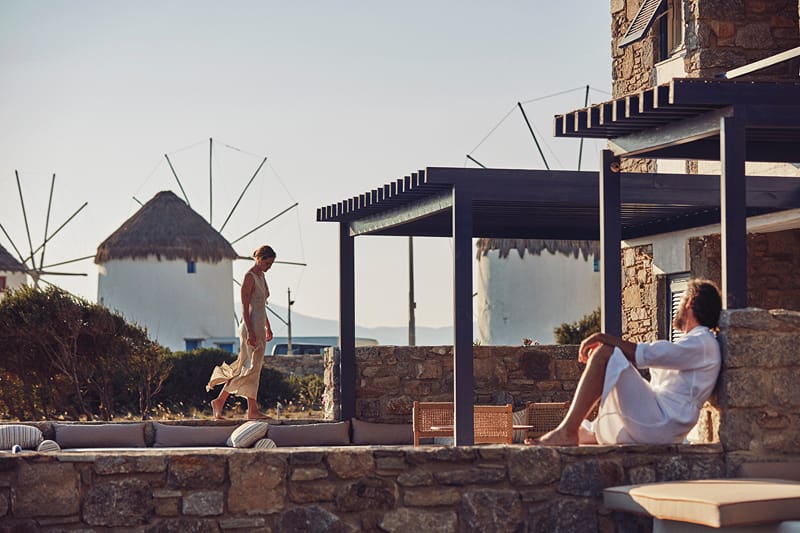
Mykonos Theoxenia
A member of Design Hotels next to the windmills, facing the sea towards Delos, in a landmark building protected by the Greek Ministry of Culture.
View on TRVL ↗
Semeli Hotel Mykonos
54 rooms and three suites in the traditional Rochari quarter, with an old mansion turned restaurant and a spa.
View on TRVL ↗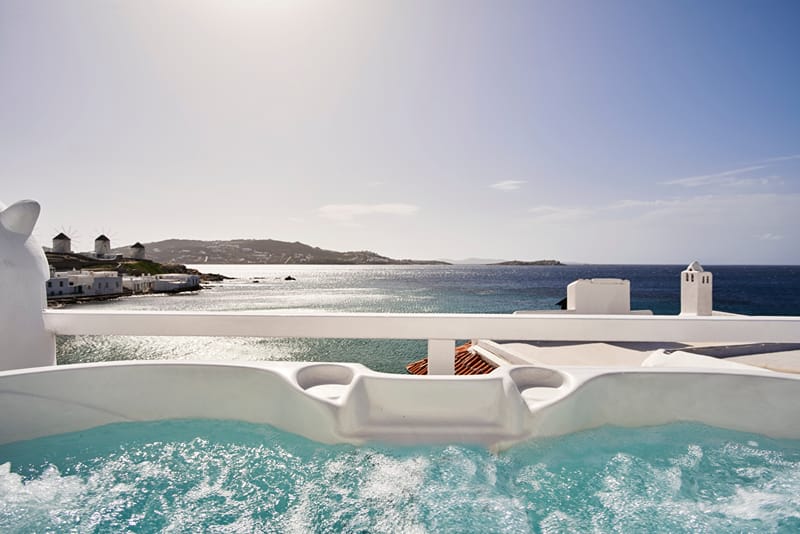
Little Venice Suites
A waterfront property in the heart of Little Venice, overlooking the windmills and Delos.
View on TRVL ↗The Essence
Mykonos is easiest to love when you let the wind set the day. Swim on the sheltered south coast when the meltemi blows and on the wild north shore when it drops; take the first boat to Delos and stand among the lions while the island is still quiet; eat kopanisti on bread in Ano Mera; and come back to Chora in time to watch the light go from the windmills. The island's fame is deserved, and the best of it is closer to the ground than its reputation suggests.