
Evening in Naxos Town begins at a marble doorway. The Portara stands alone on the islet of Palatia at the mouth of the harbour, a gate of four huge marble blocks that once led into a temple of Apollo, and people walk out along the paved causeway to watch the sun drop through it. Behind them the old town climbs to the Venetian Kastro, and behind the town the island keeps going: a wide west coast of sand, a green valley of olive groves and Byzantine chapels, villages built of marble, and the highest mountain in the Cyclades.
This is a guide to an island that is big enough to feed itself and generous enough to share. Naxos makes its own cheese, grows potatoes that are sold all over Greece, and distils a citron liqueur found nowhere else. It also has long beaches a short bus ride from town, ancient marble statues still lying in their quarries, and a summit you can reach on foot in a morning.
The Areas
Naxos Town, which everyone calls Chora, is the island's capital and port, built where the ancient city stood. Its old quarters run from the Kastro, the walled citadel on the hill, down through Bourgos, the medieval district whose name comes from the Italian borgo. Stay here if you want to arrive by ferry and walk to dinner, to shops selling local produce and jewellery, and to the evening crowd at the Portara.
South of town the west coast unrolls in one long sweep. Agios Georgios is the town beach, a short walk from Chora. Agios Prokopios, about 5 km from Chora, is the beach the island is proudest of; Agia Anna continues straight on from it, and Plaka continues from Agia Anna as a long stretch of golden sand backed by dunes. Further south, Orkos is a string of small coves with coarse sand, and Mikri Vigla sits at the end of the line. This is the coast for families and for anyone who wants to swim every day.
Inland, the Tragea valley is green with olive, plane and oak trees, vines and fruit groves, with eight villages scattered across it. Halki is its head village, and Filoti lies further along the road beneath Mount Zas. Apeiranthos, 28 km from Chora at about 600 m, is the mountain village built of marble. Stay up here, or come for long day trips, if you prefer walking, village squares and cooler air to the beach.

What to See and Do
Start with the Portara. It is the only part left of a temple of Apollo begun by the tyrant Lygdamis in the 6th century BC and never finished; the temple was planned at 59 m long and 28 m wide, and each of the gate's four marble pieces weighs about 20 tonnes. Come early in the morning to have it almost to yourself.
Then climb into the Kastro. Two of its three gates survive, Paraporti on the south side and Trani Porta on the north, where a vertical line cut into a marble pilaster once served as the Venetian measure for cloth. Inside are the Della Rocca Barozzi Tower, one of the oldest mansions, which houses the Venetian and Folk History Museum; the Tower of Crispi, the only one left of the Kastro's twelve towers; and the Catholic Cathedral, with its marble floor and memorial stones carved with family crests. The Archaeological Museum fills a five-storey former School of Commerce, which Nikos Kazantzakis attended for a year, with finds from the late Neolithic to the 6th century AD.
Naxos was famous in antiquity for its marble, and you can still see statues left where they were carved. In the Flerio area near the village of Melanes, two kouroi, colossal figures of young men from the early 6th century BC, lie where they were abandoned after breaking on the way down from the quarry slopes. The site is open all day, admission is free, and signposted footpaths lead from the stream to the statues. On the north coast, near Apollonas, a second quarry holds a half-finished kouros more than 10 m long, lying on its back. South of the village of Sagri, the ancient sanctuary of Apollo and Demeter at Gyroulas sits on a mound above a fertile valley.
In the mountains, give Apeiranthos a slow afternoon. The village starts at the 17th-century Zevgolis Tower on a rock at its entrance, from where marble-paved alleys, many arched over, lead to a square of cafes. It has five small museums, covering archaeology, geology, natural history, folk life and children's art, as well as a women's weaving cooperative and the largest library in the Cyclades. Halki, meanwhile, has neoclassical mansions with big balconies, the 17th-century Barozzi Tower, and the church of Panagia Protothroni, in continuous use since 1052. The valley around it holds some 30 Byzantine churches, among them Panagia Drossiani and Agios Georgios Diassoritis.

Walking Up Mount Zas
Zas, named after Zeus, is the highest mountain in the Cyclades, at 1,003 m, and the walk to the top is one of the best mornings you can have on the island. Myth says Zeus grew up in a cave on its slopes, and archaeologists believe the cave was first used in the Neolithic period. From the summit the view runs over the Aegean to the other Cycladic islands.
The island's Trail 2 makes a circle from Filoti. It starts at the chapel of Irini on the eastern edge of the village and climbs past the chapel of Agia Marina to the Levgasa spring, where an ancient inscription reads ΟΡΟΣ ΔΙΟΣ ΜΗΛΩΣΙΟΥ, Mount of Zeus, protector of the sheep. From the summit it drops steeply to the Zas Cave and the Katafygi spring, then to the Arion fountain under an old plane tree, a natural place to rest, before returning to Filoti. Near the cave the path becomes rugged and hard to follow, so wear proper shoes and allow time. A shorter route starts at the Aria spring near Filoti and passes the cave; it takes about 1.5 to 2.5 hours each way.
Start early in summer, carry water, and take the bus or drive to Filoti; it is about 35 minutes from Chora by bus.

What to Eat and Drink
Naxos feeds itself, and its cheeses are the place to begin. Naxos graviera, a hard table cheese made mostly from cow's milk, has had protected designation of origin since 1996. Arseniko is a hard, salty, piquant cheese of pure sheep's milk from the uplands. Xinomyzithra is a soft, slightly sour cheese, mainly of goat's milk, ready a day after milking and meant to be eaten within days. Look out too for zamponi, cured pork leg sliced like prosciutto but saltier and spicier.
The island's potatoes are famous across Greece. They grow mainly in the Livadi valley, where a state seed potato centre was founded in 1953, and you can buy them in the shops of Glinado. Order them with anything.
Kitron is the drink to know. It is made by steeping citron leaves, picked from September into winter in the groves of the Eggares and Sagri plains, in alcohol in a traditional still, and it is one of only three Greek aperitifs with protected designation of origin. It comes in three versions: clear at 33 per cent, green at 30 and yellow at 36. In Halki the Vallindras distillery, founded in 1896 in a village mansion, pioneered the liqueur and sells its own bottles.
For a long lunch, drive inland. Axiotissa near Kastraki cooks modern Greek and Naxian dishes and is booked days ahead in high season. Stou Vasilarakiou in Kinidaros is a third-generation family taverna known for its meat, and Lefteris in Apeiranthos serves on a veranda full of flowers.
Getting There and Around
Ferries leave Piraeus for Naxos every day, all year, with Blue Star Ferries taking roughly 5 hours to 5 hours 20 minutes and Seajets catamarans from about 3 hours 15 minutes, with up to seven crossings a day in summer. From Rafina, which is closer to Athens airport, high-speed boats take just under 4 hours. Santorini is about 2 hours away by regular ferry. Boats dock right at the edge of Chora, where the ticket offices line the quay.
Naxos Island National Airport, opened in 1992, sits near Agios Prokopios about 3 km from town. Olympic Air and Sky Express fly from Athens, and Aegean Airlines runs seasonal flights to Thessaloniki and Heraklion. A taxi into town costs about €20.
The public buses are good for the west coast and the main villages. From Chora it is 15 minutes to Agios Prokopios, 17 to Agia Anna and 25 to Plaka beach, and 30 minutes to Halki, 35 to Filoti and an hour to Apeiranthos. Single fares in 2026 run from €1.80 to €6.20 for the long ride to Apollonas; the bus office is at the north end of the seafront, near the ferry building. Buy your ticket before you board. Some villages only see a few buses a day, so for the mountains and the east coast a car is easier. The roads are well kept, but mountain roads wind, and the last petrol station before the east side is near Filoti.
When to Go
May, June and September are the best months for most people: warm sea, open tavernas and fewer visitors than in high summer. In July and August the sheltered west coast reaches about 30°C, with sea breezes, while the mountain villages stay cooler; this is when you should book rooms well ahead.
Autumn has its own pleasures. After August the dunes at Plaka bloom with sea lilies, and from September the citron leaves are picked for the year's kitron. Ferries from Piraeus keep running daily through the winter, so Naxos is one of the easier Cycladic islands to reach outside the summer.
Good to Know
- Buy bus tickets before boarding, from the machines or village kiosks.
- For Mount Zas, start early, carry water and wear real walking shoes; the path near the cave is rough.
- Book Axiotissa three or four days ahead in high season, and Stou Vasilarakiou in advance too.
- If you plan to drive across the island, fill up before leaving the Filoti area.
- The kouroi at Flerio are open at all hours and free to visit, but the site is not wheelchair accessible.
Our Picks
- To seeThe Portara
A 6th-century BC marble gate to a temple of Apollo that was never finished; walk the causeway at sunset.
- To seeThe Kastro
Venetian gates, the Della Rocca Barozzi Tower museum, the Catholic Cathedral and the Archaeological Museum, all within a few lanes.
- To seeThe kouroi of Flerio
Two colossal marble youths from the early 6th century BC, lying where they broke; free and open at all hours.
- To walkMount Zas, Trail 2
A circular climb to the highest summit in the Cyclades, past an ancient inscription to Zeus and the cave of his childhood.
- To walkApeiranthos
Marble-paved, arched alleys from the Zevgolis Tower to the cafe square, with five small museums along the way.
- To swimPlaka
Golden sand, dunes and junipers for shade, with tavernas and beach bars along its length.
- To drinkVallindras distillery
The house in Halki where kitron was pioneered, still selling its own bottles.
- To drink1739 Avaton
Coffee and cocktails on a terrace in the former Ursuline School at the top of the castle.
- To eatAxiotissa
Modern Greek and Naxian cooking with meat, fish and vegetarian dishes; reserve three or four days ahead in summer.
- To eatStou Vasilarakiou
A third-generation family taverna for meat grilled in a mountain village; reservations needed.
Where to Stay
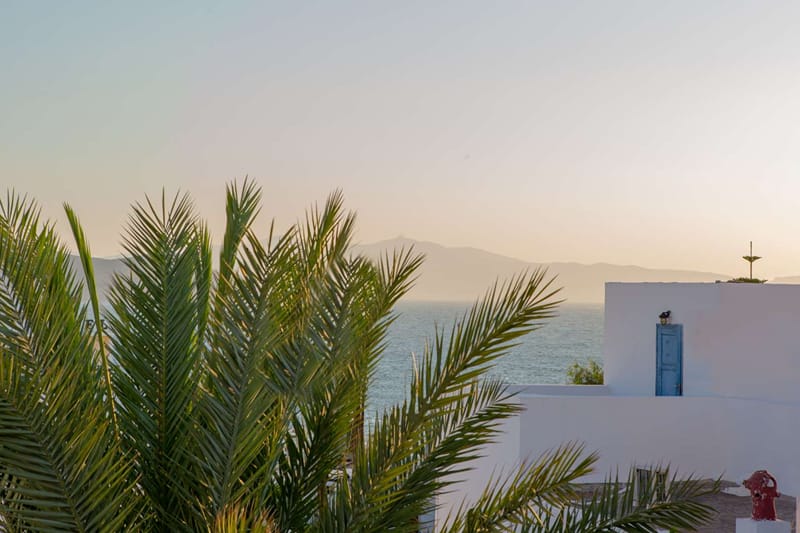
Castle Mansions Naxos
Two independent, fully furnished apartments at the foot of the Venetian Castle, in a quiet but central spot a minute from the port.
View on TRVL ↗
Laguna Coast Resort
Set 1.5 km from Chora among gardens with views from the sea to a lake that is home to flamingos, a two-minute walk from the beach.
View on TRVL ↗
The Naxian Collection
Suites and villas in authentic Cycladic style, built with Naxian marble, granite, stone and wood, 700 m from Agios Prokopios beach.
View on TRVL ↗
Ammothines Cycladic Suites
Fifteen suites on the beachfront at Plaka, with sand dunes reaching the hotel and sea and sunset views.
View on TRVL ↗The Essence
Naxos rewards the traveller who uses all of it. Swim at Plaka in the morning, eat graviera and potatoes in a village at lunch, and be back at the Portara for the sunset. Give one day to the mountain, starting early from Filoti, and another to the marble: the kouroi in their quarries, the alleys of Apeiranthos, the gates of the Kastro. Take a bottle of kitron home, and you will have a reason to come back for more.