
In the mountains north of Ioannina, the villages of Zagori are built from the ground they stand on: grey stone walls, stone-slab roofs, cobbled lanes that turn into staircases and then into mule paths leading over arched bridges to the next village. There are 46 of them spread across roughly 1,000 square kilometres, and since 2023 the whole area has been on the UNESCO World Heritage List as a cultural landscape, the villages and their network of paths and bridges counted together.
Winter suits the place. Smoke rises from the chimneys, the towers of Mount Tymfi come and go behind cloud, and the evening plan is a pie, a glass of tsipouro and a chair close to the fire. Add the Vikos Gorge, one of the deepest gorges in the world relative to its width, and a lakeside city an hour away with its own castle, and you have a short winter break that feels much farther from everyday life than the map suggests.
The Areas
Zagori is a cluster of villages rather than a single town, and the right base depends on what you want from the trip: the gorge, the high peaks, the bridges, or simply a quiet square and a fireplace. Distances are short, but the roads wind, so it helps to choose one base and make day trips.
- Monodendri — on the southern rim of the Vikos Gorge, at 1,060 metres and about 41 km north of Ioannina. The most practical base for the gorge, with the monastery of Agia Paraskevi on the cliff edge and the road to the Oxya viewpoint on its doorstep.
- Megalo and Mikro Papigo — twin villages at the foot of the Tymfi massif, with the peak of Astraka towering above, the trail to the Astraka refuge starting nearby and the rock pools of Rogovo, carved into the limestone by a mountain stream, close by. The choice for walkers and anyone who wants the big mountain view.
- Kipi and Koukouli — the bridge country of central Zagori, along the Voidomatis valley. Suits people who want short walks between villages, with the three-arched Kalogeriko bridge just outside Kipi.
- Dilofo — one of the best-preserved villages in Zagori, declared a traditional settlement, with mansions linked by cobbled lanes and no cars inside the village. For a slow, quiet stay.
- Vitsa, Kapesovo and Vradeto — the villages east of Monodendri, for the famous stone staircase of Vradeto and the Beloi viewpoint over the gorge.
- Aristi — on the border of the Vikos-Aoos National Park, above the Voidomatis river and across from the towers of Astraka, close to Papigo and the villages towards Konitsa.
- Tsepelovo — the largest village in Zagori, built in traditional stone, with around 220 residents at the 2021 census; a good base for the eastern villages.

What to See and Do
Start with the gorge. The Vikos Gorge was carved by the Voidomatis river and is the centrepiece of the Vikos-Aoos National Park, founded in 1973; it is listed by Guinness World Records as the deepest gorge in the world relative to its width. You do not have to walk it to see it. From Monodendri, a stone path of about a kilometre leads to the monastery of Agia Paraskevi, founded in 1412 and set on the edge of the drop. A narrow road north of the village passes the Stone Forest, a field of rock towers that look like stacked slabs, and ends at the Oxya viewpoint, which looks straight down into the canyon. Beloi, on the eastern side and reached from Vradeto, gives the other classic view.
The bridges are the second reason to come. Around Kipi, the Kalogeriko bridge crosses the Voidomatis on three arches; it was rebuilt in stone in 1814 by Seraphim, a monk from the monastery at Vitsa, and restored in 1865 by the Plakidas brothers of Kipi, which is why it carries both names. Nearby are the Kokkoris, or Noutsos, bridge near Koukouli and the bridge of Captain Arkouda. On a dry winter day they make an easy walk between villages.
The paths that once connected everything are still there. The best known is the Skala of Vradeto, a stone staircase of more than 1,500 steps and 39 turns that was the only way into Vradeto from Kapesovo until the road arrived in 1974. In Kapesovo itself, the Paschaleios School keeps one of the four surviving copies of Rigas Feraios’ Charta. In Monodendri, the Rizarios Exhibition Centre, open since 2000 in a stone mansion built around 1900, hosts photography exhibitions; check what is on before you go.
Leave half a day for Ioannina. Inside the walls of its castle, the inner citadel of Its Kale holds the Byzantine Museum and the Fethiye Mosque, and boats cross from the lakeshore pier to Nisi, the inhabited island in Lake Pamvotida, with its monasteries and the Ali Pasha Museum. Back on shore, Averof Street is the place to look at the city’s silverwork.

Zagori in Winter
Winter is when Zagori feels most like itself. Many rooms come with their own fireplace, the villages are quiet on weekdays, and at Christmas Greek visitors arrive in numbers, hoping for snow on the mountains. Christmas and holiday weekends are the busy moments; between them you may find only one or two chimneys smoking in a village.
The trade-off is that the high trails belong to warmer months. Official advice is that summer and early autumn are the right time to walk through the Vikos Gorge, always with an experienced guide, and the long hikes up Tymfi follow the same calendar. In winter, think in terms of viewpoints, short stretches of cobbled path, bridge walks in good weather and long lunches. Winter also brings jeep trips and skiing in the wider area for those who want something more active.
What to Eat and Drink
The pie is the centre of the table in Zagori. Many were made with corn flour, the cheap base of mountain cooking, and filled with whatever was at hand: wild greens, cheese, leeks, cabbage, lentils, mushrooms or meat. A food historian has counted 178 pie recipes from Epirus. Look for blatsaria, with a corn-flour crust, wild greens and feta, and the so-called lazy pie of filo with cheese, egg and yoghurt.
Winter food here is slow and warming: giant beans baked with spinach, leeks and dill; pork with celery, cooked in a pot sealed with dough and traditionally eaten around Christmas; trachanas simmered with sausage or mutton; trout from the rivers; and wild mushrooms, which a restaurant in Vitsa has made its whole subject. With meze, the drink is tsipouro. In Ioannina, people of all ages queue at the bakeries for bougatsa and tyropita.
Getting There and Around
Ioannina is the gateway. Aegean and Olympic fly from Athens in about an hour, and the airport is just a few kilometres from the city centre. By road, Ioannina is reached from Athens via the Rio-Antirrio bridge and from Thessaloniki along the Egnatia motorway, about three hours; buses from Athens leave Kifissos station and take about seven hours.
From Ioannina, KTEL buses serve most Zagori villages, taking between 40 minutes and an hour and a half, but departures are few, so check the timetable on ktelioannina.gr. A car makes far more sense: it lets you move between villages, viewpoints and bridges at your own pace. The mountain roads are narrow and full of bends, and in winter snow can close them, so drive in daylight where you can, watch the forecast and ask your rental company about winter equipment before you leave the city.
When to Go
For the winter version of Zagori, come between December and February: cold, often misty, with a real chance of snow and every reason to stay by the fire. Christmas and New Year are the busiest weeks and need early booking; a weekday visit in January is quieter, though fewer tavernas will be open.
The shoulder seasons are the best compromise. May and October are often named as the finest months, with mild weather, spring wildflowers or autumn colour, and hiking conditions that suit the gorge and the trails, which are best from April to October. In autumn the oak and maple woods turn red and gold.
Good to Know
Outside weekends and holidays, many places in the villages close for the winter or open only on certain days, and online opening hours are not always right, so call ahead for lunch and dinner. Book rooms early for Christmas and long weekends, when everything fills. Mountain weather changes quickly, so pack layers, waterproof shoes and something warm for the evening. Fill up and pick up what you need in Ioannina before you drive up.
Our Picks
- To seeOxya viewpoint
The view straight down into the Vikos Gorge, reached by a narrow road past the rock towers of the Stone Forest.
- To seeAgia Paraskevi monastery
A 15th-century monastery on the very edge of the gorge, about a kilometre on foot from the village.
- To walkSkala of Vradeto
More than 1,500 stone steps and 39 turns, the only route into Vradeto until 1974.
- To walkKalogeriko bridge
The three-arched bridge over the Voidomatis, the best start for a walk among the stone bridges of central Zagori.
- To seeRizarios Exhibition Centre
Photography exhibitions in a stone mansion of around 1900; check the programme before you go.
- To eatKanela & Garyfallo
A restaurant built around wild mushrooms from the Zagori forests, close to the entrance of the Vikos Gorge.
- To eatLithos Stou Taki
Bread baked daily, pies and local dishes a few metres from the square of a car-free village.
- To eatSelect
A bakery serving bougatsa and tyropita since 1964, the classic breakfast before the drive up.
Where to Stay
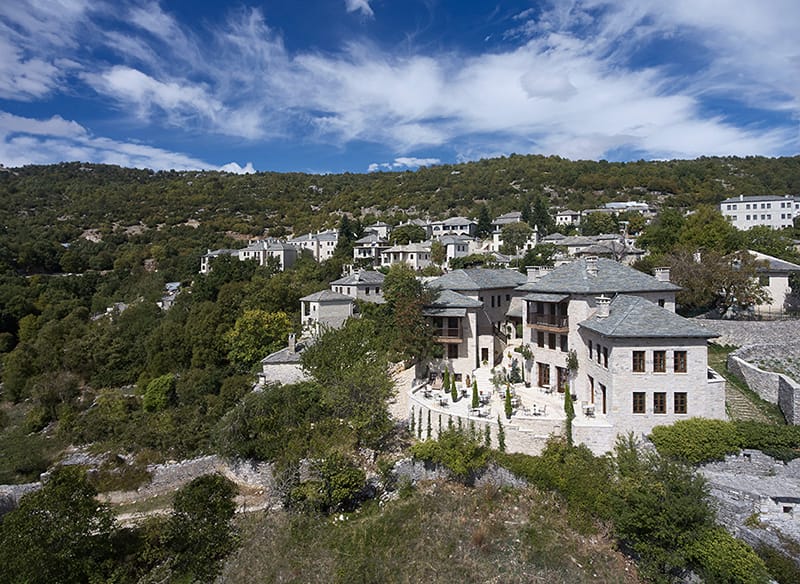
MounTrace Suites & Spa
Built in the heart of Monodendri, a stone’s throw from the Vikos Gorge, a European luxury chalet with influences from the East and a spa with sauna and hammam.
View on TRVL ↗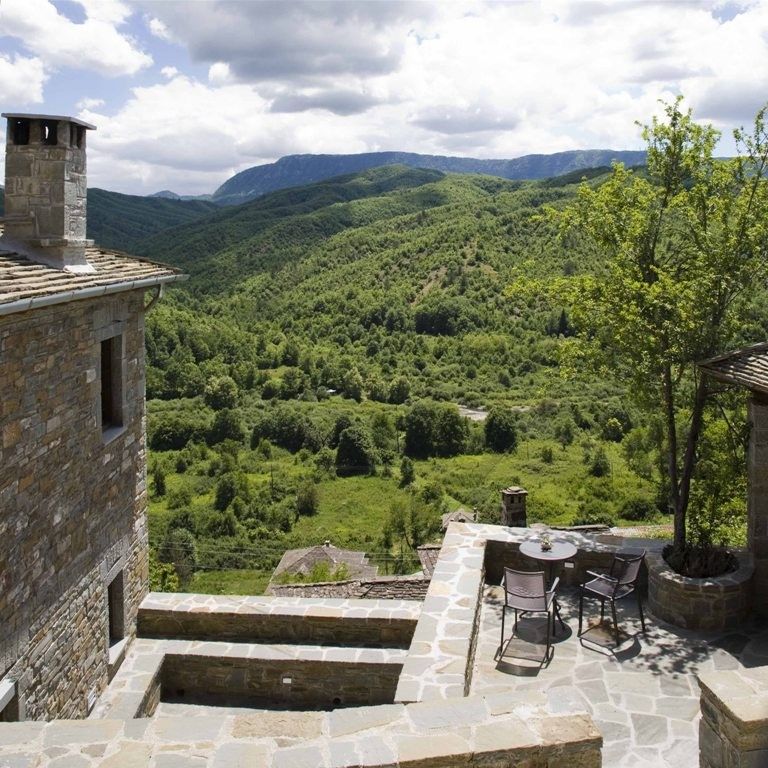
Kipi Suites
Eight suites at the top of the village, each with one or two fireplaces, looking out over Kipi, Mount Mitsikeli and the Milos stone bridge.
View on TRVL ↗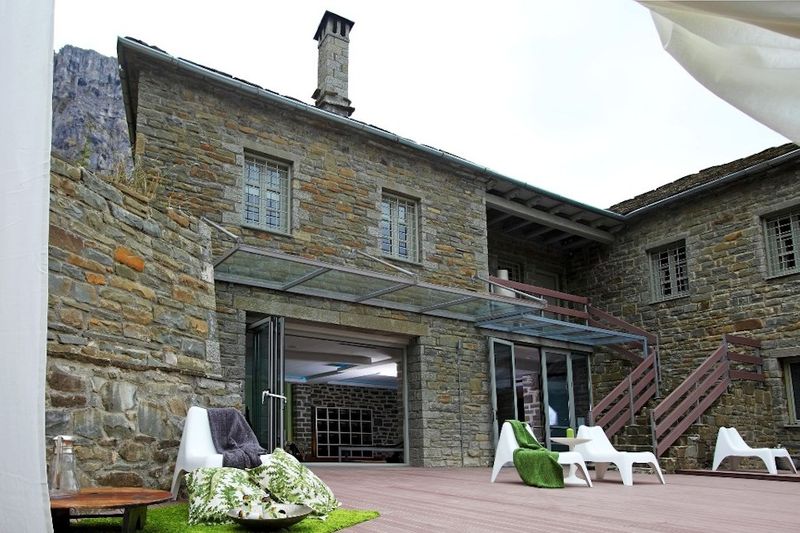
Mikro Papigo 1700
A small luxury hotel at the highest point of the village, named after its restored house of 1700, with a path from the hotel towards Drakolimni and the springs of the Voidomatis.
View on TRVL ↗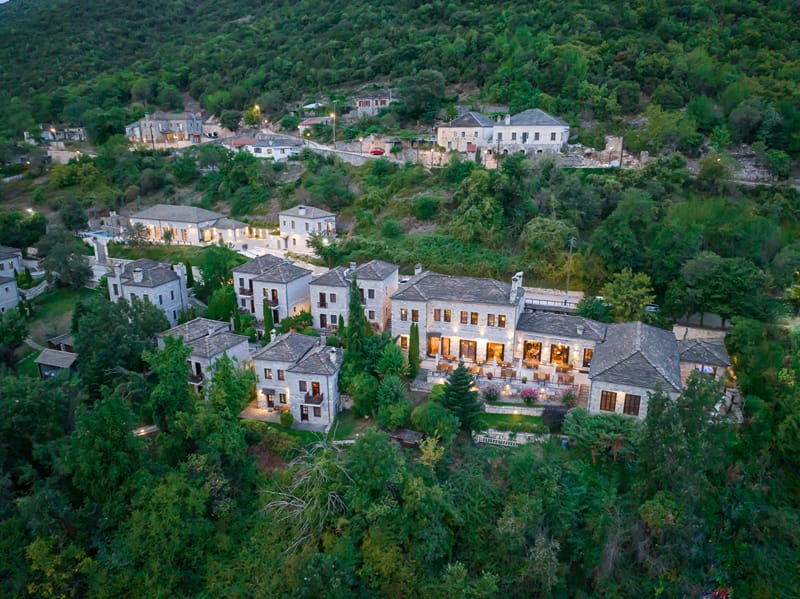
Aristi Mountain Resort
Stone buildings in the village of Aristi, across from the towers of Astraka, with a fireplace in the main lounge and a spa with an indoor heated pool.
View on TRVL ↗The Essence
Zagori is a place made by hand, one stone at a time, and winter is when you feel it most. Drive up from Ioannina with a bougatsa in your stomach, walk out to the edge of the gorge while the mist lifts, cross an old bridge over the Voidomatis, and end the day with a pie and a fire in the hearth. It is a weekend that asks very little of you, and gives back far more than its size.