
Paris is a city made for walking, and it rewards every hour spent on foot. Medieval lanes in the Marais open onto the arcades of Place des Vosges, the Left Bank cafés of Saint-Germain spill onto the pavement, and the Seine ties it all together, with bridges and quays that lead you from one neighbourhood to the next almost without noticing. The great museums are here, of course, but so is the daily pleasure of a warm baguette, a market stall and a chair in a public garden.
This guide is for planning a first or a fifth visit. It covers where to base yourself, what to book ahead, how to get around on the Métro and RER, and where to eat well without spending a fortune. Paris is large, but its centre is compact enough that a few well-chosen days can feel generous.
The Areas
Paris is divided into 20 numbered arrondissements that spiral out clockwise from the centre, and the last two digits of a postcode tell you which one you are in. Each area below is easy to reach from the others by Métro, and several are within walking distance of one another.
- Le Marais (3rd and 4th) — a dense network of historic streets, small museums and squares such as Place des Vosges, with the Seine and Notre-Dame within walking distance. The streets stay lively into the evening, so it suits visitors who want a central base and plenty to do on the doorstep.
- Saint-Germain-des-Prés (6th) — the classic Left Bank choice, with wider streets, galleries, independent shops and long-established cafés such as Les Deux Magots and the Café de Flore. Polished and very walkable, with the Louvre within easy reach across the river; budget options are fewer.
- The Latin Quarter (5th) — around the Sorbonne, informal and busy, with compact streets, bookshops and Notre-Dame just across the water. One of the easiest areas for first-time visitors, and often kinder to the budget.
- Montmartre (18th) — a hilltop village of steep streets, small squares and views across the city, crowned by the Sacré-Cœur. It feels a little apart from the centre, so it suits visitors who value atmosphere and don't mind taking the Métro to the big sights.
- Canal Saint-Martin (10th) — tree-lined quays, iron footbridges and locks, with cafés that fill up in the late afternoon and evening. A relaxed, less formal base for anyone who prefers neighbourhood life to landmarks.

What to See and Do
The Louvre needs little introduction, but it rewards planning. It is closed on Tuesdays and stays open until 9pm on Wednesdays and Fridays, when the galleries are calmer. Time-slot booking is recommended for everyone, and a ticket costs €22 for visitors from the European Economic Area and €32 for others; entry is free for under-18s. Across the river, the Musée d'Orsay fills a Beaux-Arts railway station built for the 1900 World Fair with Impressionist and Post-Impressionist painting, including dozens of works each by Monet, Renoir and Degas. It is closed on Mondays and open late on Thursdays; book a time slot online.
Notre-Dame reopened on 7 December 2024 after its restoration, and entry to the cathedral is free. Reserve a free timed slot on the official website shortly before your visit; the bell towers are a separate, paid ticket. A few minutes' walk away on the Île de la Cité, the Sainte-Chapelle was built in the 13th century by Saint Louis to house the Crown of Thorns, and its 1,113 stained-glass windows are at their best on a bright day. A dated, timed booking is required.
Two quieter favourites complete the picture. At the edge of the Tuileries, the Musée de l'Orangerie shows Monet's Water Lilies in two oval rooms lit from above, designed with the painter's own input; it is closed on Tuesdays. In the Marais, the Musée Carnavalet, the city's oldest museum, tells the history of Paris from prehistory to today in two mansions, one of them a rare piece of Renaissance architecture. Its permanent collections are free and need no booking.
For the view, climb up to the Sacré-Cœur in Montmartre. Entry to the basilica is free; the dome is a separate ticket and a narrow spiral climb of around 300 steps, with no lift. And if the Eiffel Tower is on the list, book online well ahead, as summit slots sell out first and timed tickets are valid only for the date and hour booked.

The Seine, Gardens and a Day Out
Some of the best hours in Paris cost nothing. The Jardin du Luxembourg, in front of the palace that houses the French Senate, is free to enter, with the Baroque Medici Fountain on its eastern side and green metal chairs that anyone may pull into the sun. Opening times follow the daylight, from early morning until dusk. To the east, the Coulée verte René-Dumont runs for about 4.5 km along a former railway line from near the Bastille to the Bois de Vincennes, partly on top of the Viaduc des Arts, whose arches now hold craft workshops.
In summer you can even swim in the river. From 4 July to 30 August 2026 the city opened free, supervised bathing sites in the Seine at Bercy (12th), Grenelle (15th) and Bras Marie (4th), beside the Pont Louis-Philippe, plus sites on the canals. There is no booking: you need to be a confident swimmer over 14, wear the compulsory inflatable belt and accept that sites may close for a day or two after heavy rain. Check the City of Paris website for the current season before planning around it.
For a day out, the Château de Versailles is the classic choice. RER C runs from central stations such as Saint-Michel Notre-Dame and Champ de Mars–Tour Eiffel to Versailles Château Rive Gauche in about 30 to 35 minutes, and the palace is around eight minutes' walk from the station. The palace is closed on Mondays, while the gardens stay open; book a timed entry before you go.

What to Eat and Drink
Start with bread. Every neighbourhood has its boulangerie, and the city takes its baguette seriously enough to hold an annual competition: in 2026 the Grand Prix de la Baguette went to Sithamparappillai Jegatheepan of Fournil Didot in the 14th, whose winning loaf rests for 14 hours of cold fermentation. The prize includes a year of supplying bread to the Élysée Palace.
For lunch, head to the Marché des Enfants Rouges on rue de Bretagne in the Marais, dating from 1615 and described as the oldest covered market still trading in the city. Its stalls cook everything from Moroccan tajines and Lebanese mezze to Japanese bento and Italian pasta, eaten at communal benches; it is closed on Mondays. In the evening, the bouillon is the Parisian answer to a good meal at a fair price. Bouillon Chartier on the Grands Boulevards has served inexpensive French classics such as escargots, roast chicken and profiteroles since 1896, in an Art Nouveau dining room listed as a historic monument; it generally takes no reservations, so expect a queue.
And give time to the café. A coffee or a glass of wine on a terrace, watching the street, is part of the trip rather than a break from it. Saint-Germain's historic cafés are the famous address, but the terraces along the Canal Saint-Martin are just as good for an evening drink.
Getting There and Around
Paris has two main airports. From Charles de Gaulle, RER B runs into the city, stopping at Gare du Nord and Châtelet–Les Halles. From Orly, Métro line 14 has run directly to the airport since June 2024 and reaches Châtelet in about 25 minutes. Both trips need the special Paris Region–Airports ticket, €14, rather than an ordinary fare. From London, Eurostar runs from St Pancras to Gare du Nord in about 2 hours 16 minutes, up to 18 times a day.
Within the city, a single Métro–train–RER ticket costs €2.55 and allows transfers for up to two hours; paper tickets are no longer sold. Load tickets on a Navigo Easy card, €2 from station machines, or straight on your phone through the IDF Mobilités or RATP apps or an iPhone Wallet pass. A Navigo day pass costs €12.30 and pays off after about five train journeys, though it does not cover the airports. The Métro is fast and frequent, but walking between neighbouring districts is often just as quick and far more enjoyable.
When to Go
Paris is a year-round city, but late spring and early autumn are the most comfortable. In May, highs reach about 19°C, and June brings around 22°C and the most sunshine of the year, plus the Fête de la Musique. July and August are the warmest months, with highs in the mid-20s, and the Seine bathing sites are open. September is mild at around 21°C, and October cools to about 16°C and brings Nuit Blanche. Winter is cold and grey, with highs around 7°C in December and January, but it is the quietest time for museums, and December brings the Christmas lights.
Good to Know
Book ahead for the big names: the Louvre, the Musée d'Orsay, the Sainte-Chapelle, Versailles and the Eiffel Tower all use timed tickets, and Notre-Dame needs a free reservation. Remember the weekly closures: the Louvre and the Orangerie close on Tuesdays, Orsay, Carnavalet and the palace of Versailles on Mondays. Many museums are cheaper or free at certain times; the Louvre, for example, is free to all on the first Friday evening of the month, except in July and August. Service is usually included in restaurant bills (look for service compris), so tipping is optional; rounding up or leaving a few euros for good service is common. Inside the Sacré-Cœur, cover shoulders and knees.
Our Picks
- To seeSainte-Chapelle
1,113 stained-glass windows in a 13th-century royal chapel; book a timed slot and go on a sunny day.
- To seeMusée de l'Orangerie
Monet's Water Lilies in two oval rooms lit from above; closed on Tuesdays.
- To seeMusée Carnavalet
The story of Paris in two old mansions, with free permanent collections; closed on Mondays.
- To walkCoulée verte René-Dumont
About 4.5 km of garden path on an old railway line, partly above the Viaduc des Arts.
- To lingerJardin du Luxembourg
Free entry, the Medici Fountain and green chairs to pull into the sun.
- To browseShakespeare and Company
The English-language bookshop George Whitman opened in 1951 on rue de la Bûcherie, with its own café.
- To eatMarché des Enfants Rouges
The city's oldest covered market, from 1615, for lunch at shared tables; closed on Mondays.
- To eatBouillon Chartier
French classics at fair prices in an 1896 Art Nouveau dining room; expect a queue.
- To tasteFournil Didot
The bakery behind the 2026 Grand Prix de la Baguette.
Where to Stay

Drawing Hôtel
Minutes from the city centre, close to the Palais Royal, its garden and the Palais Royal – Musée du Louvre, with a bar, restaurant and café.
View on TRVL ↗
Hotel Duo
In the centre of the city near the Hôtel de Ville, with a bar, restaurant, sauna, fitness centre and library.
View on TRVL ↗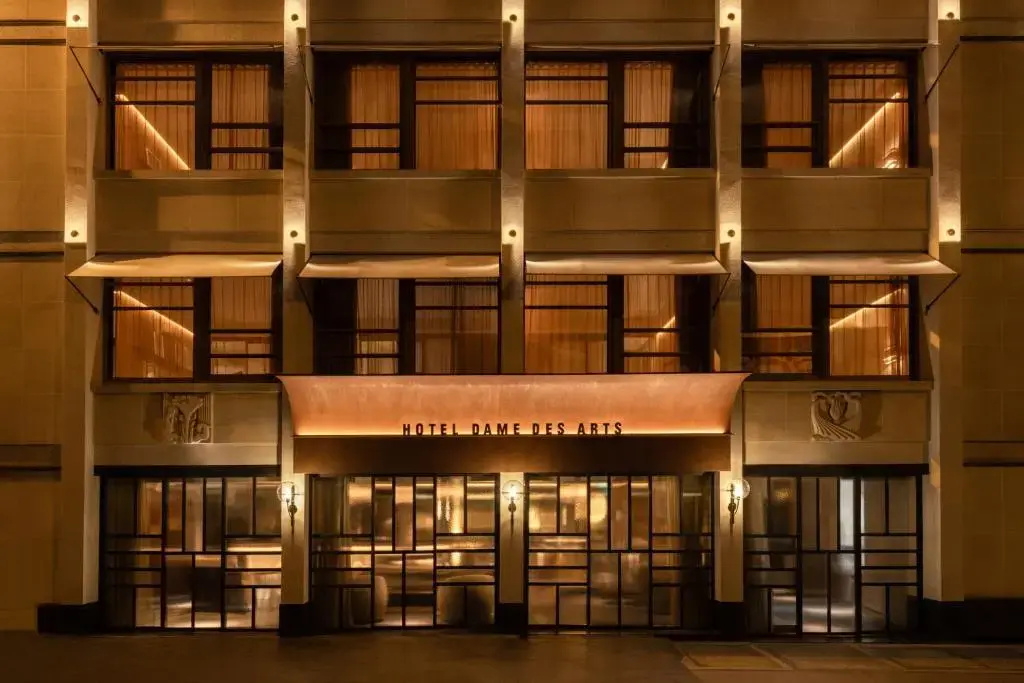
Hotel Dame des Arts
Minutes from the city centre near Saint-Michel, with a bar, restaurant, café and steam bath.
View on TRVL ↗
Mercure Paris Montmartre
Near the Moulin Rouge and Place de Clichy, with a bar, restaurant, café and fitness centre.
View on TRVL ↗The Essence
Paris is best taken slowly. Book the few things that need booking, then leave room for the rest: a morning in a market, an afternoon on a garden chair, an evening on a terrace by the canal, a walk home along the river as the lights come on. The museums will give you the masterpieces; the streets in between will give you the city, and the reason to come back.